Department of Pain and Rehabilitation, The Fourth Hospital of Hebei Medical University, Shijiazhuang, Hebei, China (mainland).
Department of Immunology, Hebei Medical University, Key Laboratory of Immune Mechanism and Intervention in Serious Diseases in Hebei Province, Shijiazhuang, Hebei, China (mainland).
Med Sci Monit. 2018 Jan 17;24:332-341. doi: 10.12659/msm.907782.
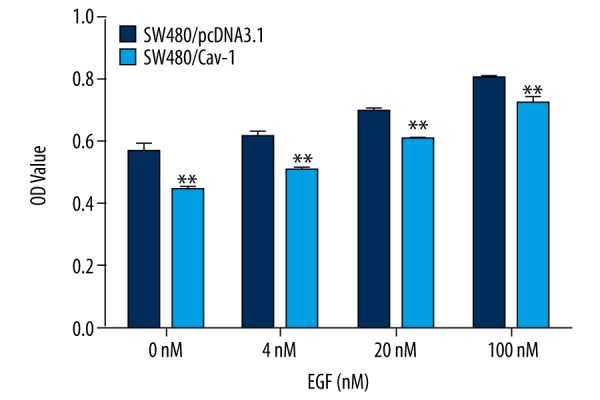
BACKGROUND Although downregulation of caveolin-1 (Cav-1), which is a key constituent of membrane caveolae and a regulator of cellular processes, is associated with colorectal cancer (CRC), its involvement in the disease progression is largely unknown. This study aimed to explore the role of Cav-1 in CRC and the associated mechanisms. MATERIAL AND METHODS Fresh tissues from patients with CRC and human CRC SW480 cells were used to evaluate Cav-1 and Ki-67 expression using immunohistochemistry and Western blotting. The MTS and Transwell assays were performed to determine the effects of Cav-1 overexpression via pcDNA3.1/Cav-1 plasmid on cell proliferation and metastasis. The effect of Cav-1 on the epidermal growth factor receptor (EGFR) activation was evaluated by Western blotting. The correlation of Cav-1 expression with clinicopathological factors was statistically analyzed. RESULTS Overexpression of Cav-1 significantly reduced proliferation, migration, and invasion of SW480 cancer cells in vitro. The EGF-induced phosphorylation of EGFR and activations of the RAF-MEK-ERK and PI3K-AKT pathways were adversely regulated by Cav-1 overexpression in vitro. In 76 cases of CRC patients with EGFR expression, a negative correlation was observed between the level of Cav-1 and tumor-node-metastasis stage, lymph node metastasis, and distant metastasis (All p<0.05). Finally, the expression level of Cav-1 was negatively correlated with that of Ki-67. CONCLUSIONS This report is the first to show that overexpression of Cav-1significantly inhibits the proliferation, migration, and invasion potential of SW480 cells, possibly through reducing EGF-induced EGFR activation. High Cav-1 expression level may be a predictor of positive outcomes in patients with colorectal cancer.
尽管窖蛋白-1(Cav-1)的下调与结直肠癌(CRC)有关,Cav-1 是质膜小窝的关键组成部分,也是细胞过程的调节剂,但它在疾病进展中的作用在很大程度上尚不清楚。本研究旨在探讨 Cav-1 在 CRC 中的作用及其相关机制。
使用免疫组织化学和 Western blot 检测来自 CRC 患者和人 CRC SW480 细胞的新鲜组织中 Cav-1 和 Ki-67 的表达。通过 pcDNA3.1/Cav-1 质粒过表达 Cav-1 对细胞增殖和转移的影响通过 MTS 和 Transwell 测定来评估。通过 Western blot 评估 Cav-1 对表皮生长因子受体(EGFR)激活的影响。统计分析 Cav-1 表达与临床病理因素的相关性。
Cav-1 的过表达显著降低了 SW480 癌细胞在体外的增殖、迁移和侵袭。Cav-1 的过表达在体外还可负调控 EGF 诱导的 EGFR 磷酸化以及 RAF-MEK-ERK 和 PI3K-AKT 通路的激活。在 76 例具有 EGFR 表达的 CRC 患者中,Cav-1 水平与肿瘤-淋巴结-转移分期、淋巴结转移和远处转移呈负相关(均 p<0.05)。最后,Cav-1 的表达水平与 Ki-67 呈负相关。
本报告首次表明,Cav-1 的过表达显著抑制 SW480 细胞的增殖、迁移和侵袭潜力,可能通过减少 EGF 诱导的 EGFR 激活。Cav-1 高表达水平可能是结直肠癌患者预后良好的预测指标。