• 文献检索
  • 文档翻译
  • 深度研究
  • 学术资讯
  • Suppr Zotero 插件Zotero 插件
  • 邀请有礼
  • 套餐&价格
  • 历史记录
应用&插件
Suppr Zotero 插件Zotero 插件浏览器插件Mac 客户端Windows 客户端微信小程序
定价
高级版会员购买积分包购买API积分包
服务
文献检索文档翻译深度研究API 文档MCP 服务
关于我们
关于 Suppr公司介绍联系我们用户协议隐私条款
关注我们

Suppr 超能文献

核心技术专利:CN118964589B侵权必究
粤ICP备2023148730 号-1Suppr @ 2026

文献检索

告别复杂PubMed语法,用中文像聊天一样搜索,搜遍4000万医学文献。AI智能推荐,让科研检索更轻松。

立即免费搜索

文件翻译

保留排版,准确专业,支持PDF/Word/PPT等文件格式,支持 12+语言互译。

免费翻译文档

深度研究

AI帮你快速写综述,25分钟生成高质量综述,智能提取关键信息,辅助科研写作。

立即免费体验

发现一种用于胃肠道间质瘤(GISTs)的高选择性KIT激酶原发性V559D突变体抑制剂。

Discovery of a highly selective KIT kinase primary V559D mutant inhibitor for gastrointestinal stromal tumors (GISTs).

作者信息

Yu Kailin, Liu Xuesong, Jiang Zongru, Hu Chen, Zou Fengming, Chen Cheng, Ge Juan, Wu Jiaxin, Liu Xiaochuan, Wang Aoli, Wang Wenliang, Wang Wenchao, Qi Ziping, Wang Beilei, Wang Li, Yan Hezhong, Wang Jiaoxue, Ren Tao, Tang Jun, Liu Qingsong, Liu Jing

机构信息

High Magnetic Field Laboratory, Chinese Academy of Sciences, Hefei, Anhui 230031, P. R. China.

University of Science and Technology of China, Hefei, Anhui 230036, P. R. China.

出版信息

Oncotarget. 2017 Nov 15;8(67):111110-111118. doi: 10.18632/oncotarget.22624. eCollection 2017 Dec 19.

DOI:10.18632/oncotarget.22624
PMID:29340041
原文链接:https://pmc.ncbi.nlm.nih.gov/articles/PMC5762309/
Abstract

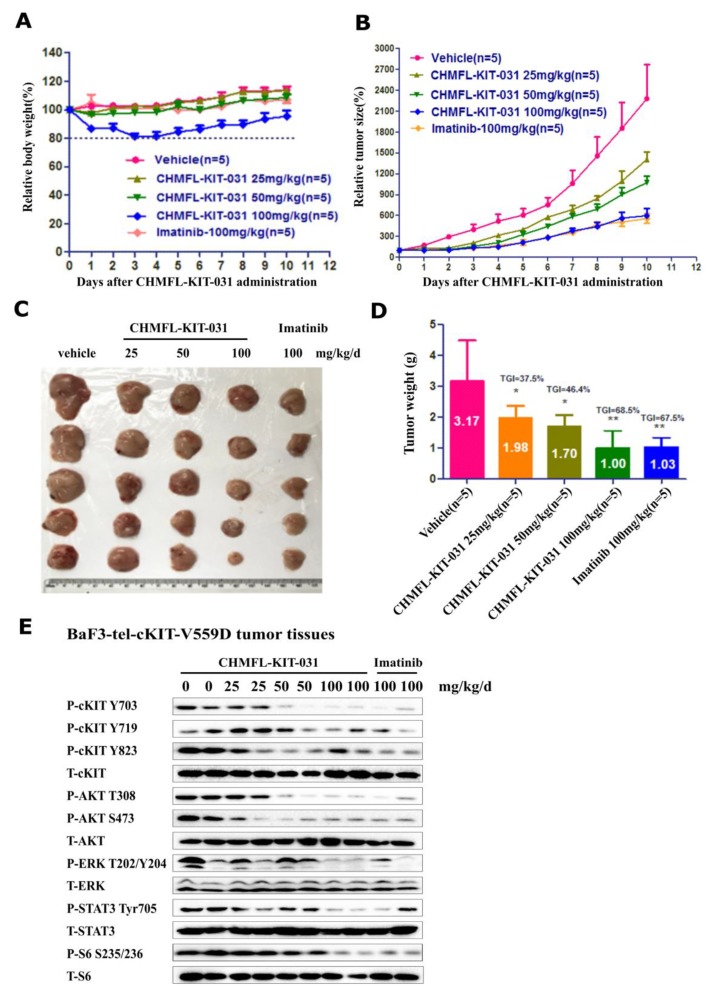
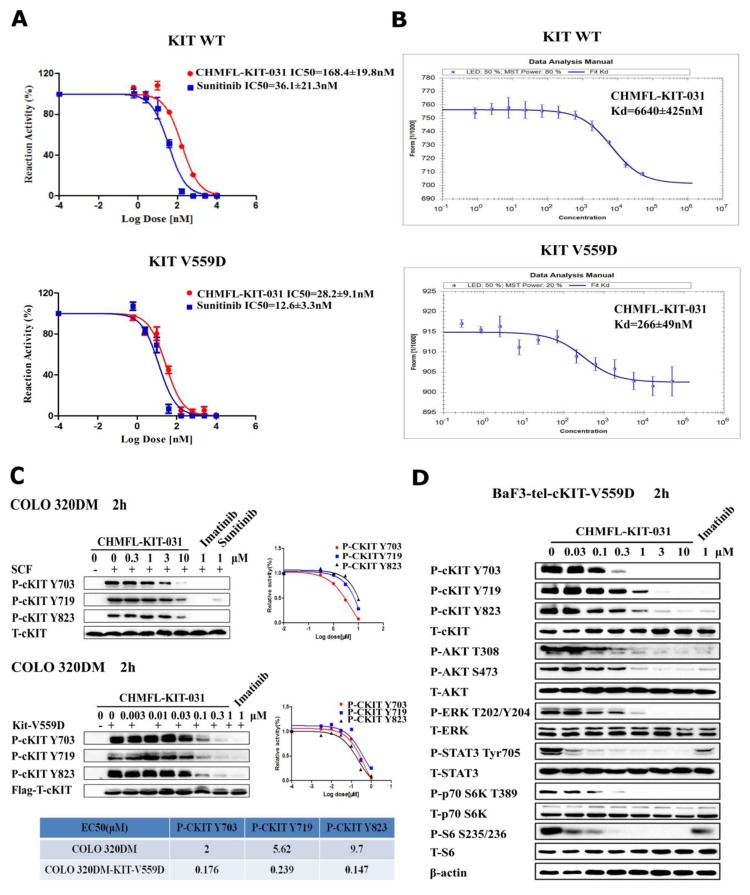
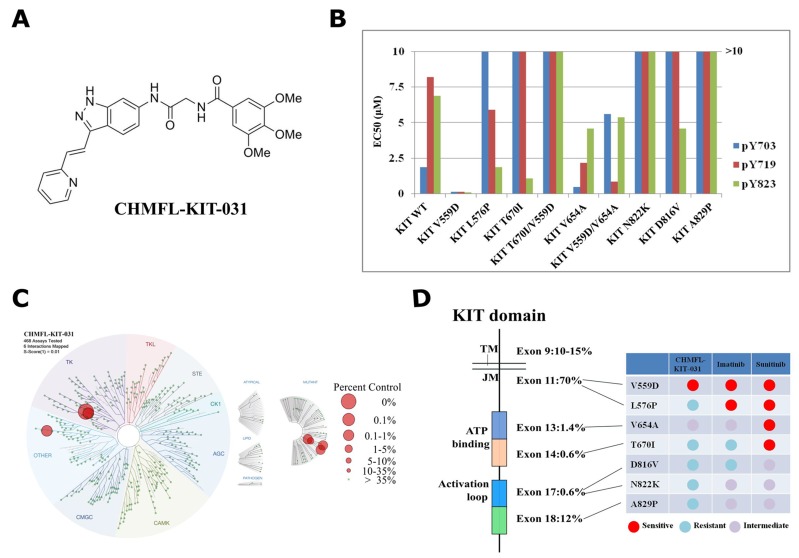
KIT kinase V559D mutation is the most prevalent primary gain-of-function mutation in Gastrointestinal Stromal Tumors (GISTs). Here we reported a highly selective KIT V559D inhibitor CHMFL-KIT-031, which displayed about 10-20 fold selectivity over KIT wt in the biochemical assay (IC: 28 nM over 168 nM; Kd: 266 nM versus 6640 nM) and in cell (EC: 176 nM versus 2000 nM for pY703) examination. It also displayed 15∼400-fold selectivity over other primary mutants such as L576P and secondary mutants including T670I, V654A (ATP binding pocket) as well as N822K and D816V (activation loop). In addition, it exhibited a selectivity S score (1) of 0.01 among 468 kinases/mutants in the KINOMEScan assay. CHMFL-KIT-031 showed potent inhibitory efficacy for KIT V559D mediated signaling pathways in cell and anti-tumor activity (Tumor Growth Inhibition: 68.5%). Its superior selectivity would make it a good pharmacological tool for further dissection of KIT V559D mediated pathology in the GISTs.

摘要

KIT激酶V559D突变是胃肠道间质瘤(GISTs)中最常见的原发性功能获得性突变。在此我们报道了一种高选择性的KIT V559D抑制剂CHMFL-KIT-031,在生化分析中(IC:28 nM对比168 nM;Kd:266 nM对比6640 nM)以及细胞检测中(pY703的EC:176 nM对比2000 nM),它对野生型KIT的选择性约为10 - 20倍。它对其他原发性突变体如L576P以及继发性突变体包括T670I、V654A(ATP结合口袋)以及N822K和D816V(激活环)也表现出了15至400倍的选择性。此外,在KINOMEScan分析中,它在468种激酶/突变体中的选择性S评分(1)为0.01。CHMFL-KIT-031在细胞中对KIT V559D介导的信号通路显示出强效抑制效力以及抗肿瘤活性(肿瘤生长抑制率:68.5%)。其卓越的选择性使其成为进一步剖析GISTs中KIT V559D介导的病理学的良好药理学工具。
https://cdn.ncbi.nlm.nih.gov/pmc/blobs/6c76/5762309/8c94b50dbb60/oncotarget-08-111110-g003.jpg
https://cdn.ncbi.nlm.nih.gov/pmc/blobs/6c76/5762309/3f5bda8f4cb8/oncotarget-08-111110-g001.jpg
https://cdn.ncbi.nlm.nih.gov/pmc/blobs/6c76/5762309/25a6a694016a/oncotarget-08-111110-g002.jpg
https://cdn.ncbi.nlm.nih.gov/pmc/blobs/6c76/5762309/8c94b50dbb60/oncotarget-08-111110-g003.jpg
https://cdn.ncbi.nlm.nih.gov/pmc/blobs/6c76/5762309/3f5bda8f4cb8/oncotarget-08-111110-g001.jpg
https://cdn.ncbi.nlm.nih.gov/pmc/blobs/6c76/5762309/25a6a694016a/oncotarget-08-111110-g002.jpg
https://cdn.ncbi.nlm.nih.gov/pmc/blobs/6c76/5762309/8c94b50dbb60/oncotarget-08-111110-g003.jpg

相似文献

1
Discovery of a highly selective KIT kinase primary V559D mutant inhibitor for gastrointestinal stromal tumors (GISTs).发现一种用于胃肠道间质瘤(GISTs)的高选择性KIT激酶原发性V559D突变体抑制剂。
Oncotarget. 2017 Nov 15;8(67):111110-111118. doi: 10.18632/oncotarget.22624. eCollection 2017 Dec 19.
2
Discovery of 2-(4-Chloro-3-(trifluoromethyl)phenyl)--(4-((6,7-dimethoxyquinolin-4-yl)oxy)phenyl)acetamide (CHMFL-KIT-64) as a Novel Orally Available Potent Inhibitor against Broad-Spectrum Mutants of c-KIT Kinase for Gastrointestinal Stromal Tumors.发现 2-(4-氯-3-(三氟甲基)苯基)-N-(4-((6,7-二甲氧基喹啉-4-基)氧基)苯基)乙酰胺(CHMFL-KIT-64)是一种新型口服有效抑制剂,可用于治疗胃肠道间质瘤的广谱 c-KIT 激酶突变体。
J Med Chem. 2019 Jul 11;62(13):6083-6101. doi: 10.1021/acs.jmedchem.9b00280. Epub 2019 Jun 28.
3
Discovery of ( E)- N-(3-Fluorophenyl)- N-(3-(2-(pyridin-2-yl)vinyl)-1 H-indazol-6-yl)malonamide (CHMFL-KIT-033) as a Novel c-KIT T670I Mutant Selective Kinase Inhibitor for Gastrointestinal Stromal Tumors (GISTs).发现(E)-N-(3-氟苯基)-N-(3-(2-(吡啶-2-基)乙烯基)-1H-吲唑-6-基)丙二酰胺(CHMFL-KIT-033)作为一种新型的胃肠道间质瘤(GISTs)c-KIT T670I 突变选择性激酶抑制剂。
J Med Chem. 2019 May 23;62(10):5006-5024. doi: 10.1021/acs.jmedchem.9b00176. Epub 2019 May 14.
4
Discovery of N-((1-(4-(3-(3-((6,7-Dimethoxyquinolin-3-yl)oxy)phenyl)ureido)-2-(trifluoromethyl)phenyl)piperidin-4-yl)methyl)propionamide (CHMFL-KIT-8140) as a Highly Potent Type II Inhibitor Capable of Inhibiting the T670I "Gatekeeper" Mutant of cKIT Kinase.N-((1-(4-(3-(3-((6,7-二甲氧基喹啉-3-基)氧基)苯基)脲基)-2-(三氟甲基)苯基)哌啶-4-基)甲基)丙酰胺(CHMFL-KIT-8140)作为一种能够抑制cKIT激酶T670I“守门人”突变体的高效II型抑制剂的发现。
J Med Chem. 2016 Sep 22;59(18):8456-72. doi: 10.1021/acs.jmedchem.6b00902. Epub 2016 Aug 30.
5
Axitinib overcomes multiple imatinib resistant cKIT mutations including the gatekeeper mutation T670I in gastrointestinal stromal tumors.阿昔替尼可克服多种伊马替尼耐药的cKIT突变,包括胃肠道间质瘤中的守门人突变T670I。
Ther Adv Med Oncol. 2019 May 17;11:1758835919849757. doi: 10.1177/1758835919849757. eCollection 2019.
6
Discovery of N-(3-((1-Isonicotinoylpiperidin-4-yl)oxy)-4-methylphenyl)-3-(trifluoromethyl)benzamide (CHMFL-KIT-110) as a Selective, Potent, and Orally Available Type II c-KIT Kinase Inhibitor for Gastrointestinal Stromal Tumors (GISTs).发现 N-(3-((1-异烟酰基哌啶-4-基)氧基)-4-甲基苯基)-3-(三氟甲基)苯甲酰胺(CHMFL-KIT-110)作为一种选择性、有效且可口服的 II 型 c-KIT 激酶抑制剂,用于治疗胃肠道间质瘤(GISTs)。
J Med Chem. 2016 Apr 28;59(8):3964-79. doi: 10.1021/acs.jmedchem.6b00200. Epub 2016 Apr 14.
7
Efficacy of the kinase inhibitor SU11248 against gastrointestinal stromal tumor mutants refractory to imatinib mesylate.激酶抑制剂SU11248对甲磺酸伊马替尼耐药的胃肠道间质瘤突变体的疗效。
Clin Cancer Res. 2006 Apr 15;12(8):2622-7. doi: 10.1158/1078-0432.CCR-05-2275.
8
Discovery of 4-Methyl-N-(4-((4-methylpiperazin-1-yl)methyl)-3-(trifluoromethyl)phenyl)-3-((1-nicotinoylpiperidin-4-yl)oxy)benzamide (CHMFL-ABL/KIT-155) as a Novel Highly Potent Type II ABL/KIT Dual Kinase Inhibitor with a Distinct Hinge Binding.发现4-甲基-N-(4-((4-甲基哌嗪-1-基)甲基)-3-(三氟甲基)苯基)-3-((1-烟酰基哌啶-4-基)氧基)苯甲酰胺(CHMFL-ABL/KIT-155)作为一种新型高效的II型ABL/KIT双激酶抑制剂,具有独特的铰链结合。
J Med Chem. 2017 Jan 12;60(1):273-289. doi: 10.1021/acs.jmedchem.6b01290. Epub 2016 Dec 14.
9
Dasatinib (BMS-354825), a dual SRC/ABL kinase inhibitor, inhibits the kinase activity of wild-type, juxtamembrane, and activation loop mutant KIT isoforms associated with human malignancies.达沙替尼(BMS-354825),一种双重SRC/ABL激酶抑制剂,可抑制与人类恶性肿瘤相关的野生型、近膜区和激活环突变型KIT异构体的激酶活性。
Cancer Res. 2006 Jan 1;66(1):473-81. doi: 10.1158/0008-5472.CAN-05-2050.
10
The human tyrosine kinase Kit and its gatekeeper mutant T670I, show different kinetic properties: Implications for drug design.人类酪氨酸激酶Kit及其守门人突变体T670I表现出不同的动力学特性:对药物设计的启示。
Bioorg Med Chem. 2016 Oct 1;24(19):4555-4562. doi: 10.1016/j.bmc.2016.07.059. Epub 2016 Aug 2.

引用本文的文献

1
Nintedanib overcomes drug resistance from upregulation of FGFR signalling and imatinib-induced KIT mutations in gastrointestinal stromal tumours.尼达尼布克服了由 FGFR 信号上调和伊马替尼诱导的胃肠道间质瘤中的 KIT 突变引起的耐药性。
Mol Oncol. 2022 Apr;16(8):1761-1774. doi: 10.1002/1878-0261.13199. Epub 2022 Mar 6.
2
Identifying Secondary Mutations in Chinese Patients with Imatinib-Resistant Gastrointestinal Stromal Tumors (GISTs) by Next Generation Sequencing (NGS).通过下一代测序(NGS)鉴定对伊马替尼耐药的中国胃肠道间质瘤(GIST)患者的继发突变。
Pathol Oncol Res. 2020 Jan;26(1):91-100. doi: 10.1007/s12253-019-00770-6. Epub 2019 Nov 22.
3

本文引用的文献

1
Discovery of N-(3-((1-Isonicotinoylpiperidin-4-yl)oxy)-4-methylphenyl)-3-(trifluoromethyl)benzamide (CHMFL-KIT-110) as a Selective, Potent, and Orally Available Type II c-KIT Kinase Inhibitor for Gastrointestinal Stromal Tumors (GISTs).发现 N-(3-((1-异烟酰基哌啶-4-基)氧基)-4-甲基苯基)-3-(三氟甲基)苯甲酰胺(CHMFL-KIT-110)作为一种选择性、有效且可口服的 II 型 c-KIT 激酶抑制剂,用于治疗胃肠道间质瘤(GISTs)。
J Med Chem. 2016 Apr 28;59(8):3964-79. doi: 10.1021/acs.jmedchem.6b00200. Epub 2016 Apr 14.
2
Efficacy and safety of regorafenib for advanced gastrointestinal stromal tumours after failure of imatinib and sunitinib (GRID): an international, multicentre, randomised, placebo-controlled, phase 3 trial.regorafenib 治疗伊马替尼和舒尼替尼治疗失败的晚期胃肠道间质瘤的疗效和安全性(GRID):一项国际、多中心、随机、安慰剂对照、3 期临床试验。
Lancet. 2013 Jan 26;381(9863):295-302. doi: 10.1016/S0140-6736(12)61857-1. Epub 2012 Nov 22.
3
Predictive biomarkers and tumor microenvironment in female genital melanomas: a multi-institutional study of 55 cases.
女性生殖道黑色素瘤的预测生物标志物和肿瘤微环境:55 例多机构研究。
Mod Pathol. 2020 Jan;33(1):138-152. doi: 10.1038/s41379-019-0345-2. Epub 2019 Aug 5.
Frequencies of KIT and PDGFRA mutations in the MolecGIST prospective population-based study differ from those of advanced GISTs.MolecGIST 前瞻性基于人群研究中的 KIT 和 PDGFRA 突变频率与晚期 GIST 不同。
Med Oncol. 2012 Sep;29(3):1765-72. doi: 10.1007/s12032-011-0074-y. Epub 2011 Sep 28.
4
Primary and secondary kinase genotypes correlate with the biological and clinical activity of sunitinib in imatinib-resistant gastrointestinal stromal tumor.原发性和继发性激酶基因型与舒尼替尼在伊马替尼耐药胃肠道间质瘤中的生物学和临床活性相关。
J Clin Oncol. 2008 Nov 20;26(33):5352-9. doi: 10.1200/JCO.2007.15.7461. Epub 2008 Oct 27.
5
Gastrointestinal stromal tumour.胃肠道间质瘤
Lancet. 2007 May 19;369(9574):1731-41. doi: 10.1016/S0140-6736(07)60780-6.
6
An efficient rapid system for profiling the cellular activities of molecular libraries.一种用于分析分子文库细胞活性的高效快速系统。
Proc Natl Acad Sci U S A. 2006 Feb 28;103(9):3153-8. doi: 10.1073/pnas.0511292103. Epub 2006 Feb 21.
7
A small molecule-kinase interaction map for clinical kinase inhibitors.临床激酶抑制剂的小分子-激酶相互作用图谱。
Nat Biotechnol. 2005 Mar;23(3):329-36. doi: 10.1038/nbt1068. Epub 2005 Feb 13.
8
Biology of gastrointestinal stromal tumors.胃肠道间质瘤的生物学
J Clin Oncol. 2004 Sep 15;22(18):3813-25. doi: 10.1200/JCO.2004.05.140.
9
Kinase mutations and imatinib response in patients with metastatic gastrointestinal stromal tumor.转移性胃肠道间质瘤患者的激酶突变与伊马替尼反应
J Clin Oncol. 2003 Dec 1;21(23):4342-9. doi: 10.1200/JCO.2003.04.190.
10
Inhibition of c-kit receptor tyrosine kinase activity by STI 571, a selective tyrosine kinase inhibitor.选择性酪氨酸激酶抑制剂STI 571对c-kit受体酪氨酸激酶活性的抑制作用。
Blood. 2000 Aug 1;96(3):925-32.