Metzger Marie, Yuan Wen Lun, Haymann Jean-Philippe, Flamant Martin, Houillier Pascal, Thervet Eric, Boffa Jean-Jacques, Vrtovsnik François, Froissart Marc, Bankir Lise, Fouque Denis, Stengel Bénédicte
Centre de recherches en Epidémiologie et Santé des Populations, Inserm, University of Paris-Sud, University of Versailles Saint-Quentin, University of Paris-Saclay, Villejuif, France.
Centre des Sciences du Goût et de l'Alimentation, Centre National de la Recherche Scientifique, Institut National de la Recherche Agronomique, University of Bourgogne Franche-Comté, Dijon, France.
Kidney Int Rep. 2017 Aug 30;3(1):105-114. doi: 10.1016/j.ekir.2017.08.010. eCollection 2018 Jan.
Reducing protein intake is recommended for slowing chronic kidney disease (CKD) progression, but assessment of its true effectiveness is sparse.
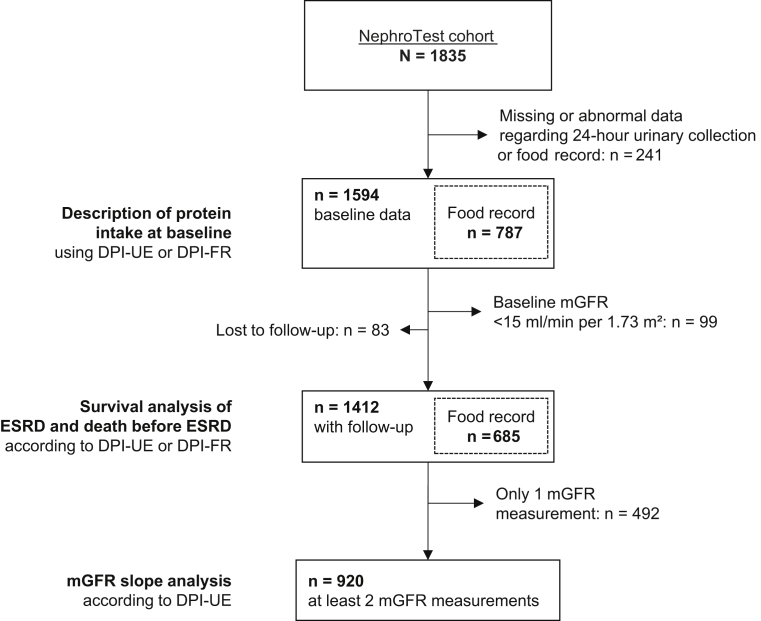
Using the Maroni formula, we assessed dietary protein intake (DPI) from 24-hour urinary urea excretion in 1594 patients (67% men and 33% women) with CKD, 784 of whom also had 7-day food records. Cause-specific hazard ratios (HRs) and 95% confidence intervals for the competing risks of DPI-associated end-stage renal disease (ESRD) or death were estimated in 1412 patients with baseline glomerular filtration rate ≥15 ml/min per 1.73 m, measured by Cr-EDTA renal clearance (mGFR).
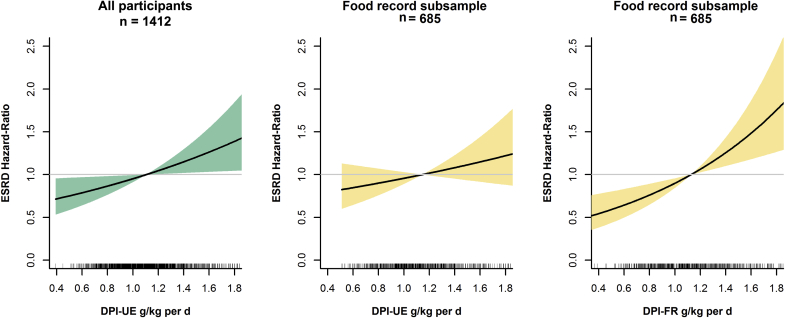
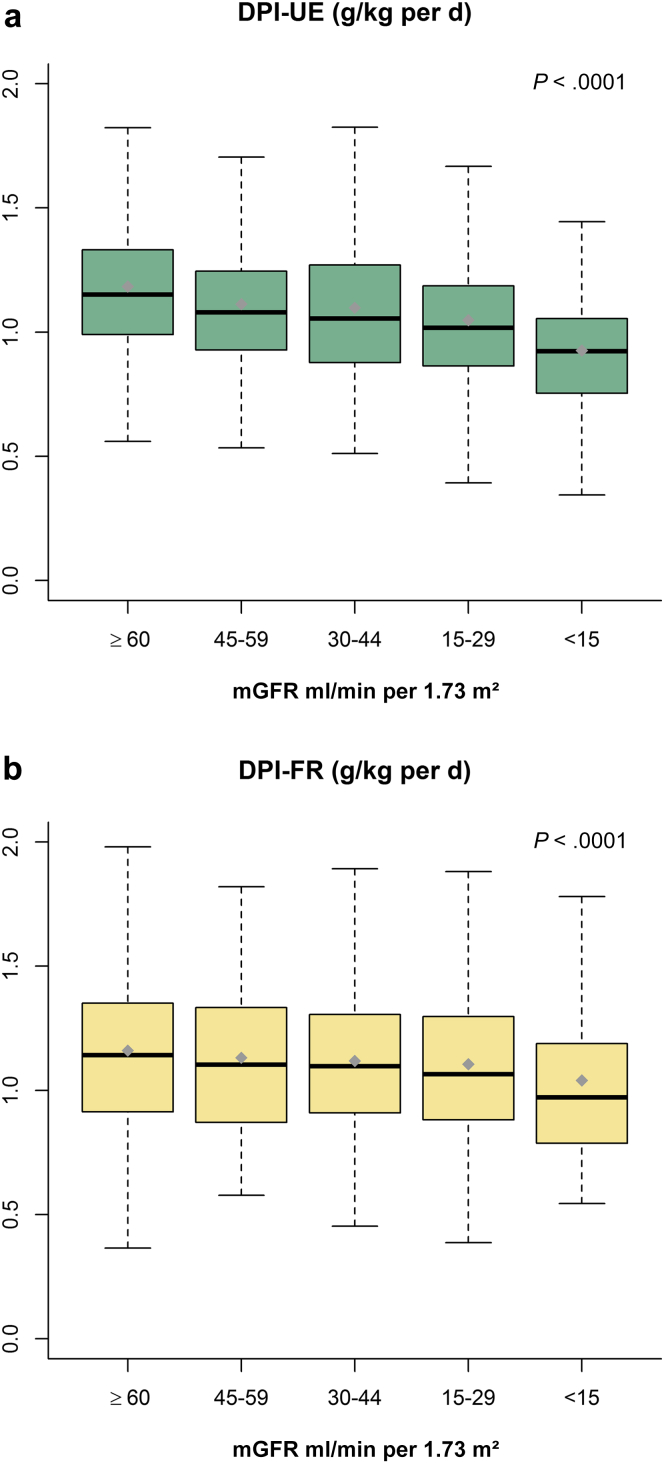
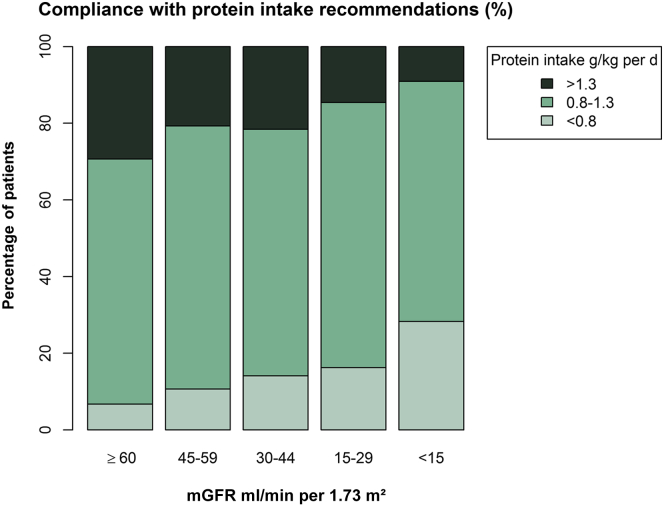
Overall, mean DPI estimated from urea excretion was 1.09 ± 0.30 g/kg of body weight per day (range = 0.34-2.76); 20% of patients had values > 1.3 g/kg per day, and 1.9% had values < 0.6 g/kg per day. Urea excretion and food records produced similar estimates of mean DPI. The lower the mGFR, the lower the mean DPI. Over a median follow-up of 5.6 years, there were 319 ESRD events and 189 pre-ESRD deaths. After adjusting for relevant covariates, each 0.1 g/kg daily higher baseline urea excretion-based DPI or food record-based DPI was associated with an HR for ESRD of 1.05 (95% confidence interval 1.01-1.10) or 1.09 (95% confidence interval 1.04-1.14), respectively. HRs were stronger in patients with baseline mGFR < 30 ml/min per 1.73 m. There was no association with mortality. The mean age of the patients was 59 ± 15 years, and mean body mass index was 26.6 ± 5.2 kg/m.
In this prospective observational study, the lower the baseline DPI, the slower the progression toward ESRD. Most importantly, the absence of threshold for the relation between DPI and ESRD risk indicates that there is no optimal DPI in the range observed in this cohort.
建议减少蛋白质摄入量以减缓慢性肾脏病(CKD)的进展,但对其实际效果的评估却很少。
我们使用马罗尼公式,通过24小时尿尿素排泄量评估了1594例CKD患者(67%为男性,33%为女性)的膳食蛋白质摄入量(DPI),其中784例患者还记录了7天的食物摄入情况。在1412例基线肾小球滤过率≥15 ml/min/1.73 m²的患者中,通过铬-乙二胺四乙酸肾清除率(mGFR)测量,估计了与DPI相关的终末期肾病(ESRD)或死亡竞争风险的病因特异性风险比(HRs)和95%置信区间。
总体而言,根据尿素排泄量估计的平均DPI为每天1.09±0.30 g/kg体重(范围=0.34-2.76);20%的患者值>1.3 g/kg/天,1.9%的患者值<0.6 g/kg/天。尿素排泄量和食物记录得出的平均DPI估计值相似。mGFR越低,平均DPI越低。在中位随访5.6年期间,有319例ESRD事件和189例ESRD前期死亡。在调整相关协变量后,基于基线尿素排泄量的DPI或基于食物记录的DPI每增加0.1 g/kg/天,ESRD的HR分别为1.05(95%置信区间1.01-1.10)或1.09(95%置信区间)。在基线mGFR<30 ml/min/1.73 m²的患者中,HRs更强。与死亡率无关。患者的平均年龄为59±15岁,平均体重指数为26.6±5.2 kg/m²。
在这项前瞻性观察研究中,基线DPI越低,向ESRD进展的速度越慢。最重要的是,DPI与ESRD风险之间的关系不存在阈值,这表明在该队列观察到的范围内没有最佳DPI。