Department of Philosophy, University of Wollongong Faculty of Law Humanities and the Arts, Wollongong, New South Wales, Australia
Wellcome Trust Centre for Neuroimaging, London, UK.
J R Soc Interface. 2018 Jan;15(138). doi: 10.1098/rsif.2017.0792.
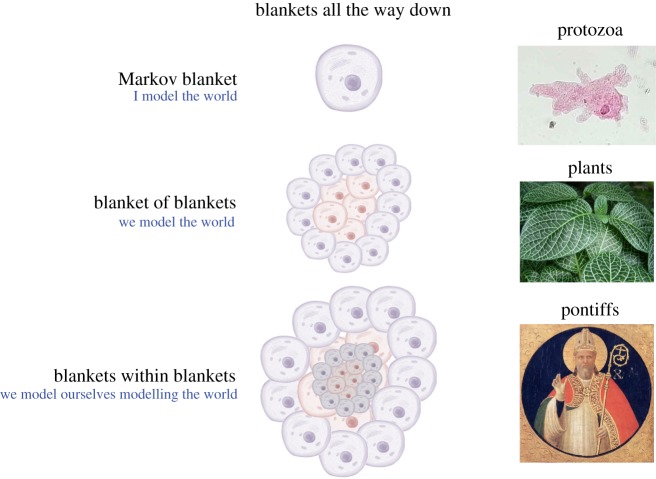
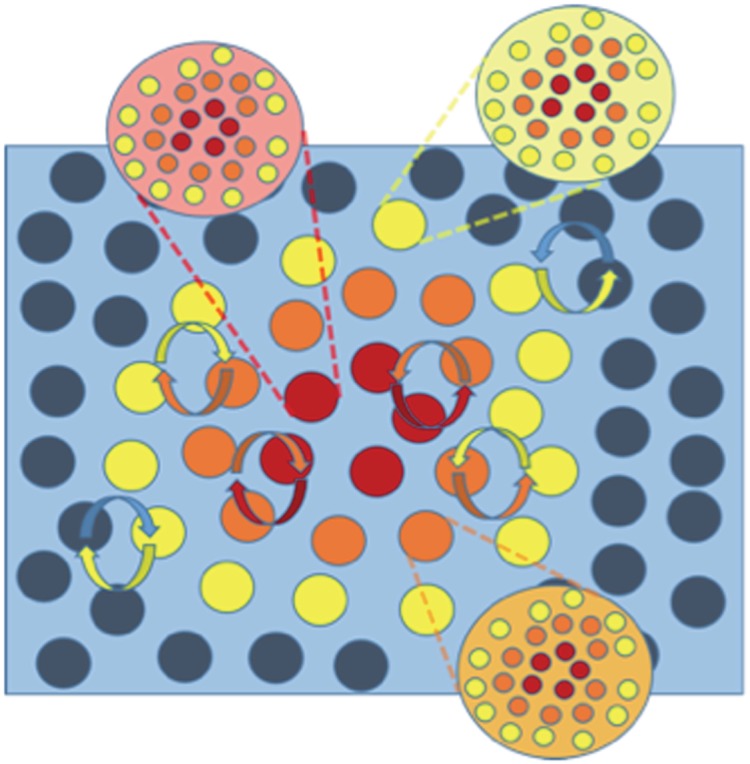
This work addresses the autonomous organization of biological systems. It does so by considering the boundaries of biological systems, from individual cells to , in terms of the presence of Markov blankets under the active inference scheme-a corollary of the free energy principle. A Markov blanket defines the boundaries of a system in a statistical sense. Here we consider how a collective of Markov blankets can self-assemble into a global system that itself has a Markov blanket; thereby providing an illustration of how autonomous systems can be understood as having layers of nested and self-sustaining boundaries. This allows us to show that: (i) any living system is a Markov blanketed system and (ii) the boundaries of such systems need not be co-extensive with the biophysical boundaries of a living organism. In other words, autonomous systems are hierarchically composed of Markov blankets of Markov blankets-all the way down to individual cells, all the way up to you and me, and all the way out to include elements of the local environment.
这项工作探讨了生物系统的自主组织。它通过考虑生物系统的边界来实现这一点,从单个细胞到 ,根据主动推理方案下的马克夫 blankets 的存在——自由能原理的推论。马克夫 blankets 从统计意义上定义了系统的边界。在这里,我们考虑如何将集体的马克夫 blankets 自我组装成一个具有马克夫 blankets 的全局系统;从而提供了一个说明,说明自主系统如何被理解为具有嵌套和自我维持的边界层。这使我们能够证明:(i)任何生命系统都是一个马克夫 blankets 系统,(ii)这样的系统的边界不一定与生物体的生物物理边界一致。换句话说,自主系统是由马克夫 blankets 的马克夫 blankets 分层组成的——一直到单个细胞,一直到你和我,一直到包括局部环境的元素。