Thünen Institute of Climate-Smart Agriculture, Braunschweig, DE-38116, Germany.
TNO, Department of Climate, Air and Sustainability, Utrecht, NL-3584, The Netherlands.
Sci Rep. 2018 Jan 17;8(1):969. doi: 10.1038/s41598-017-18021-6.
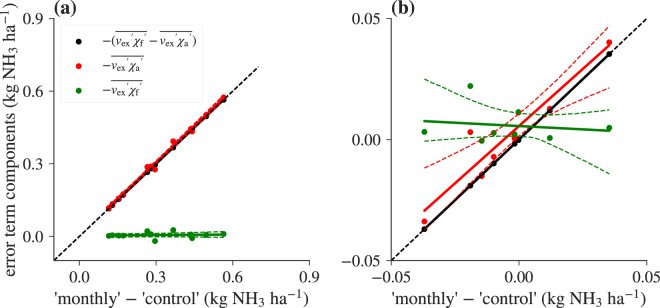
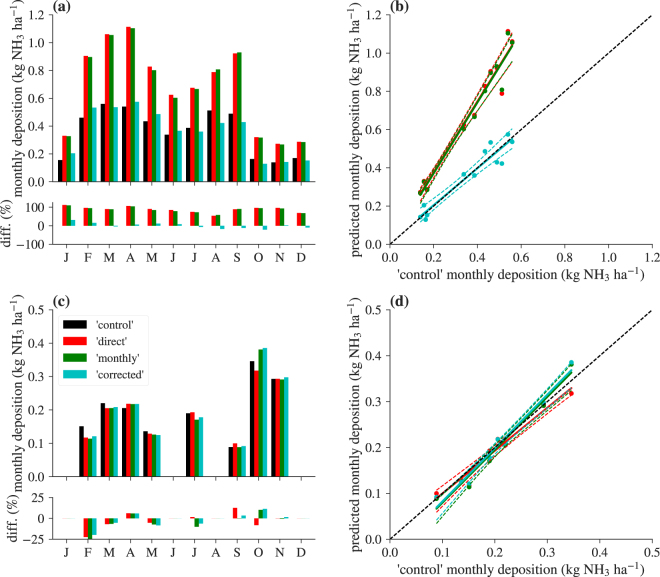
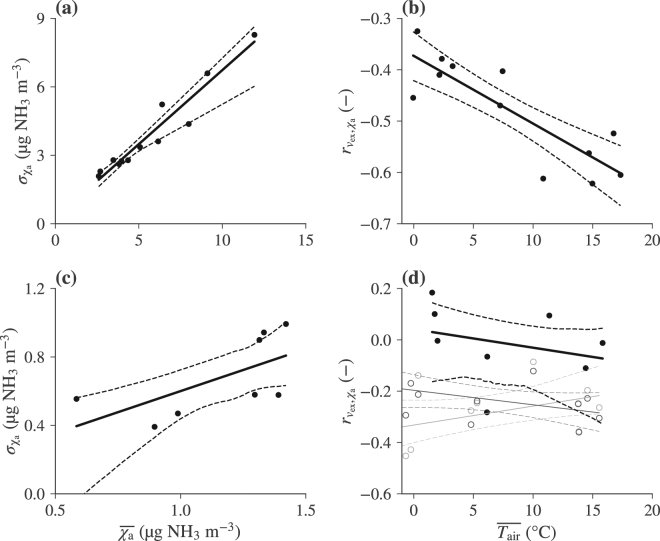
Long-term monitoring stations for atmospheric pollutants are often equipped with low-resolution concentration samplers. In this study, we analyse the errors associated with using monthly average ammonia concentrations as input variables for bidirectional biosphere-atmosphere exchange models, which are commonly used to estimate dry deposition fluxes. Previous studies often failed to account for a potential correlation between ammonia exchange velocities and ambient concentrations. We formally derive the exact magnitude of these errors from statistical considerations and propose a correction scheme based on parallel measurements using high-frequency analysers. In case studies using both modelled and measured ammonia concentrations and micrometeorological drivers from sites with varying pollution levels, we were able to substantially reduce bias in the predicted ammonia fluxes. Neglecting to account for these errors can, in some cases, lead to significantly biased deposition estimates compared to using high-frequency instrumentation or corrected averaging strategies. Our study presents a first step towards a unified correction scheme for data from nation-wide air pollutant monitoring networks to be used in chemical transport and air quality models.
长期大气污染物监测站通常配备低分辨率浓度采样器。在这项研究中,我们分析了将月平均氨浓度用作双向生物圈-大气交换模型输入变量所带来的误差,这些模型常用于估算干沉降通量。先前的研究往往没有考虑到氨交换速度和环境浓度之间存在潜在的相关性。我们从统计学角度正式推导出这些误差的确切幅度,并提出了一种基于使用高频分析仪进行平行测量的校正方案。在使用具有不同污染水平站点的模型化和实测氨浓度以及微气象驱动因素进行的案例研究中,我们能够显著减少预测氨通量的偏差。如果忽略这些误差,与使用高频仪器或校正平均策略相比,在某些情况下可能会导致沉积估计值出现显著偏差。我们的研究朝着建立用于化学输送和空气质量模型的全国性空气污染物监测网络数据的统一校正方案迈出了第一步。