Park Jason A, Safer Joshua D
Transgender Medicine Research Group, Boston University School of Medicine and Center for Transgender Medicine and Surgery, Boston Medical Center, Boston, Massachusetts.
Transgend Health. 2018 Jan 1;3(1):10-16. doi: 10.1089/trgh.2017.0047. eCollection 2018.
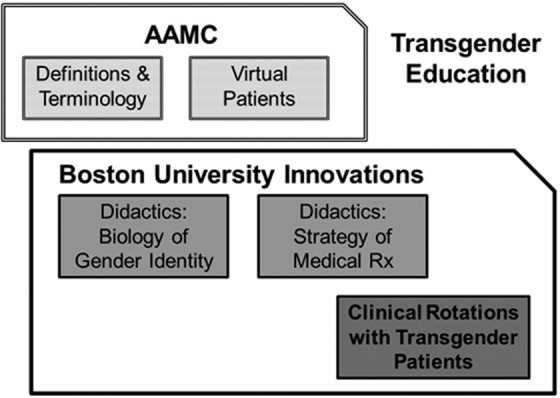
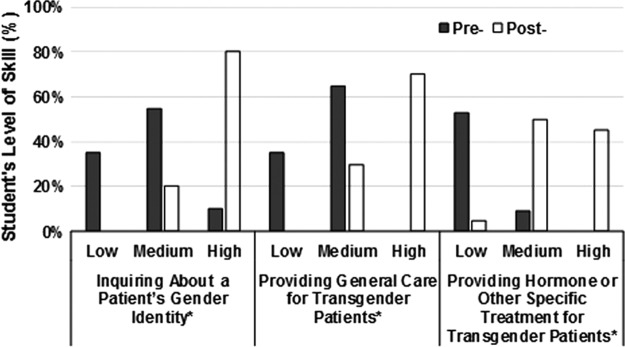
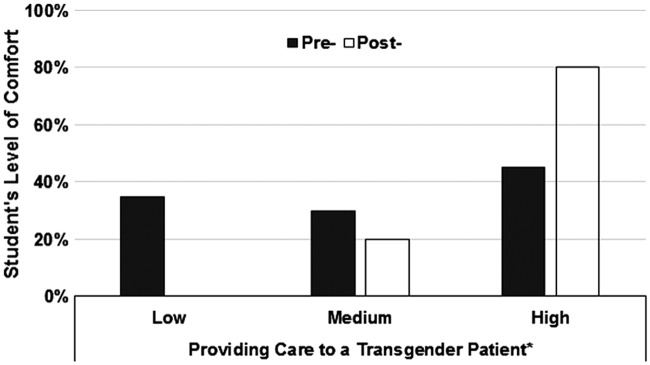
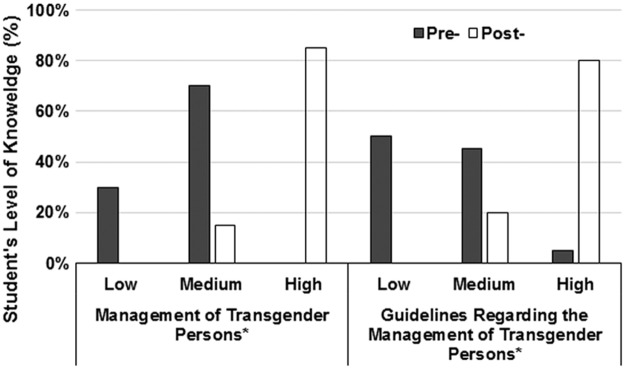
Transgender individuals are medically underserved in the United States and face many documented disparities in care due to providers' lack of education, training, and comfort. We have previously demonstrated that specific transgender medicine content in a medical school curriculum increases students' willingness to treat transgender patients. However, we have also identified that those same students are less comfortable with transgender care relative to care for lesbian, gay, and bisexual patients. We aimed to demonstrate that clinical exposure to care for transgender patients would help close this gap. At Boston University School of Medicine, we piloted a transgender medicine elective where students rotate on services that provide clinical care for transgender individuals. Pre- and postsurveys were administered to students who participated in the elective. After completing the elective, students who reported "high" comfort increased from 45% (9/20) to 80% (16/20) (=0.04), and students who reported "high" knowledge regarding management of transgender patients increased from 0% (0/20) to 85% (17/20) (<0.001. Although integrating evidence-based, transgender-specific content into medical curricula improves student knowledge and comfort with transgender medical care, gaps remain. Clinical exposure to transgender medicine during clinical years can contribute to closing that gap and improving access to care for transgender individuals.
在美国,跨性别者在医疗服务方面未得到充分满足,由于医疗服务提供者缺乏教育、培训以及相关服务体验,他们在医疗护理方面面临诸多已被记录的差异。我们之前已经证明,医学院课程中特定的跨性别医学内容会提高学生治疗跨性别患者的意愿。然而,我们也发现,相对于治疗女同性恋、男同性恋和双性恋患者,这些学生在跨性别护理方面的舒适度较低。我们旨在证明,临床接触跨性别患者的护理将有助于缩小这一差距。在波士顿大学医学院,我们试点了一门跨性别医学选修课,学生们在为跨性别者提供临床护理的科室轮转。对参加该选修课的学生进行了课前和课后调查。完成选修课后,报告“高度”舒适度的学生从45%(9/20)增至80%(16/20)(P = 0.04),报告对跨性别患者管理有“高度”了解的学生从0%(0/20)增至85%(17/20)(P<0.001)。虽然将基于证据的、特定于跨性别的内容纳入医学课程可提高学生对跨性别医疗护理的知识和舒适度,但差距依然存在。临床实习期间接触跨性别医学有助于缩小这一差距,并改善跨性别者获得医疗护理的机会。