Fevang Espen, Haaland Karin, Røislien Jo, Bjørshol Conrad Arnfinn
Department of Research and Development, Norwegian Air Ambulance Foundation, Drøbak, Norway.
Department of Anesthesiology and Intensive Care, Stavanger University Hospital, Stavanger, Norway.
BMC Anesthesiol. 2018 Jan 18;18(1):10. doi: 10.1186/s12871-018-0474-z.
Endotracheal intubation of patients with massive regurgitation represents a challenge in emergency airway management. Gastric contents tend to block suction catheters, and few treatment alternatives exist. Based on a technique that was successfully applied in our district, we wanted to examine if endotracheal intubation would be easier and quicker to perform when the patient is turned over to a semiprone position, as compared to the supine position.
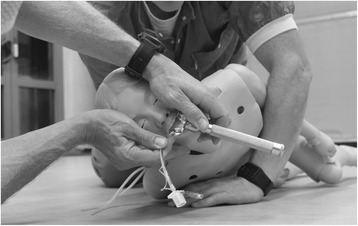
In a randomized crossover simulation trial, a child manikin with on-going regurgitation was intubated both in the supine and semiprone positions. Endpoints were experienced difficulty with the procedure and time to intubation, as well as visually confirmed intubation and first-pass success rate.
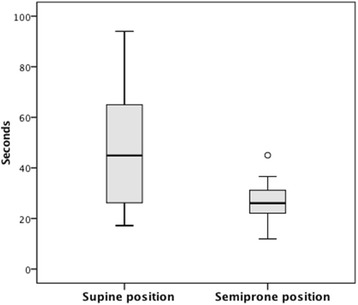
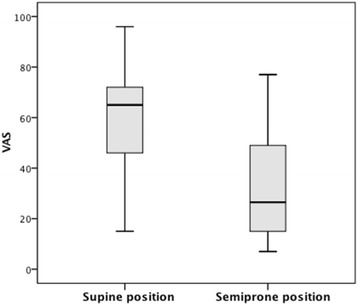
Intubation in the semiprone position was significantly easier and faster compared to the supine position; the median experienced difficulty on a visual analogue scale was 27 and 65, respectively (p = 0.004), and the median time to intubation was 26 and 45 s, respectively (p = 0.001). There were no significant differences in frequency of visually confirmed intubation (16 and 18, p = 0.490) of first-pass success rate (17 and 18, p = 1.000).
In this experiment, endotracheal intubation during massive regurgitation with the patient in the semiprone position was significantly easier and quicker to perform than in the supine position. Endotracheal intubation in the semiprone position can provide a quick rescue method in situations where airway management is hindered by massive regurgitation, and it represents a possible supplement to current airway management training.
对于有大量反流的患者进行气管插管是紧急气道管理中的一项挑战。胃内容物容易堵塞吸引导管,且治疗选择有限。基于在我们地区成功应用的一项技术,我们想研究与仰卧位相比,将患者翻转至半俯卧位时气管插管是否会更容易且更快完成。
在一项随机交叉模拟试验中,对一名持续反流的儿童人体模型分别在仰卧位和半俯卧位进行插管。观察指标包括操作过程中遇到的困难、插管时间,以及可视确认的插管情况和首次插管成功率。
与仰卧位相比,半俯卧位插管明显更容易且更快;视觉模拟量表上的中位操作困难程度分别为27和65(p = 0.004),中位插管时间分别为26和45秒(p = 0.001)。可视确认插管的频率(分别为16和18,p = 0.490)和首次插管成功率(分别为17和18,p = 1.000)无显著差异。
在本实验中,对于有大量反流的患者,半俯卧位气管插管比仰卧位明显更容易且更快完成。半俯卧位气管插管可为因大量反流而阻碍气道管理的情况提供一种快速的抢救方法,并且它是当前气道管理培训的一种可能补充。