Marine Geology & Seafloor Surveying, Department of Geosciences, University of Malta, Msida, Malta.
Istituto Nazionale di Oceanografia e di Geofisica Sperimentale (OGS), Trieste, Italy.
Sci Rep. 2018 Jan 18;8(1):1078. doi: 10.1038/s41598-018-19446-3.
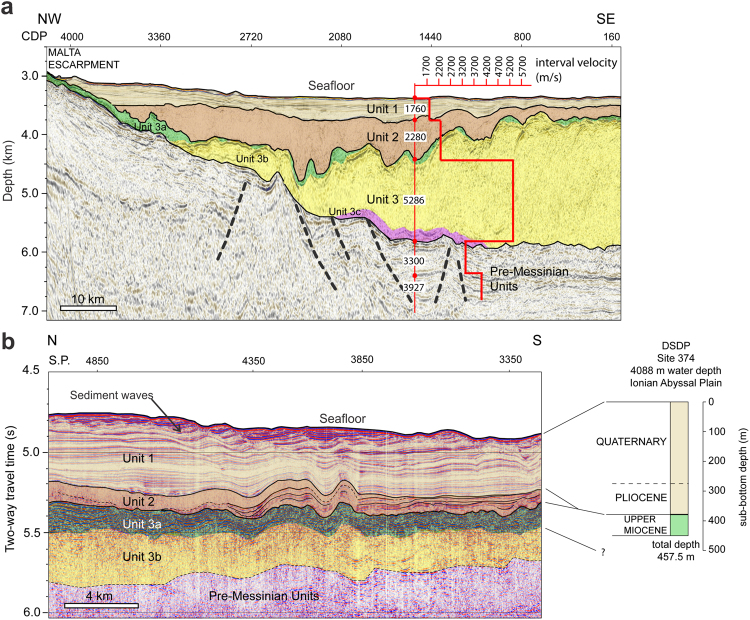
The Messinian salinity crisis (MSC) - the most abrupt, global-scale environmental change since the end of the Cretaceous - is widely associated with partial desiccation of the Mediterranean Sea. A major open question is the way normal marine conditions were abruptly restored at the end of the MSC. Here we use geological and geophysical data to identify an extensive, buried and chaotic sedimentary body deposited in the western Ionian Basin after the massive Messinian salts and before the Plio-Quaternary open-marine sedimentary sequence. We show that this body is consistent with the passage of a megaflood from the western to the eastern Mediterranean Sea via a south-eastern Sicilian gateway. Our findings provide evidence for a large amplitude drawdown in the Ionian Basin during the MSC, support the scenario of a Mediterranean-wide catastrophic flood at the end of the MSC, and suggest that the identified sedimentary body is the largest known megaflood deposit on Earth.
墨西拿盐度危机(MSC)——自白垩纪末期以来最剧烈、全球性的环境变化——与地中海部分干涸广泛相关。一个主要的悬而未决的问题是 MSC 末期正常海洋条件是如何突然恢复的。在这里,我们利用地质和地球物理数据来识别在大规模的墨西拿盐之后和上新世-第四纪开阔海洋沉积序列之前在爱奥尼亚盆地西部沉积的广泛的、埋藏的和混乱的沉积体。我们表明,该物体与通过西西里东南部门户从地中海西部到东部的特大洪水一致。我们的发现为 MSC 期间爱奥尼亚盆地大幅下降提供了证据,支持 MSC 末期地中海范围内灾难性洪水的情景,并表明所识别的沉积体是地球上已知的最大特大大洪水沉积体。