Department of Orthopedic Surgery, Seoul National University Bundang Hospital, Seoul National University College of Medicine, Seongnam, Korea.
Medical Research Collaborating Center, Seoul National University Bundang Hospital, Seoul National University College of Medicine, Seongnam, Korea.
J Korean Med Sci. 2018 Jan 29;33(5):e38. doi: 10.3346/jkms.2018.33.e38.
Atypical femoral fracture (AFF) has been high-lightened, because it was associated with the long-term use of bisphosphonate. Comparing western countries, the incidence rate of AFF was unclear in East Asian patients. Our purposes were to estimate the incidence rate of radiologically defined AFF in Korea, and to determine the association between occurrence of AFF and long-term use of bisphosphonate.
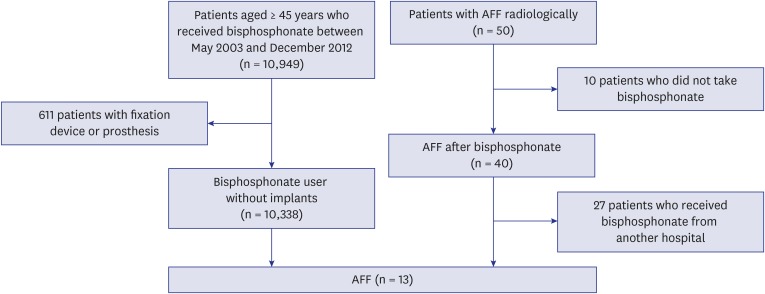
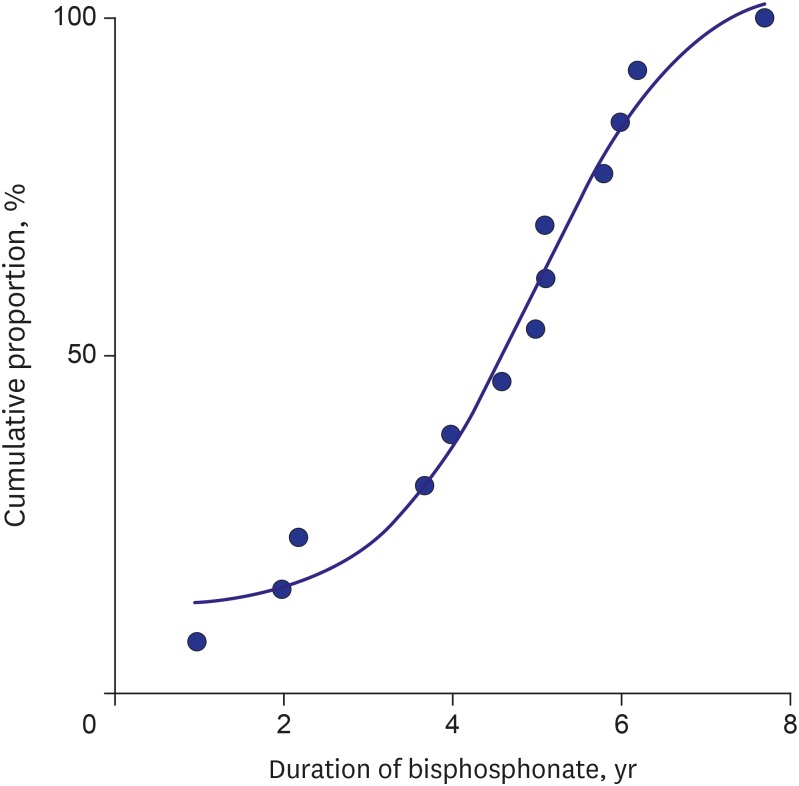
We conducted a hospital-based, retrospective cohort study in patients aged ≥ 45 years, who took bisphosphonate. The occurrence of AFF was estimated by using incidence rate, and the age-adjusted incidence rate to U.S. 2010 Census data. The association between occurrence of AFF and the duration of bisphosphonate use was examined. The cumulative probability of AFF was plotted per each duration of bisphosphonate use.
Among 10,338 individuals who took bisphosphonate, 13 patients with AFF following use of bisphosphonate were identified. The incidence rate was 85.9/100,000 person-years (95% confidence interval [CI], 50.2-146.9), and age-adjusted incidence rate was 72.7/100,000 person-years (95% CI, 29.1-175.8). In Poisson regression analysis, higher body mass index (BMI) was associated with an increased risk of AFF (relative risk, 1.2; 95% CI, 1.004-1.359). The cumulative probability of AFF increased abruptly when the duration of bisphosphonate use was 4 years or more.
Among Korean patients, the incidence rate of AFF was on a par with those of western countries, and this can provide basic information to conduct further studies by evaluating risk and benefit of continuing bisphosphonate.
非典型股骨骨折(AFF)已引起重视,因为它与长期使用双膦酸盐有关。与西方国家相比,东亚患者的 AFF 发病率尚不清楚。我们的目的是评估韩国放射学定义的 AFF 的发病率,并确定 AFF 的发生与长期使用双膦酸盐之间的关系。
我们对≥45 岁、服用双膦酸盐的患者进行了一项基于医院的回顾性队列研究。使用发病率和年龄调整后的发病率来评估 AFF 的发生率,以与美国 2010 年人口普查数据进行比较。检查 AFF 的发生与双膦酸盐使用时间之间的关系。根据双膦酸盐使用时间绘制 AFF 的累积概率图。
在 10338 名服用双膦酸盐的患者中,发现了 13 例 AFF 患者。发病率为 85.9/100,000 人年(95%置信区间 [CI],50.2-146.9),年龄调整后的发病率为 72.7/100,000 人年(95%CI,29.1-175.8)。在泊松回归分析中,较高的体重指数(BMI)与 AFF 的风险增加相关(相对风险,1.2;95%CI,1.004-1.359)。当双膦酸盐使用时间达到 4 年或以上时,AFF 的累积概率急剧增加。
在韩国患者中,AFF 的发病率与西方国家相当,这可以提供基本信息,通过评估继续使用双膦酸盐的风险和获益来进一步开展研究。