Institute of Medical Sciences, University of Aberdeen, Foresterhill, Aberdeen, UK
Division of Psychiatry, University of Edinburgh, Royal Edinburgh Hospital, Edinburgh, UK.
Philos Trans R Soc Lond B Biol Sci. 2018 Mar 19;373(1742). doi: 10.1098/rstb.2017.0037.
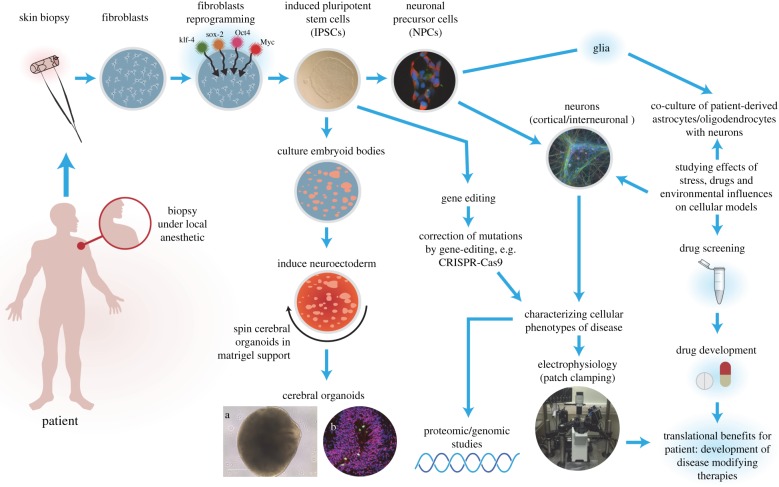
Solid progress has occurred over the last decade in our understanding of the molecular genetic basis of neurodevelopmental disorders, and of schizophrenia and autism in particular. Although the genetic architecture of both disorders is far more complex than previously imagined, many key loci have at last been identified. This has allowed and technologies to be refined to model specific high-penetrant genetic loci involved in both disorders. Using the / and / loci as exemplars, we explore the opportunities and challenges of using animal models and human-induced pluripotent stem cell technologies to further understand/treat and potentially reverse the worst consequences of these debilitating disorders.This article is part of a discussion meeting issue 'Of mice and mental health: facilitating dialogue between basic and clinical neuroscientists'.
在过去的十年中,我们对神经发育障碍、尤其是精神分裂症和自闭症的分子遗传基础的理解取得了实质性进展。尽管这两种疾病的遗传结构远比以前想象的复杂,但许多关键基因座终于被确定。这使得和技术得以改进,以模拟这两种疾病中涉及的特定高外显率遗传基因座。我们以/和/基因座为例,探讨了使用动物模型和人类诱导多能干细胞技术来进一步理解/治疗和潜在逆转这些使人衰弱的疾病的最坏后果的机会和挑战。本文是“老鼠与精神健康:促进基础和临床神经科学家之间对话”专题讨论的一部分。