The Royal Marsden NHS Foundation Trust, London and Surrey, United Kingdom.
The Institute of Cancer Research, London and Surrey, United Kingdom.
Sci Rep. 2018 Jan 23;8(1):1445. doi: 10.1038/s41598-018-19212-5.
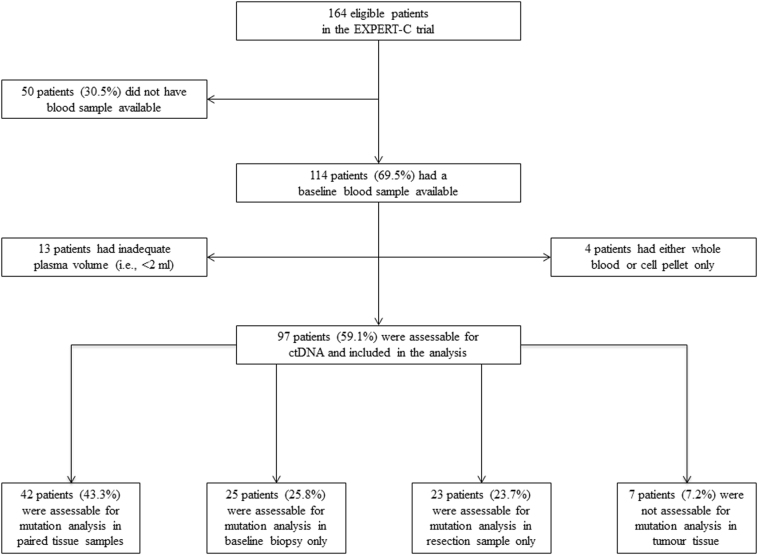
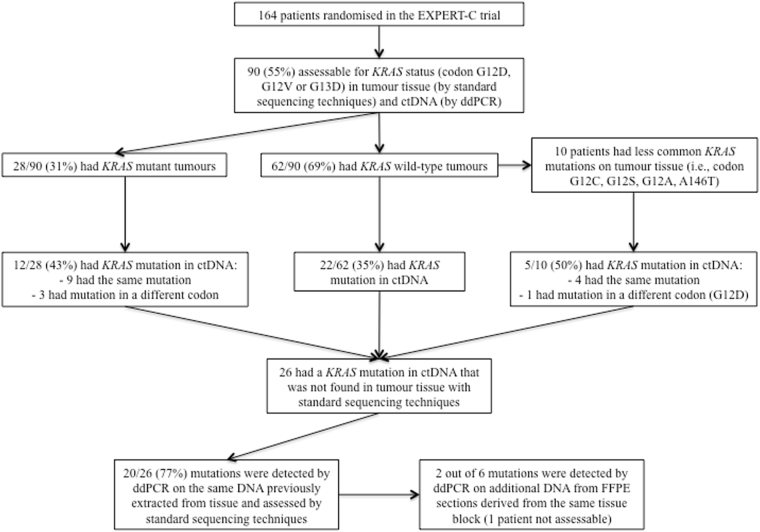
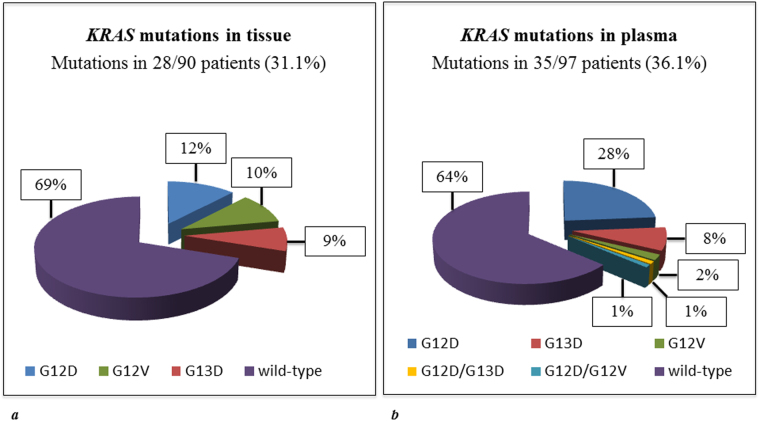
There are limited data on circulating, cell-free, tumour (ct)DNA analysis in locally advanced rectal cancer (LARC). Digital droplet (dd)PCR was used to investigate KRAS/BRAF mutations in ctDNA from baseline blood samples of 97 LARC patients who were treated with CAPOX followed by chemoradiotherapy, surgery and adjuvant CAPOX ± cetuximab in a randomised phase II trial. KRAS mutation in G12D, G12V or G13D was detected in the ctDNA of 43% and 35% of patients with tumours that were mutant and wild-type for these hotspot mutations, respectively, according to standard PCR-based analyses on tissue. The detection rate in the ctDNA of 10 patients with less common mutations was 50%. In 26 cases ctDNA analysis revealed KRAS mutations that were not previously found in tissue. Twenty-two of these (84.6%) were detected following repeat tissue testing by ddPCR. Overall, the ctDNA detection rate in the KRAS mutant population was 66%. Detection of KRAS mutation in ctDNA failed to predict prognosis or refine patient selection for cetuximab. While this study confirms the feasibility of ctDNA analysis in LARC and the high sensitivity of ddPCR, larger series are needed to better address the role of ctDNA as a prognostic or predictive tool in this setting.
在局部晚期直肠癌(LARC)中,关于循环无细胞肿瘤(ct)DNA 分析的资料有限。在一项随机的 II 期试验中,我们使用数字液滴(dd)PCR 检测了接受 CAPOX 治疗后接受放化疗、手术和辅助 CAPOX±西妥昔单抗治疗的 97 例 LARC 患者基线血液样本中的 ctDNA 中的 KRAS/BRAF 突变。根据组织上基于标准 PCR 的分析,ctDNA 中分别检测到肿瘤中这些热点突变的突变型和野生型患者中 KRAS 突变 G12D、G12V 或 G13D 的比例分别为 43%和 35%。10 例少见突变患者的 ctDNA 检测率为 50%。在 26 例 ctDNA 分析中发现了组织中未发现的 KRAS 突变。ddPCR 重复组织检测后,其中 22 例(84.6%)被检出。总体而言,KRAS 突变人群中 ctDNA 的检出率为 66%。ctDNA 检测到 KRAS 突变未能预测预后或改善西妥昔单抗的患者选择。虽然这项研究证实了 ctDNA 分析在 LARC 中的可行性和 ddPCR 的高灵敏度,但需要更大的系列来更好地解决 ctDNA 作为该环境中预后或预测工具的作用。