
肾脏细胞死亡的免疫学后果。
Immunological consequences of kidney cell death.
机构信息
Division of Nephrology and Dialysis, Department of Medicine III, Medical University Vienna, Vienna, Austria.
Division of Nephrology, Department of Internal Medicine III, University Hospital Carl Gustav Carus at the Technische Universität Dresden, Dresden, Germany.
出版信息
Cell Death Dis. 2018 Jan 25;9(2):114. doi: 10.1038/s41419-017-0057-9.
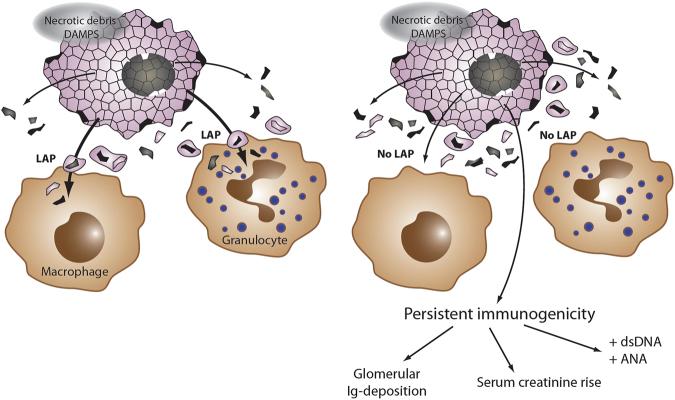
Death of renal cells is central to the pathophysiology of acute tubular necrosis, autoimmunity, necrotizing glomerulonephritis, cystic kidney disease, urosepsis, delayed graft function and transplant rejection. By means of regulated necrosis, immunogenic damage-associated molecular patterns (DAMPs) and highly reactive organelles such as lysosomes, peroxisomes and mitochondria are released from the dying cells, thereby causing an overwhelming immunologic response. The rupture of the plasma membrane exhibits the "point of no return" for the immunogenicity of regulated cell death, explaining why apoptosis, a highly organized cell death subroutine with long-lasting plasma membrane integrity, elicits hardly any immune response. Ferroptosis, an iron-dependent necrotic type cell death, results in the release of DAMPs and large amounts of lipid peroxides. In contrast, anti-inflammatory cytokines are actively released from cells that die by necroptosis, limiting the DAMP-induced immune response to a surrounding microenvironment, whereas at the same time, inflammasome-associated caspases drive maturation of intracellularly expressed interleukin-1β (IL-1β). In a distinct setting, additionally interleukin-18 (IL-18) is expressed during pyroptosis, initiated by gasdermin-mediated plasma membrane rupture. As all of these pathways are druggable, we provide an overview of regulated necrosis in kidney diseases with a focus on immunogenicity and potential therapeutic interventions.
细胞死亡是急性肾小管坏死、自身免疫、坏死性肾小球肾炎、囊性肾病、尿脓毒症、移植物功能延迟和移植排斥等多种肾脏疾病病理生理学的核心。通过调节性细胞坏死,免疫原性损伤相关分子模式(DAMPs)和溶酶体、过氧化物酶体和线粒体等高度反应性细胞器从死亡细胞中释放出来,从而引起强烈的免疫反应。质膜的破裂显示了调节性细胞死亡免疫原性的“不归路”,这解释了为什么凋亡(一种具有持久质膜完整性的高度组织化细胞死亡子程序)几乎不会引起任何免疫反应。铁依赖性坏死性细胞死亡铁死亡会导致 DAMPs 和大量脂质过氧化物的释放。相比之下,坏死细胞会主动释放抗炎细胞因子,从而将 DAMPs 诱导的免疫反应限制在周围的微环境中,同时,半胱天冬酶相关的炎性小体驱动细胞内表达的白细胞介素-1β(IL-1β)的成熟。在另一种特定情况下,细胞焦亡在天冬氨酸半胱氨酸酶-1(caspase-1)依赖性的细胞程序性死亡过程中会被激活,通过 gasdermin 介导的质膜破裂而启动,细胞焦亡过程中会表达白细胞介素-18(IL-18)。由于所有这些途径都可以被药物干预,因此我们提供了肾脏疾病中调节性细胞坏死的概述,重点关注其免疫原性和潜在的治疗干预措施。


 Zotero 插件