La Starza Roberta, Pierini Tiziana, Pastorino Lorenza, Albi Elisa, Matteucci Caterina, Crescenzi Barbara, Sportoletti Paolo, Covarelli Piero, Falzetti Franca, Roti Giovanni, Ascani Stefano, Mecucci Cristina
1Molecular Medicine Laboratory, Hematology and Bone Marrow Transplantation Unit, University of Perugia, Hospital S. Maria della Misericordia, Piazzale Menghini n.9, 06132 Perugia, Italy.
2Department of Internal Medicine and Medical Specialties (DiMI), University of Genova and IRCCS AOU San Martino-IST, Viale Benedetto XV n.6, 16132 Genova, Italy.
Mol Cytogenet. 2018 Jan 16;11:6. doi: 10.1186/s13039-017-0353-1. eCollection 2018.
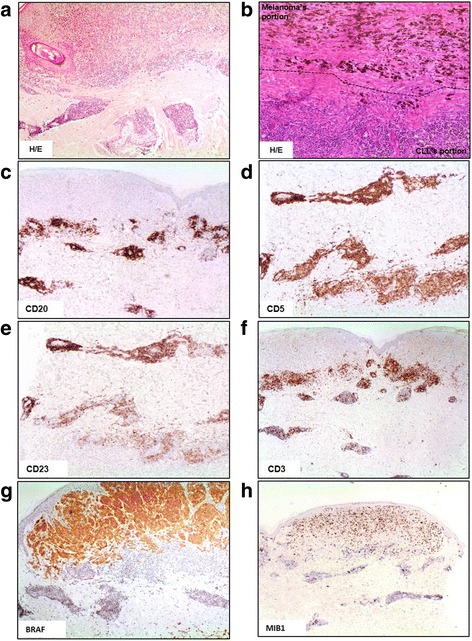
Collision tumors are rare entities that consist of two histologically distinct tumor types arising in the same anatomic site. An association between chronic lymphocytic leukemia (CLL) and malignant melanoma (MM) has been already described. Up to now, they have been documented only at positive regional lymph nodes while we focused on collision tumor in a skin lesion.
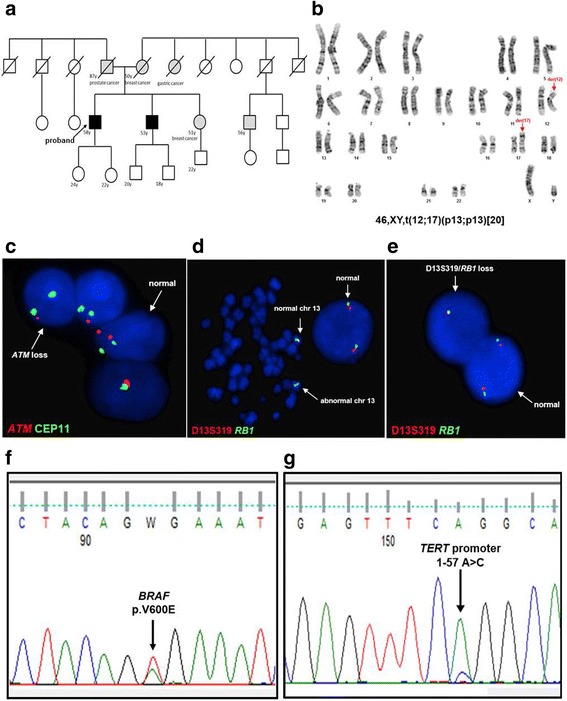
We characterized the genomic profile of a skin CLL/MM collision tumor in a patient with a 9-years story of CLL. Typical high-grade genomic biomarkers featured the CLL: the immunoglobulin heavy variable genes were unmutated; a clonal del(11q), involving and , was present in the peripheral blood (PB) and skin lesion, while a subclonal large del(13q)/D13S319 was detected only in the PB. Interestingly, the del(13q) clone, increased from 10% to 46% from diagnosis to relapse. , , and were wild type. The MM lesion carried a and a promoter mutation.As the family story was consistent with a genetic predisposition to cancer, we performed mutational analysis of genes involved in familial melanoma and CLL, and of and . No germinal mutation known to predispose to CLL, MM, or breast cancer was found. Interestingly, conventional cytogenetic detected a constitutional t(12;17)(p13;p13).
Our data are consistent with distinct genetic landscape of the two tumors which were characterized by specific disease-related abnormalities. CLL cells carried poor prognostic imbalances, i.e. large deletions of the long arm of chromosomes 11 and 13, while in MM cells two functionally linked mutations, i.e. and a promoter occurred. Although, known germline variations predisposing to MM and/or CLL were ruled out, genetic counseling suggested the proband family was at high risk for MM.
碰撞瘤是一种罕见的实体瘤,由同一解剖部位出现的两种组织学上不同的肿瘤类型组成。慢性淋巴细胞白血病(CLL)与恶性黑色素瘤(MM)之间的关联已有报道。到目前为止,它们仅在阳性区域淋巴结中被记录,而我们关注的是皮肤病变中的碰撞瘤。
我们对一名患有9年CLL病史患者的皮肤CLL/MM碰撞瘤的基因组特征进行了分析。典型的高级别基因组生物标志物是CLL的特征:免疫球蛋白重链可变基因未发生突变;外周血(PB)和皮肤病变中存在涉及 和 的克隆性del(11q),而仅在PB中检测到亚克隆性大del(13q)/D13S319。有趣的是,从诊断到复发,del(13q)克隆从10%增加到46%。 、 和 为野生型。MM病变携带 启动子突变。由于家族史与癌症遗传易感性一致,我们对参与家族性黑色素瘤和CLL的基因以及 和 进行了突变分析。未发现已知的易患CLL、MM或乳腺癌的胚系突变。有趣的是,传统细胞遗传学检测到一个染色体核型t(12;17)(p13;p13)。
我们的数据与两种肿瘤不同的遗传格局一致,这两种肿瘤具有特定的疾病相关异常特征。CLL细胞携带预后不良的失衡,即染色体11和13长臂的大片段缺失,而MM细胞中发生了两个功能相关的突变,即 和 启动子突变。尽管排除了已知的易患MM和/或CLL的种系变异,但遗传咨询表明先证者家族患MM的风险很高。