Lin Ruo-Kai, Hung Wan-Yu, Huang Yu-Fang, Chang Yu-Jia, Lin Chien-Hsing, Chen Wei-Yu, Chiu Shih-Feng, Chang Shih-Ching, Tsai Shih-Feng
Graduate Institute of Pharmacognosy, Taipei Medical University, Taipei, Taiwan, R.O.C.
Master Program for Clinical Pharmacogenomics and Pharmacoproteomics, Taipei Medical University, Taipei, Taiwan, R.O.C.
Oncotarget. 2017 Nov 1;8(69):113431-113443. doi: 10.18632/oncotarget.22266. eCollection 2017 Dec 26.
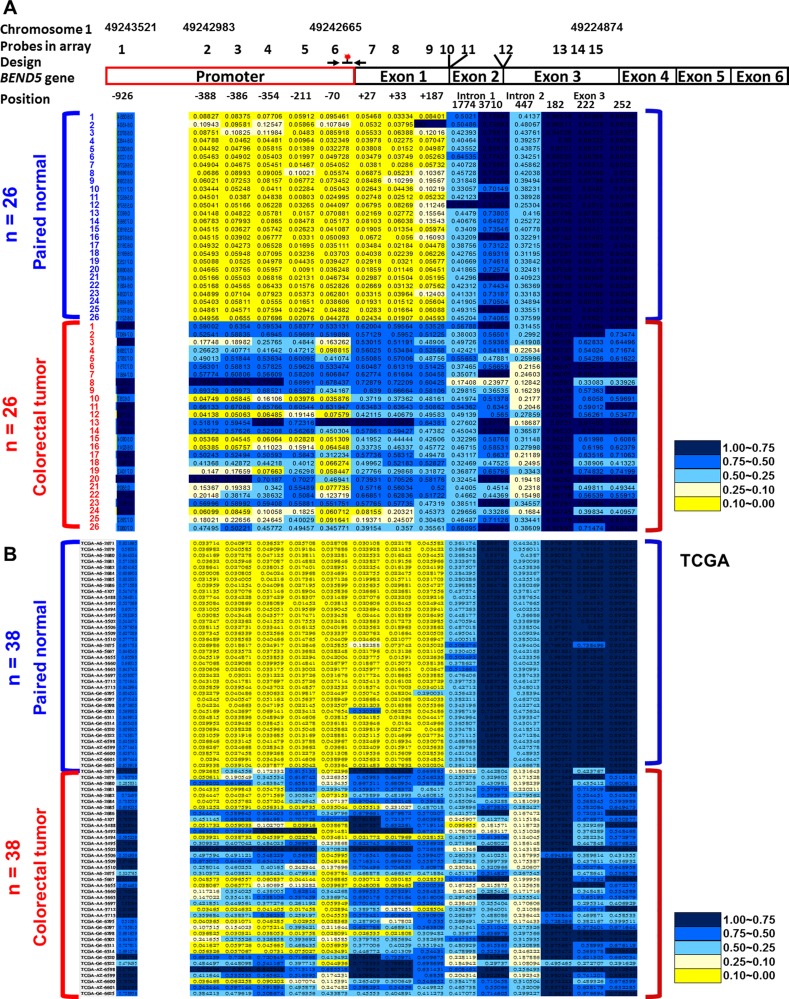
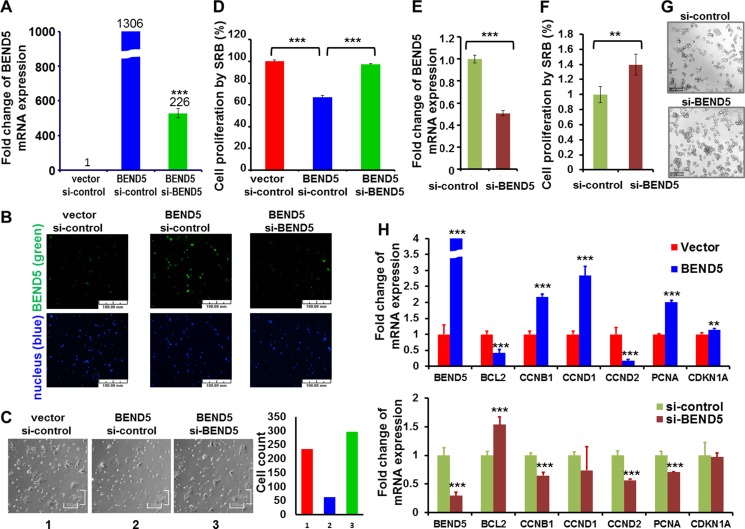
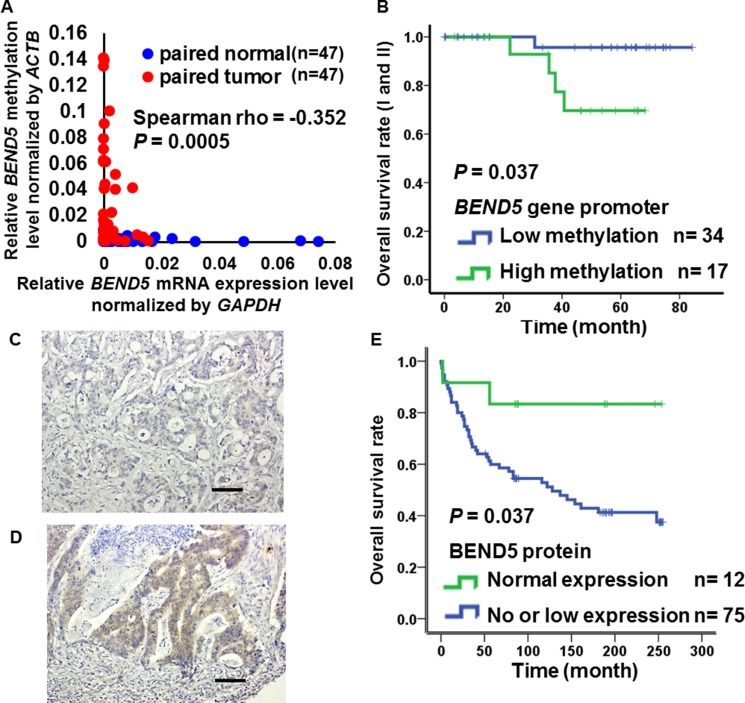
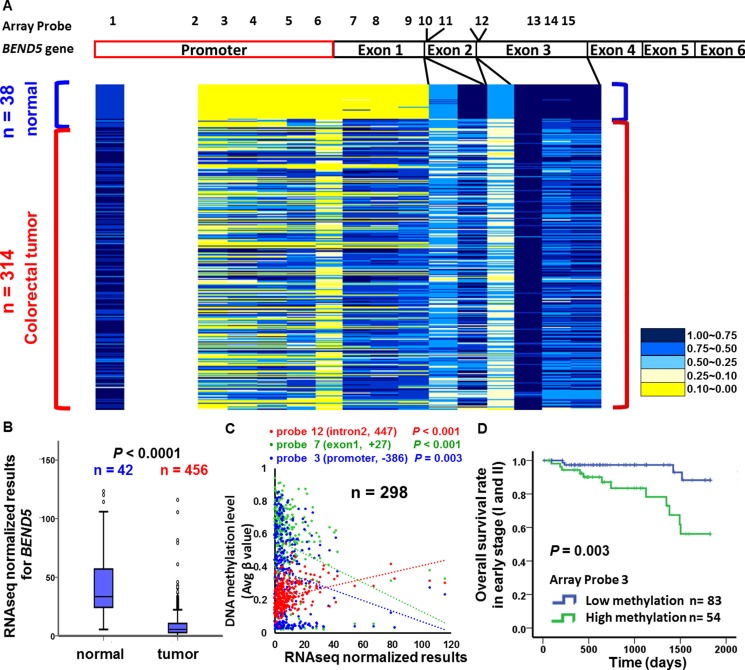
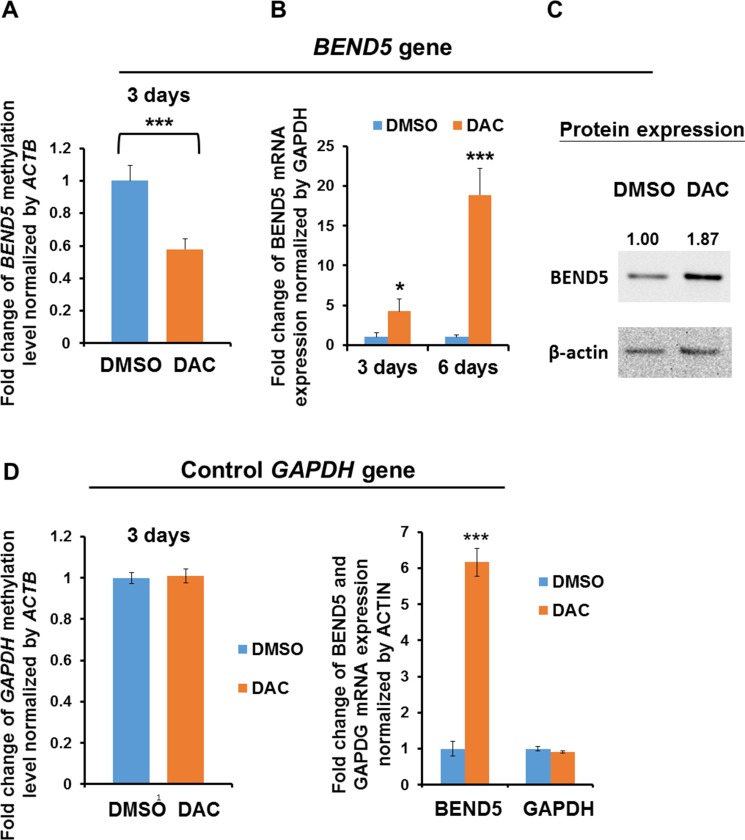
Aberrant hypermethylation of CpG islands in tumor suppressor genes (TSGs) contributes to colorectal tumorigenesis. To identify new colorectal cancer (CRC) screening marker, we investigated DNA methylation alterations in novel TSGs. Using HumanMethylation450 BeadChip arrays, CpG regions in were the most highly methylated among all genomic regions in 26 colorectal tumors compared to paired non-neoplastic tissues from a Taiwan cohort. Therefore, was selected for further analysis. Quantitative methylation-specific real-time PCR revealed that 86.7% (117/135) of CRC patients exhibited hypermethylated . Real-time reverse transcription PCR identified that BEND5 mRNA expression was downregulated in 68% (32/47) of the analyzed samples. hypermethylation was associated with poor overall survival (OS) in Taiwan patients with early-stage CRC ( 0.037). In a CRC tissue set from South Korea, OS was higher in patients with high BEND5 protein expression than in those with low BEND5 protein expression ( 0.037) by using immunohistochemistry assays. Consistently, BEND5 hypermethylation was associated with poor OS in patients with early-stage CRC in The Cancer Genome Atlas (TCGA) data set ( 0.003). Multivariate Cox proportional hazards regression analysis further supported that hypermethylation of BEND5 genes was significantly associated with OS in Taiwan and TCGA CRC patients ( 0.023 and 0.033, respectively). Finally, the cell model assay with transient transfection of BEND5 or si-BEND5 knockdown indicated that BEND5 inhibited cancer cell proliferation. In conclusion, epigenetic alteration in the candidate TSG contributes to colorectal cancer development and is a prognostic marker of CRC.
肿瘤抑制基因(TSGs)中CpG岛的异常高甲基化促进了结直肠癌的发生。为了鉴定新的结直肠癌(CRC)筛查标志物,我们研究了新型TSGs中的DNA甲基化改变。使用HumanMethylation450 BeadChip芯片,与来自台湾队列的配对非肿瘤组织相比,26例结直肠癌肿瘤中所有基因组区域中某区域的CpG区域甲基化程度最高。因此,选择该区域进行进一步分析。定量甲基化特异性实时PCR显示,86.7%(117/135)的CRC患者该区域呈现高甲基化。实时逆转录PCR鉴定出在所分析的样本中,68%(32/47)的样本中BEND5 mRNA表达下调。在台湾早期CRC患者中,该区域高甲基化与总体生存期(OS)较差相关(P = 0.037)。在一组来自韩国的CRC组织中,通过免疫组织化学分析,BEND5蛋白高表达患者的OS高于BEND5蛋白低表达患者(P = 0.037)。同样,在癌症基因组图谱(TCGA)数据集中,早期CRC患者中BEND5高甲基化与OS较差相关(P = 0.003)。多变量Cox比例风险回归分析进一步支持,台湾和TCGA CRC患者中BEND5基因高甲基化与OS显著相关(分别为P = 0.023和P = 0.033)。最后,BEND5瞬时转染或si - BEND5敲低的细胞模型试验表明,BEND5抑制癌细胞增殖。总之,候选TSG中该区域的表观遗传改变促进了结直肠癌的发展,并且是CRC的一个预后标志物。