Department of Chemistry and Biochemistry, Texas Tech University, Lubbock, TX, 79423, USA.
Sci Rep. 2018 Jan 26;8(1):1639. doi: 10.1038/s41598-018-19908-8.
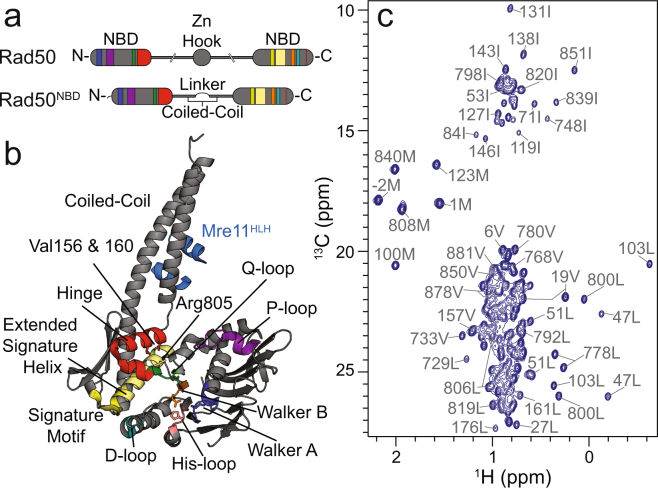
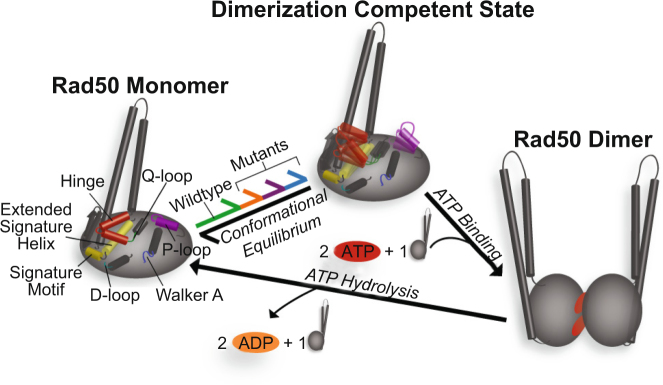
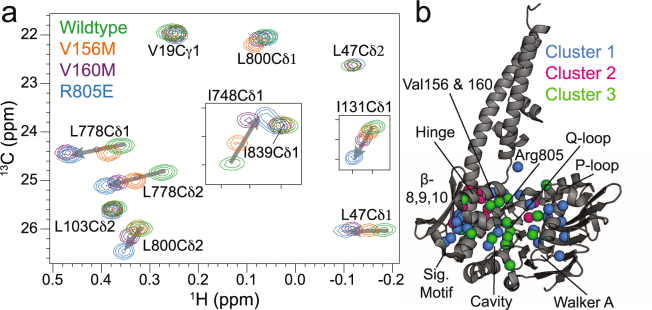
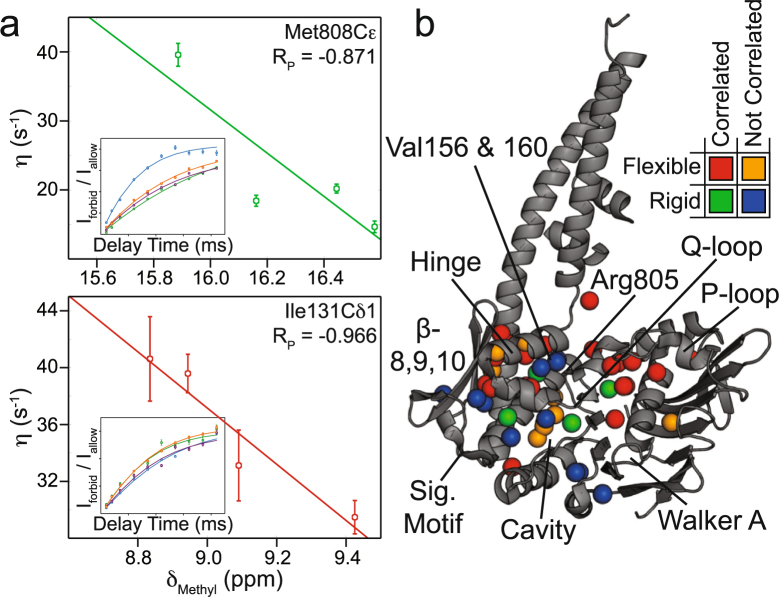
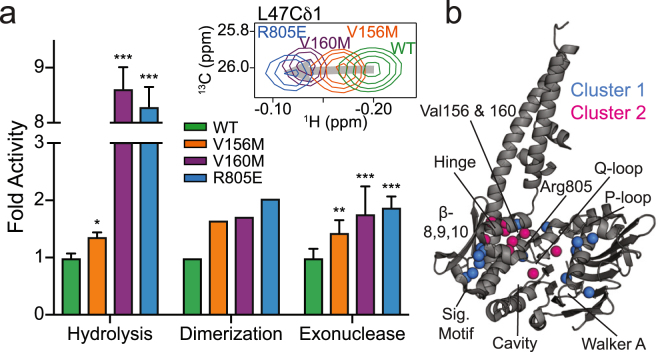
The Mre11-Rad50 protein complex is an initial responder to sites of DNA double strand breaks. Many studies have shown that ATP binding to Rad50 causes global changes to the Mre11-Rad50 structure, which are important for DNA repair functions. Here we used methyl-based NMR spectroscopy on a series of mutants to describe a dynamic allosteric pathway within Rad50. Mutations result in changes in the side chain methyl group chemical environment that are correlated with altered nanosecond timescale dynamics. We also observe striking relationships between the magnitude of chemical shift perturbations and Rad50 and Mre11 activities. Together, these data suggest an equilibrium between a ground state and an "active" dimerization competent state of Rad50 that has locally altered structure and dynamics and is poised for ATP-induced dimerization and eventual ATP hydrolysis. Thus, this sparsely populated intermediate is critical for Mre11-Rad50-directed DNA double strand break repair.
Mre11-Rad50 蛋白复合物是 DNA 双链断裂位点的初始应答者。许多研究表明,ATP 与 Rad50 的结合导致 Mre11-Rad50 结构的全局变化,这对于 DNA 修复功能很重要。在这里,我们使用基于甲基的 NMR 光谱学对一系列突变体进行了描述,以描述 Rad50 内的动态变构途径。突变导致侧链甲基基团化学环境的变化,与改变的纳秒时间尺度动力学相关。我们还观察到化学位移扰动的幅度与 Rad50 和 Mre11 活性之间存在显著关系。这些数据表明,Rad50 处于一个平衡状态,存在一个“活跃”的二聚化能力状态,该状态具有局部改变的结构和动力学,并且能够诱导二聚化和最终的 ATP 水解。因此,这种稀疏分布的中间产物对于 Mre11-Rad50 指导的 DNA 双链断裂修复至关重要。