Cimino Silvia, Cerniglia Luca, Ballarotto Giulia, Marzilli Eleonora, Pascale Esterina, D'Addario Claudio, Adriani Walter, Tambelli Renata
Department of Dynamic and Clinical Psychology, Sapienza University of Rome, Rome, Italy.
Faculty of Psychology, International Telematic University Uninettuno, Rome, Italy.
Front Psychiatry. 2018 Jan 10;8:303. doi: 10.3389/fpsyt.2017.00303. eCollection 2017.
The effect of gene polymorphisms and promoter methylation, associated with maladaptive developmental outcomes, vary depending on environmental factors (e.g., parental psychopathology). Most studies have focused on 0- to 5-year-old children, adolescents, or adults, whereas there is dearth of research on school-age youths and pre-adolescents.
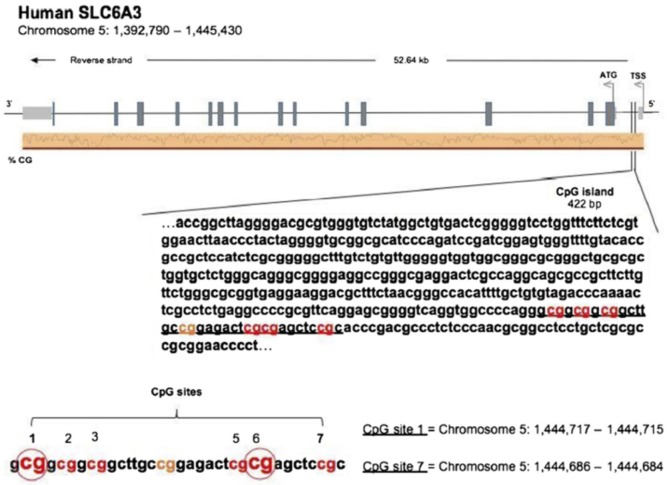
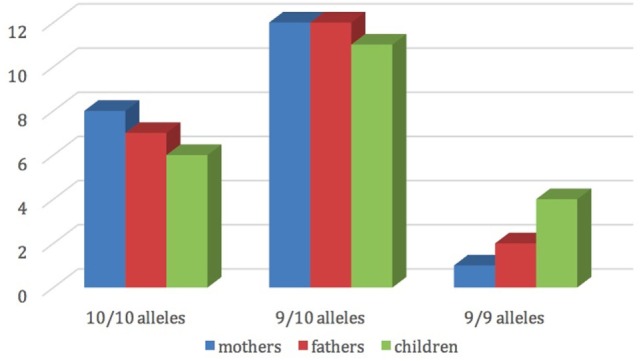
In a sample of 21 families recruited at schools, we addressed parents' psychopathological symptoms (through SCL-90-R); offspring emotional-behavioral functioning (through CBCL-6-18); dopamine transporter gene (DAT1) for epigenetic status of the 5'-untranslated region (UTR) and for genotype, i.e., variable number of tandem repeats polymorphism at the 3'-UTR. Possible associations were explored between bio-genetic and psychological characteristics within the same individual and between triplets of children, mothers, and fathers.
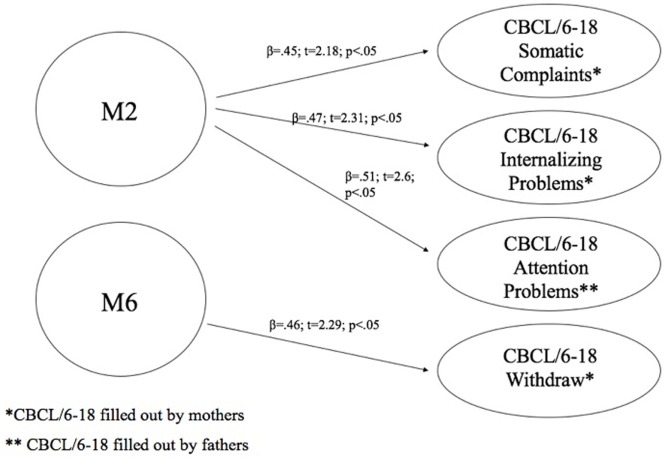
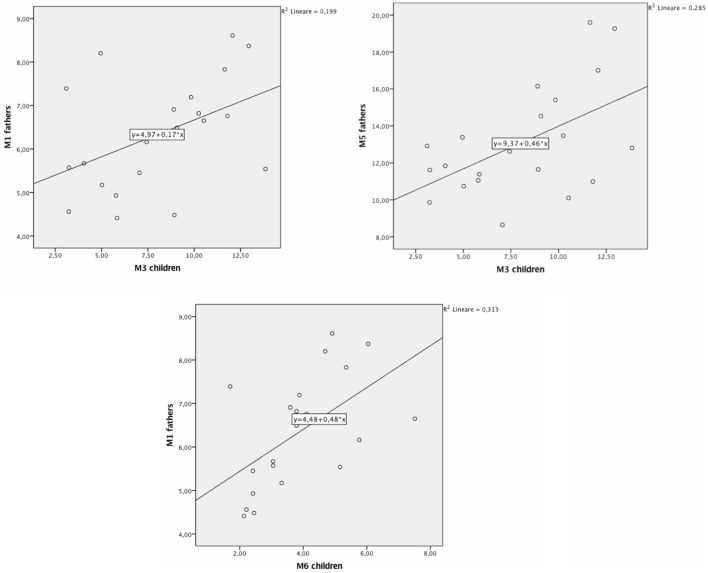
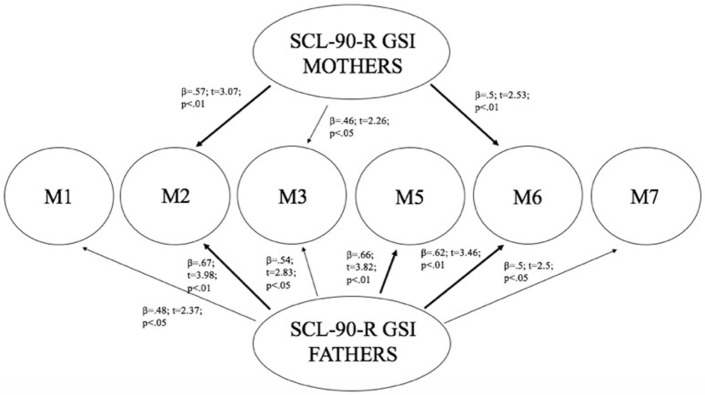
DAT methylation of CpG at positions M1, M6, and M7 in mothers was correlated with maternal (phobic) anxiety, whereas in fathers' position M6 was related to paternal depression, anxiety, hostility, psychoticism, and higher Global Severity Index (GSI). No significant correlations were found between maternal and offspring DAT methylation. Significant correlations were found between fathers' methylation at CpG M1 and children's methylation at CpG M6. Linear regressions showed that mothers and fathers' GSI predicted children's methylation at CpG sites M2, M3, and M6, whereas fathers' GSI predicted children's methylation at CpG sites, particularly M1, M2, and M6. Moreover, offspring methylation of DAT at CpG M2 predicted somatic complaint, internalizing and attention problems; methylation of DAT at CpG M6 predicted withdraw.
This study may have important clinical implication for the prevention and treatment of emotional-behavioral difficulties in children, as it adds to previous knowledge about the role of genetic and environmental factors in predicting psychopathological symptoms within non-clinical populations.
与适应不良的发育结果相关的基因多态性和启动子甲基化的影响因环境因素(如父母的精神病理学)而异。大多数研究集中在0至5岁的儿童、青少年或成年人身上,而对学龄青年和青春期前儿童的研究较少。
在从学校招募的21个家庭的样本中,我们评估了父母的心理病理症状(通过SCL-90-R);后代的情绪行为功能(通过CBCL-6-18);多巴胺转运体基因(DAT1)的5'-非翻译区(UTR)的表观遗传状态和基因型,即3'-UTR处的串联重复多态性可变数目。探讨了同一个体内生物遗传特征与心理特征之间以及儿童、母亲和父亲三联体之间可能的关联。
母亲中M1、M6和M7位点的CpG的DAT甲基化与母亲的(恐惧)焦虑相关,而在父亲中,M6位点与父亲的抑郁、焦虑、敌意、精神病性和更高的总体严重程度指数(GSI)相关。未发现母亲和后代DAT甲基化之间存在显著相关性。发现父亲在CpG M1处的甲基化与儿童在CpG M6处的甲基化之间存在显著相关性。线性回归表明,母亲和父亲的GSI预测了儿童在CpG位点M2、M3和M6处的甲基化,而父亲的GSI预测了儿童在CpG位点,特别是M1、M2和M6处的甲基化。此外,后代在CpG M2处的DAT甲基化预测了躯体主诉、内化和注意力问题;在CpG M6处的DAT甲基化预测了退缩。
本研究可能对儿童情绪行为障碍的预防和治疗具有重要的临床意义,因为它增加了先前关于遗传和环境因素在预测非临床人群心理病理症状中的作用的知识。