Cherkaoui Abdessalam, Diene Seydina M, Fischer Adrien, Leo Stefano, François Patrice, Schrenzel Jacques
Bacteriology Laboratory, Division of Laboratory Medicine, Department of Genetics and Laboratory Medicine, Geneva University Hospitals, Geneva, Switzerland.
Genomic Research Laboratory, Division of Infectious Diseases, Geneva University Hospitals, Geneva, Switzerland.
Front Microbiol. 2018 Jan 12;8:2676. doi: 10.3389/fmicb.2017.02676. eCollection 2017.
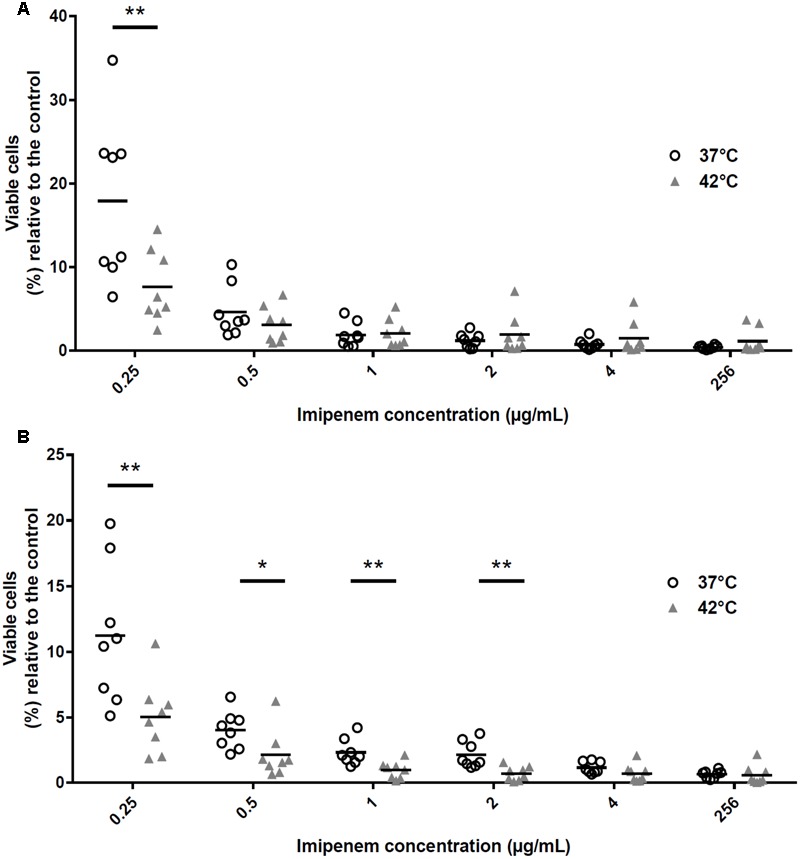
The purpose of the present study was to investigate the penicillin binding proteins (PBPs), drug influx and efflux modulations during heat stress and their effects on the bactericidal action of imipenem on non-typeable (NTHi). The two NTHi clinical isolates (GE47 and GE88, imipenem MICs by E-test > 32 μg/mL) examined in this study were collected at Geneva University Hospitals. The imipenem killing activity was assessed after incubation of the NTHi strains at either 37 or 42°C for 3 h with increasing concentrations of imipenem. The detection of PBPs was carried out by Bocillin-FL. Global transcriptional changes were monitored by RNA-seq after pre-incubation of bacterial cells at either 37 or 42°C, and the expression levels of relevant target genes were confirmed by qRT-PCR. Quantitation of NTHi viable cells after incubation with 0.25 μg/mL of imipenem for 3 h revealed more than a twofold decrease in GE47 and GE88 viable cells at 42°C as compared to 37°C. Transcriptome analysis showed that under heat stress conditions, there were 141 differentially expressed genes with a | log2(fold change)| > 1, including 67 up-regulated and 74 down-regulated genes. The expression levels of (encoding PBP1b) and (regulator of AcrAB-TolC efflux pump) were significantly increased at 42°C. In contrast, the transcript levels of (encoding the outer membrane protein P2) and (encoding AcrB) were significantly lower under heat stress condition. This study shows that the transcriptional modulation of , and in the heat stress response is correlated to enhanced antimicrobial effects of imipenem on non-typeable .
本研究的目的是调查热应激期间的青霉素结合蛋白(PBPs)、药物流入和流出调节及其对亚胺培南对不可分型(NTHi)细菌杀菌作用的影响。本研究中检测的两株NTHi临床分离株(GE47和GE88,E-test法测定的亚胺培南MIC>32μg/mL)是在日内瓦大学医院收集的。在37或42°C下将NTHi菌株与浓度不断增加的亚胺培南孵育3小时后,评估亚胺培南的杀菌活性。通过Bocillin-FL检测PBPs。在37或42°C对细菌细胞进行预孵育后,通过RNA测序监测全局转录变化,并通过qRT-PCR确认相关靶基因的表达水平。用0.25μg/mL亚胺培南孵育3小时后对NTHi活菌进行定量分析,结果显示,与37°C相比,42°C时GE47和GE88活菌数量减少了两倍多。转录组分析表明,在热应激条件下,有141个差异表达基因,|log2(倍数变化)|>1,其中包括67个上调基因和74个下调基因。在42°C时,(编码PBP1b)和(AcrAB-TolC外排泵的调节因子)的表达水平显著增加。相反,在热应激条件下,(编码外膜蛋白P2)和(编码AcrB)的转录水平显著降低。本研究表明,热应激反应中、和的转录调节与亚胺培南对不可分型细菌抗菌作用增强相关。