Yildirim Duzgun, Alis Deniz, Bakir Alev, Ustabasioglu Fethi E, Samanci Cesur, Colakoglu Bulent
Department of Radiology, Acibadem Taksim Hospital, Istanbul, Turkey.
Department of Radiology, Cerrahpasa Faculty of Medicine, Istanbul University, Istanbul, Turkey.
Indian J Radiol Imaging. 2017 Oct-Dec;27(4):463-469. doi: 10.4103/ijri.IJRI_409_16.
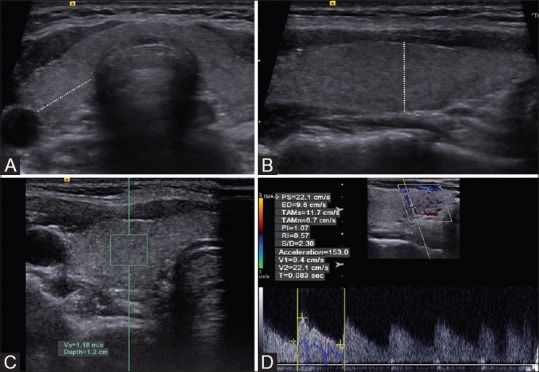
Differential diagnosis of parenchymal thyroid diseases by gray-scale ultrasound is quite difficult for a radiologist as the findings are very similar to each other. In this study we aimed to assess some quantitative spectral Doppler parameters, resistivity index (RI), acceleration time (AT), and quantitative elastography [shear wave velocity (SWV)] together to show their reliability for differential diagnosis of parenchymal thyroid diseases.
We retrospectively reviewed findings of 227 patients (179 females, 48 males) that underwent spectral Doppler ultrasound and acoustic radiation force impulse between October 2013 and March 2016. Ages of the patients were between 18 and 74 years (39.52 ± 12.67). Based on clinical and laboratory findings, patients were divided into five groups (N: Normal, EH: Early Hashimoto, H: Late Hashimoto, M: Nodular Thyroid Disease, HM: Hashimoto + Nodular Thyroid Disease). Detailed statistical analyses were done on parameters such as age, gender, volume information, and RI, AT (ms), SWV (m/s).
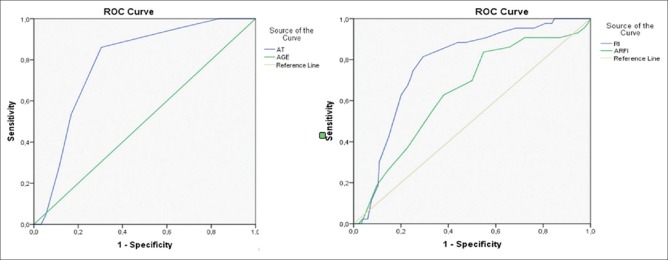
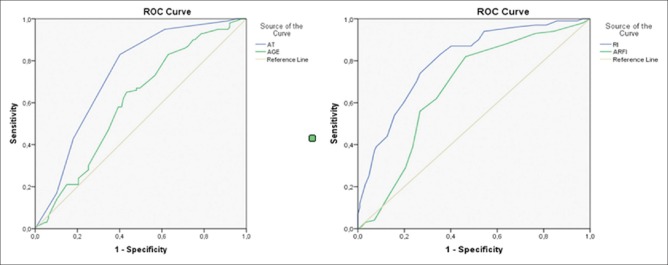
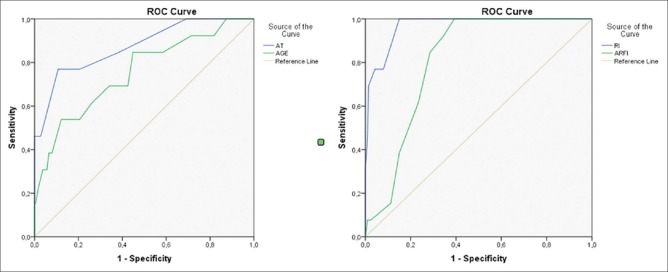
No significant effect of gender or volume on the differentiation of disease pattern (Chi-square test: = 0.306, Kruskal-Wallis test: = 0.290) was found in this study. RI (0.41 ± 0.06) and SWV values (1.19 ± 0.18 m/s) were the lowest. AT values (>55 ms) were the highest in EH group (area under the curve: 0.913). Existence of H decreased RI and SWV values, while it extended AT in a different thyroid disease.
Thyroid parenchymal diseases could be classified and differentiated from each other by measuring RI, AT, and SWV values quantitatively. So, in suspicious cases, these parameters could be a reliable asset for differential diagnosis.
对于放射科医生而言,通过灰阶超声对甲状腺实质疾病进行鉴别诊断颇具难度,因为其表现彼此非常相似。在本研究中,我们旨在综合评估一些定量频谱多普勒参数、阻力指数(RI)、加速时间(AT)以及定量弹性成像[剪切波速度(SWV)],以展示它们在甲状腺实质疾病鉴别诊断中的可靠性。
我们回顾性分析了2013年10月至2016年3月期间接受频谱多普勒超声和声学辐射力脉冲检查的227例患者(179例女性,48例男性)的检查结果。患者年龄在18至74岁之间(39.52±12.67)。根据临床和实验室检查结果,患者被分为五组(N:正常,EH:早期桥本氏病,H:晚期桥本氏病,M:结节性甲状腺疾病,HM:桥本氏病+结节性甲状腺疾病)。对年龄、性别、体积信息以及RI、AT(毫秒)、SWV(米/秒)等参数进行了详细的统计分析。
本研究未发现性别或体积对疾病模式分化有显著影响(卡方检验:=0.306,克鲁斯卡尔-沃利斯检验:=0.290)。RI(0.41±0.06)和SWV值(1.19±0.18米/秒)最低。EH组的AT值(>55毫秒)最高(曲线下面积:0.913)。在不同的甲状腺疾病中,桥本氏病的存在会降低RI和SWV值,同时延长AT。
通过定量测量RI、AT和SWV值,可以对甲状腺实质疾病进行分类和相互鉴别。因此,在可疑病例中,这些参数可能是鉴别诊断的可靠依据。