Department of Physiological Chemistry, University of Veterinary Medicine Hannover, 30559 Hannover, Germany.
Department of Biochemistry and Chemistry of Nutrition, Faculty of Veterinary Medicine, Cairo University, Giza 12211, Egypt.
Int J Mol Sci. 2018 Jan 30;19(2):402. doi: 10.3390/ijms19020402.
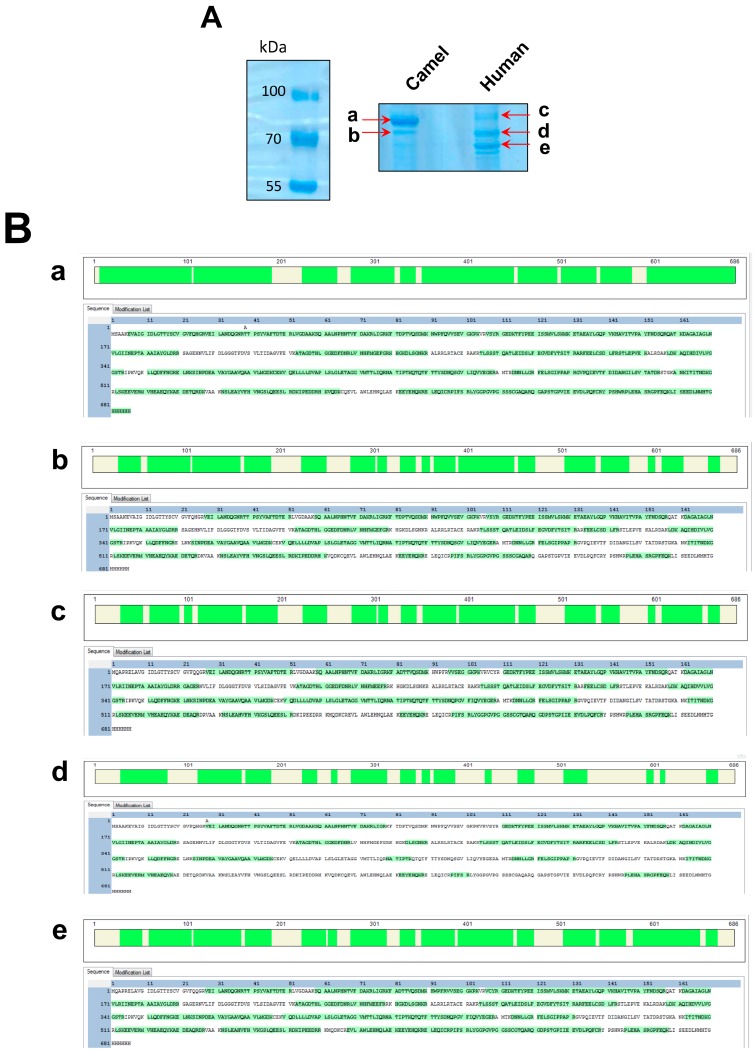
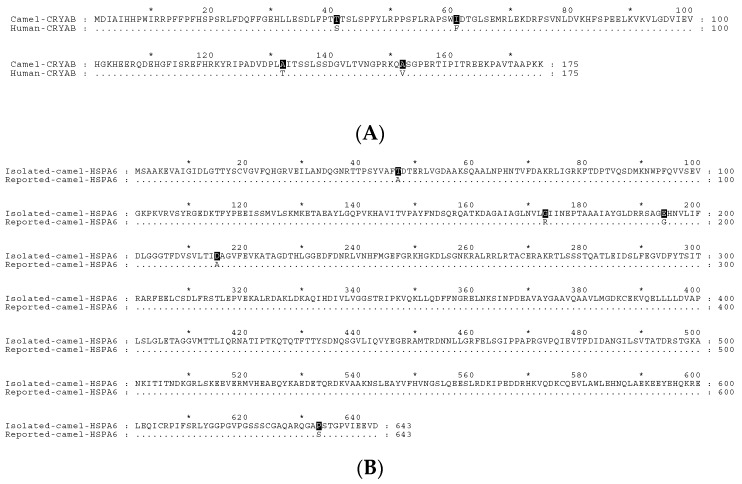
Increased expression of heat shock proteins (HSPs) following heat stress or other stress conditions is a common physiological response in almost all living organisms. Modification of cytosolic proteins including HSPs by -GlcNAc has been shown to enhance their capabilities for counteracting lethal levels of cellular stress. Since HSPs are key players in stress resistance and protein homeostasis, we aimed to analyze their forms at the cellular and molecular level using camel and human HSPs as models for efficient and moderate thermotolerant mammals, respectively. In this study, we cloned the cDNA encoding two inducible HSP members, HSPA6 and CRYAB from both camel () and human in a Myc-tagged mammalian expression vector. Expression of these chaperones in COS-1 cells revealed protein bands of approximately 25-kDa for both camel and human CRYAB and 70-kDa for camel HSPA6 and its human homologue. While localization and trafficking of the camel and human HSPs revealed similar cytosolic localization, we could demonstrate altered glycan structure between camel and human HSPA6. Interestingly, the glycoform of camel HSPA6 was rapidly formed and stabilized under normal and stress culture conditions whereas human HSPA6 reacted differently under similar thermal and hypoxic stress conditions. Our data suggest that efficient glycosylation of camel HSPA6 is among the mechanisms that provide camelids with a superior capability for alleviating stressful environmental circumstances.
在热应激或其他应激条件下,热休克蛋白(HSPs)的表达增加是几乎所有生物的常见生理反应。已经表明,通过 -GlcNAc 对细胞质蛋白(包括 HSPs)进行修饰可以增强它们抵抗细胞应激致死水平的能力。由于 HSPs 是应激抗性和蛋白质动态平衡的关键参与者,我们旨在使用骆驼和人类 HSPs 分别作为高效和适度耐热哺乳动物的模型,在细胞和分子水平上分析它们的形式。在这项研究中,我们在 Myc 标记的哺乳动物表达载体中从骆驼()和人类中克隆了编码两种诱导型 HSP 成员 HSPA6 和 CRYAB 的 cDNA。在 COS-1 细胞中表达这些伴侣蛋白时,发现骆驼和人类 CRYAB 的蛋白条带约为 25-kDa,骆驼 HSPA6 及其人类同源物的蛋白条带约为 70-kDa。虽然骆驼和人类 HSPs 的定位和运输显示出类似的细胞质定位,但我们可以证明骆驼和人类 HSPA6 之间的糖基化结构发生了改变。有趣的是,骆驼 HSPA6 的糖基化形式在正常和应激培养条件下迅速形成并稳定,而人类 HSPA6 在类似的热和缺氧应激条件下反应不同。我们的数据表明,骆驼 HSPA6 的有效糖基化是骆驼科动物缓解应激环境的能力优越的机制之一。