Zhao Ren Ru, O'Sullivan Anthony J, Fiatarone Singh Maria A
1Exercise, Health, and Performance Research Group, Faculty of Health Sciences, University of Sydney, Lidcombe, NSW 2141 Australia.
4Clinical Rehabilitation Centre, University of Longyan, Longyan, Fujian Province 364012 China.
Eur Rev Aging Phys Act. 2018 Jan 22;15:1. doi: 10.1186/s11556-018-0190-1. eCollection 2018.
Diabetes is an important risk factor for cognitive impairment. Although some studies suggest that physical exercise can minimize age-related cognitive declines or improve brain morphology or function, benefits in diabetes or impaired glucose tolerance are unclear. Therefore, our aim was to evaluate the efficacy of exercise or physical activity on cognition in adults with type 2 diabetes, insulin resistance or impaired glucose tolerance.
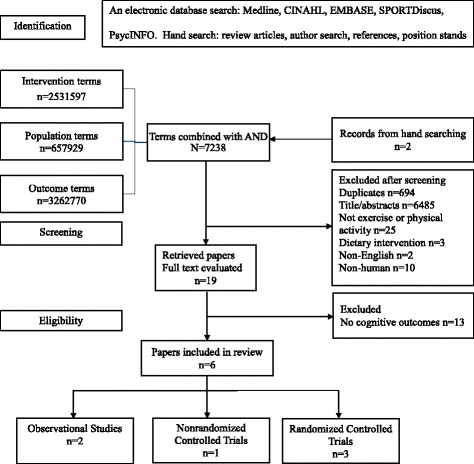
An electronic search for studies published from the earliest record until February 2017 was conducted using Medline, EMBASE, SPORTDiscus, CINAHL, and PsycINFO. Any experimental or observational study designs were included, as long as they were conducted in individuals of any age with type 2 diabetes, insulin resistance or impaired glucose tolerance, and they directly examined exercise/physical activity effects on cognitive outcomes or the relationship between changes in cognition and changes in either insulin resistance and glucose homeostasis. Study quality was assessed using the PEDro scale; data on participant and intervention characteristics and outcomes were extracted.
Six studies enrolling 2289 participants met the eligibility criteria. Quality was modest and effect sizes variable and mostly small or negligible. Overall, four of the six studies (67%) reported significant benefits of greater exercise/physical activity participation for some aspects of cognition, but only 26% of cognitive outcomes were significant across all trials. Clinical improvements in insulin resistance/glucose homeostasis were related to improvements in cognitive function in three studies. Overall results were inconsistent, with benefits varying across exercise types and cognitive domains.
Literature does not provide evidence that physical activity or exercise interventions contribute to a better cognitive function in patients with type 2 diabetes or impaired glucose tolerance. Large-scale, long-term, robust randomized controlled trials are required to determine if exercise improves cognition in this high-risk cohort, and to investigate putative mechanistic links between cognition, body composition, metabolism, and inflammation in diabetes and related metabolic syndromes.
糖尿病是认知障碍的一个重要危险因素。尽管一些研究表明体育锻炼可以将与年龄相关的认知衰退降至最低程度,或改善大脑形态或功能,但对于糖尿病或糖耐量受损者的益处尚不清楚。因此,我们的目的是评估运动或体育活动对2型糖尿病、胰岛素抵抗或糖耐量受损的成年人认知功能的疗效。
利用Medline、EMBASE、SPORTDiscus、CINAHL和PsycINFO对从最早记录到2017年2月发表的研究进行电子检索。纳入任何实验性或观察性研究设计,只要其针对任何年龄的2型糖尿病、胰岛素抵抗或糖耐量受损个体进行,并且直接研究运动/体育活动对认知结果的影响,或认知变化与胰岛素抵抗和葡萄糖稳态变化之间的关系。使用PEDro量表评估研究质量;提取关于参与者、干预特征和结果的数据。
六项纳入2289名参与者的研究符合纳入标准。质量一般,效应大小各异,大多较小或可忽略不计。总体而言,六项研究中的四项(67%)报告称,更多地参与运动/体育活动对某些认知方面有显著益处,但在所有试验中,只有26%的认知结果具有显著性。三项研究中胰岛素抵抗/葡萄糖稳态的临床改善与认知功能改善相关。总体结果不一致,益处因运动类型和认知领域而异。
文献未提供证据表明体育活动或运动干预对2型糖尿病或糖耐量受损患者的认知功能有改善作用。需要大规模、长期、有力的随机对照试验来确定运动是否能改善这一高危人群的认知,并研究糖尿病及相关代谢综合征中认知、身体成分、代谢和炎症之间的假定机制联系。