Fedele Shahana, Arnold Myrtha, Krieger Jean-Philippe, Wolfstädter Bernd, Meyer Urs, Langhans Wolfgang, Mansouri Abdelhak
Physiology and Behavior Laboratory, ETH Zurich, Schwerzenbach, Switzerland.
Laboratorium für Organische Chemie, ETH Zurich, Zürich, Switzerland.
Physiol Rep. 2018 Feb;6(3). doi: 10.14814/phy2.13517.
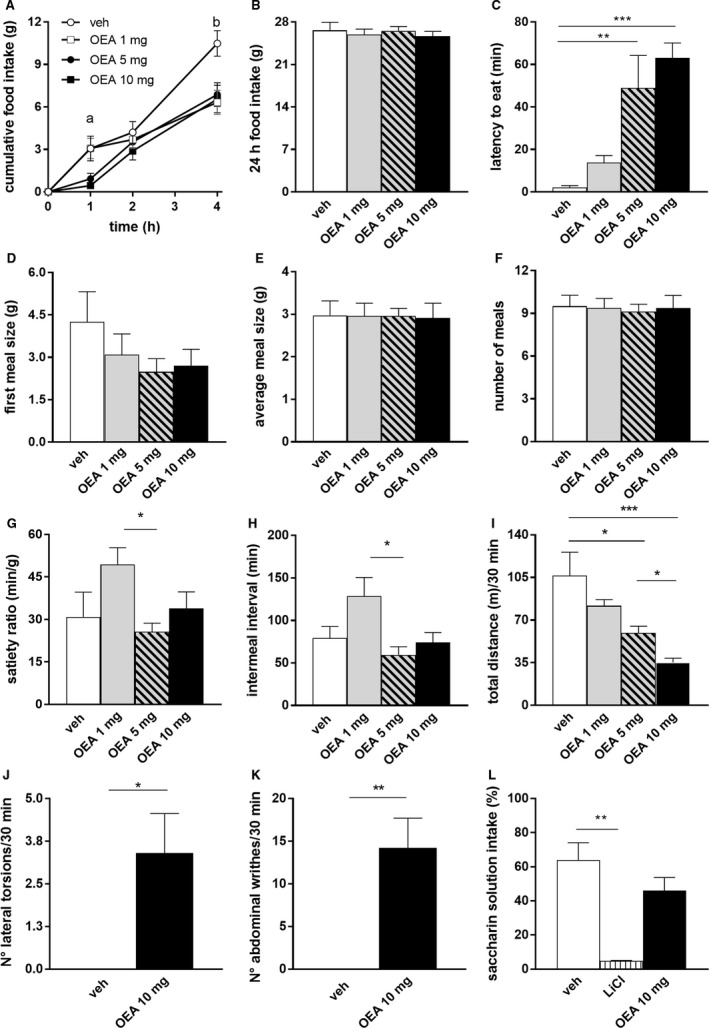
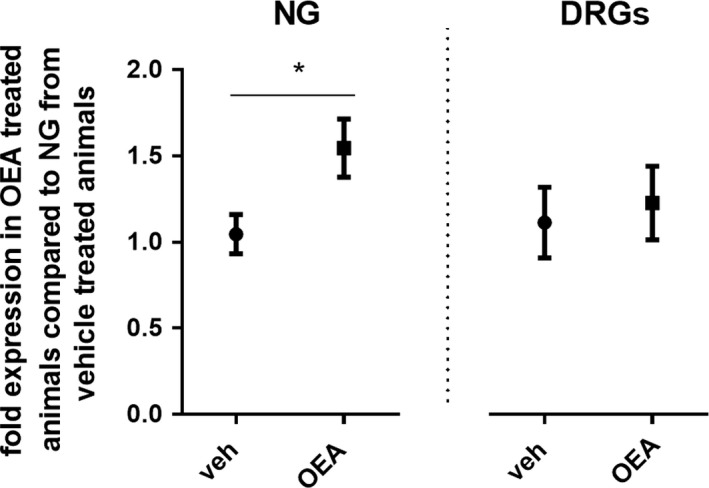
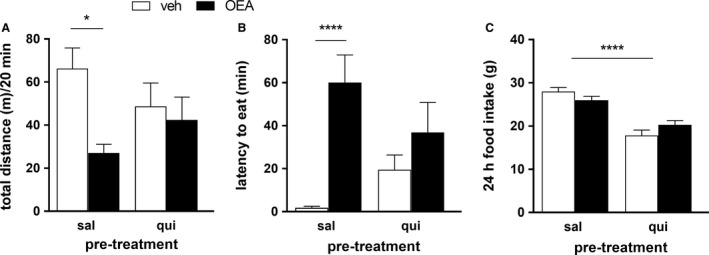
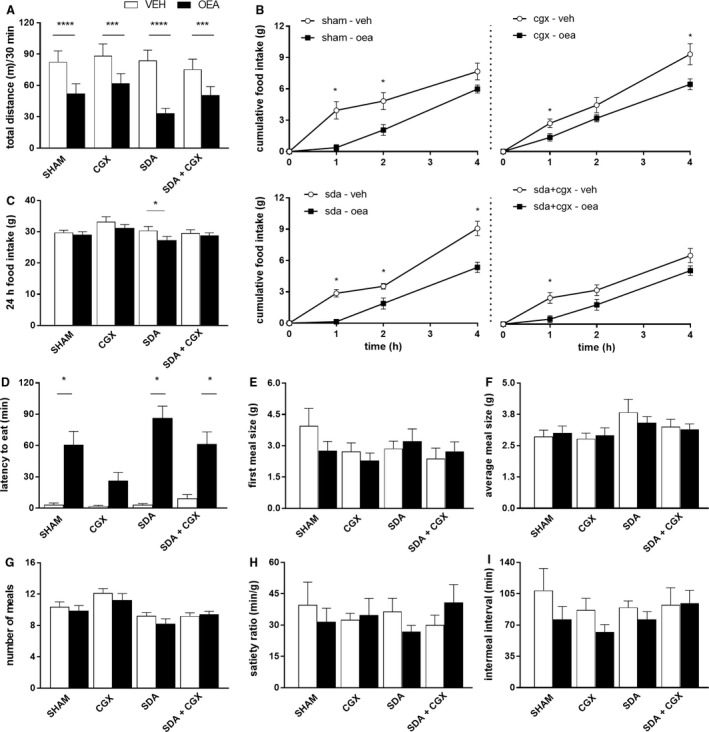
The endogenous peroxisome proliferator-activated receptor alpha (PPAR-α) agonist Oleoylethanolamide (OEA) inhibits eating in rodents, mainly by delaying the onset of meals. The underlying mechanisms of OEA-induced anorexia, however, remain unclear. Animals treated with high OEA doses were shown to display signs of discomfort and impaired locomotion. Therefore, we first examined whether the impaired locomotion may contribute to OEA's anorectic effect. Second, it is controversial whether abdominal vagal afferents are necessary for OEA's anorectic effect. Thus, we explored alternative peripheral neural pathways mediating IP OEA's anorectic effect by performing a celiac-superior mesenteric ganglionectomy (CGX) or a subdiaphragmatic vagal deafferentation (SDA) alone or in combination. Exogenously administered OEA at a commonly used dose (10 mg/kg BW, IP) concurrently reduced food intake and compromised locomotor activity. Attempts to dissociate both phenomena using the dopamine D2/D3 receptor agonist Quinpirole (1 mg/kg BW, SC) failed because Quinpirole antagonized both, OEA-induced locomotor impairment and delay in eating onset. CGX attenuated the prolongation of the latency to eat by IP OEA, but neither SDA nor CGX prevented IP OEA-induced locomotor impairment. Our results indicate that IP OEA's anorectic effect may be secondary to impaired locomotion rather than due to physiological satiety. They further confirm that vagal afferents do not mediate exogenous OEA's anorectic effects, but suggest a role for spinal afferents in addition to an alternative, nonneuronal signaling route.
内源性过氧化物酶体增殖物激活受体α(PPAR-α)激动剂油酰乙醇胺(OEA)可抑制啮齿动物进食,主要是通过延迟进食开始时间。然而,OEA诱导厌食的潜在机制仍不清楚。高剂量OEA处理的动物表现出不适和运动障碍迹象。因此,我们首先研究运动障碍是否可能导致OEA的厌食作用。其次,腹腔迷走神经传入纤维对于OEA的厌食作用是否必要存在争议。因此,我们通过单独或联合进行腹腔-肠系膜上神经节切除术(CGX)或膈下迷走神经去传入术(SDA),探索介导腹腔注射OEA厌食作用的其他外周神经通路。以常用剂量(10 mg/kg体重,腹腔注射)外源性给予OEA可同时减少食物摄入量并损害运动活性。使用多巴胺D2/D3受体激动剂喹吡罗(1 mg/kg体重,皮下注射)来区分这两种现象的尝试失败了,因为喹吡罗同时拮抗了OEA诱导的运动障碍和进食开始延迟。CGX减弱了腹腔注射OEA导致的进食潜伏期延长,但SDA和CGX均未预防腹腔注射OEA诱导的运动障碍。我们的结果表明,腹腔注射OEA的厌食作用可能继发于运动障碍而非生理饱腹感。结果进一步证实迷走神经传入纤维不介导外源性OEA的厌食作用,但提示除了一条替代的非神经元信号通路外,脊髓传入纤维也发挥作用。