Zhang Liyong, Xiong Wei, Peng Yuming, Zhang Wei, Han Ruquan
Department of Anesthesiology, Beijing Tiantan Hospital, Capital Medical University, No. 6, Tiantan Xili, Dongcheng District, Beijing, 100050, People's Republic of China.
Trials. 2018 Feb 2;19(1):85. doi: 10.1186/s13063-018-2447-4.
Ventilator-induced lung injury is a major cause of postoperative pulmonary complications (PPCs) in patients undergoing neurosurgery after general anesthesia. However, there is no study on the effect of a lung-protective ventilation strategy in patients undergoing neurosurgery.
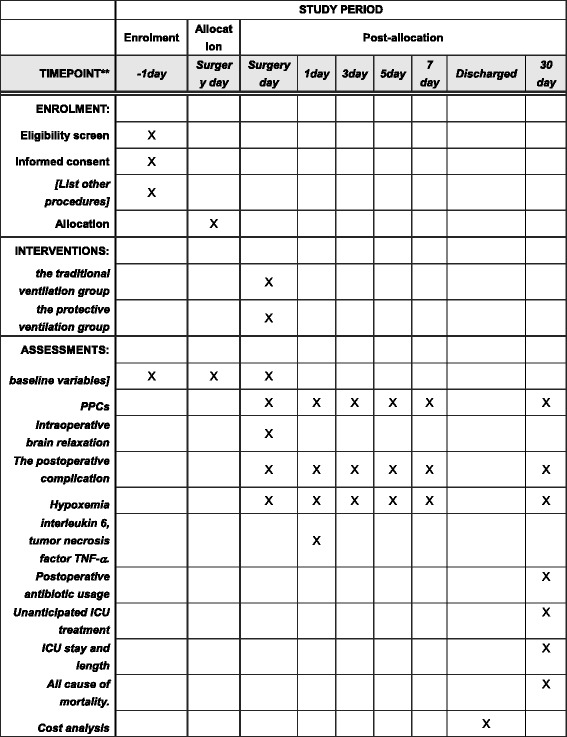
This is a single-center, randomized, parallel-group controlled trial which will be carried out at Beijing Tiantan Hospital, Capital Medical University. Three hundred and thirty-four patients undergoing intracranial tumor surgery will be randomly allocated to the control group and the protective-ventilation strategy group. In the control group, tidal volume (VT) will be set at 10-12 ml/kg of predicted body weight but PEEP and recruitment maneuvers will not be used. In the protective group, VT will be set at 6-8 ml/kg of predicted body weight, PEEP at 6-8 cmHO, and a recruitment maneuver will be used intermittently. The primary outcome is pulmonary complications within 7 days postoperatively. Secondary outcomes include intraoperative brain relaxation, the postoperative complications within 30 days and the cost analysis.
This study aims to determine if the protective, pulmonary-ventilation strategy decreases the incidence of PPCs in patients undergoing neurosurgical anesthesia. If our results are positive, the study will indicate whether the protective, pulmonary-ventilation strategy is efficiently and safely used in neurosurgical patients undergoing the craniotomy.
ClinicalTrials.gov, ID: NCT02386683 . Registered on 18 October 2014.
呼吸机相关性肺损伤是全身麻醉后神经外科手术患者术后肺部并发症(PPCs)的主要原因。然而,尚无关于肺保护性通气策略对神经外科手术患者影响的研究。
这是一项将在北京天坛医院开展的单中心、随机、平行组对照试验。334例颅内肿瘤手术患者将被随机分配至对照组和肺保护性通气策略组。对照组中,潮气量(VT)将设定为预测体重的10 - 12 ml/kg,但不使用呼气末正压通气(PEEP)和肺复张手法。在肺保护性通气策略组中,VT将设定为预测体重的6 - 8 ml/kg,PEEP设定为6 - 8 cmH₂O,并间歇性使用肺复张手法。主要结局是术后7天内的肺部并发症。次要结局包括术中脑松弛情况、30天内的术后并发症以及成本分析。
本研究旨在确定肺保护性通气策略是否能降低神经外科麻醉患者的PPCs发生率。如果我们的结果是阳性的,该研究将表明肺保护性通气策略在接受开颅手术的神经外科患者中是否能有效且安全地使用。
ClinicalTrials.gov,标识符:NCT02386683。于2014年10月18日注册。