Zhao Yang, Liu Zhongfen, Zhang Hu
Department of Cardiology, The First People's Hospital of Jinan, Jinan, Shandong 250000, P.R. China.
Department of Emergency Medical, The People's Hospital of Zhangqiu, Zhangqiu, Shandong 250200, P.R. China.
Exp Ther Med. 2018 Feb;15(2):1505-1509. doi: 10.3892/etm.2017.5535. Epub 2017 Nov 21.
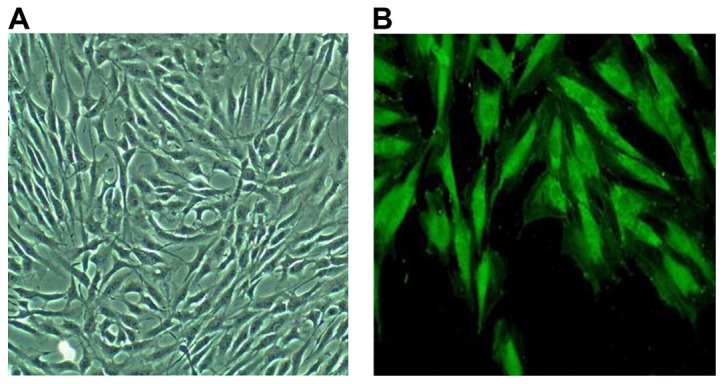
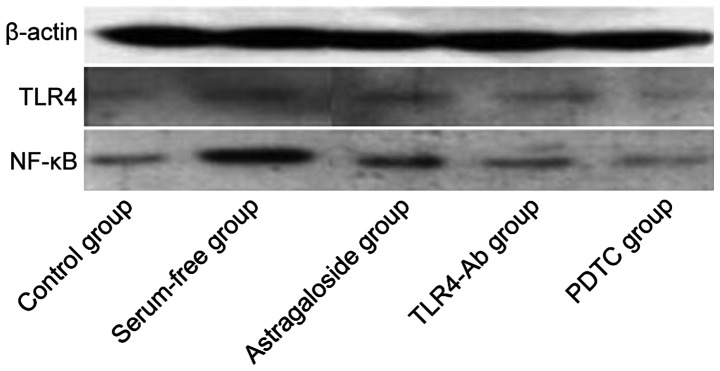
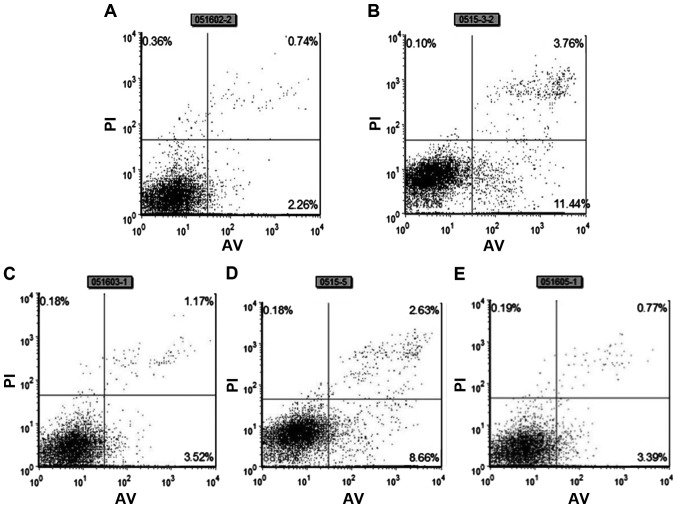
Astragaloside is a monomer isolated from , a flowering plant in the family Fabaceae. The aim of the present study was to investigate the anti-apoptotic affect of astragaloside on myocardial cells through the TLR4/NF-κB signaling pathway. Astragaloside, NF-κB inhibitor pyrrolidine dithiocarbamate (PDTC) and Toll-like receptor 4 (TLR4) blocking antibody solution were prepared , and myocardial cells were incubated and cultured in serum-free medium overnight. Cells were divided into five groups: the normal control group, serum-free group, astragaloside group, TLR4 blocking antibody group and NF-κB inhibitor PDTC group. The myocardial cell apoptosis in each group was detected using flow cytometry, and the expression levels of TLR4 and NF-κB were detected via western blotting. The apoptosis rate in the serum-free group was significantly higher than that in the normal control group. The apoptosis rate of myocardial cells in the TLR4 blocking antibody group and NF-κB inhibitor PDTC group was lower than that in the serum-free group. In addition, the myocardial cell apoptosis was more obviously decreased in the astragaloside group, and the protein expression levels of TLR4 and NF-κB in the serum-free group were significantly higher than those in normal control group. The protein expression levels of TLR4 and NF-κB in the astragaloside group were obviously lower than those in the serum-free group, and the protein expression levels of TLR4 and NF-κB in the TLR4 blocking antibody group and NF-κB inhibitor PDTC group were decreased. In conclusion, astragaloside reduced myocardial cell apoptosis and protected myocardial cells, which may be one of the mechanisms of a traditional Chinese medicine monomer in treating heart failure.
黄芪甲苷是从豆科开花植物中分离出的一种单体。本研究的目的是通过TLR4/NF-κB信号通路研究黄芪甲苷对心肌细胞的抗凋亡作用。制备了黄芪甲苷、NF-κB抑制剂吡咯烷二硫代氨基甲酸盐(PDTC)和Toll样受体4(TLR4)阻断抗体溶液,并将心肌细胞在无血清培养基中孵育培养过夜。细胞分为五组:正常对照组、无血清组、黄芪甲苷组、TLR4阻断抗体组和NF-κB抑制剂PDTC组。采用流式细胞术检测各组心肌细胞凋亡情况,通过蛋白质印迹法检测TLR4和NF-κB的表达水平。无血清组的凋亡率显著高于正常对照组。TLR4阻断抗体组和NF-κB抑制剂PDTC组心肌细胞的凋亡率低于无血清组。此外,黄芪甲苷组心肌细胞凋亡明显减少,无血清组TLR4和NF-κB的蛋白表达水平显著高于正常对照组。黄芪甲苷组TLR4和NF-κB的蛋白表达水平明显低于无血清组,TLR4阻断抗体组和NF-κB抑制剂PDTC组TLR4和NF-κB的蛋白表达水平降低。综上所述,黄芪甲苷可减少心肌细胞凋亡,保护心肌细胞,这可能是中药单体治疗心力衰竭的机制之一。