Gupta Nidhi, Gopal Keshav, Wu Chengsheng, Alshareef Abdulraheem, Chow Alexandra, Wu Fang, Wang Peng, Ye Xiaoxia, Bigras Gilbert, Lai Raymond
Department of Laboratory Medicine and Pathology, Cross Cancer Institute, University of Alberta, 11560 University Avenue, Edmonton, AB T6G 1Z2, Canada.
Department of Oncology, University of Alberta, Edmonton, AB T6G 1Z2, Canada.
Cancers (Basel). 2018 Feb 3;10(2):41. doi: 10.3390/cancers10020041.
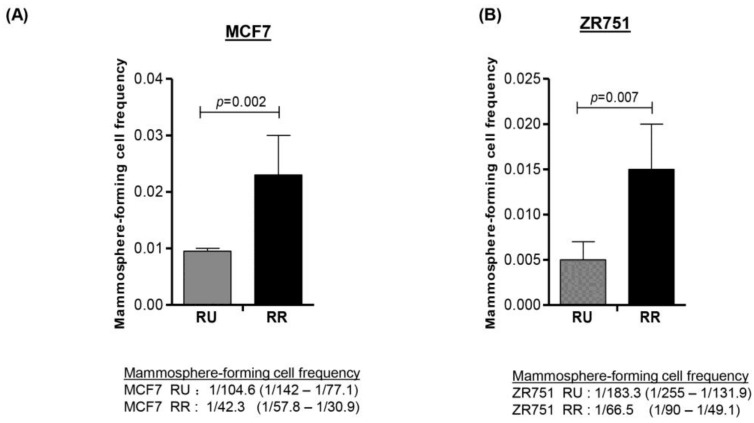
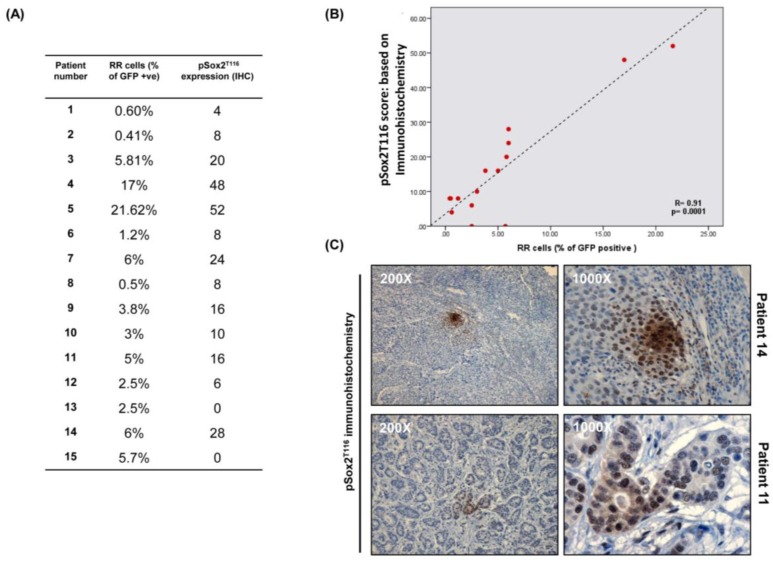
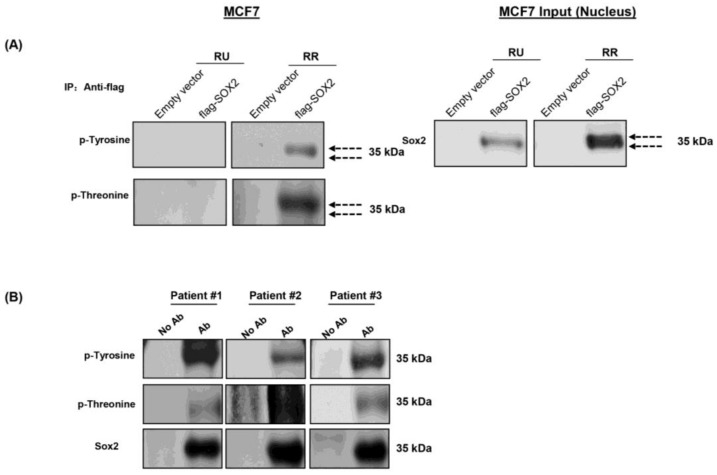
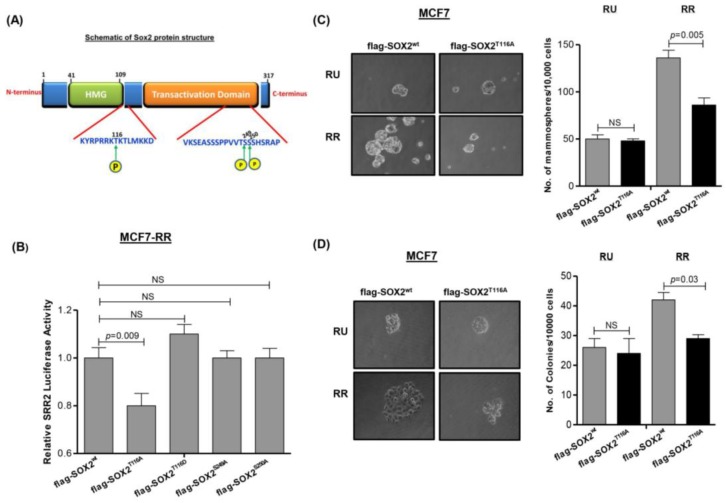
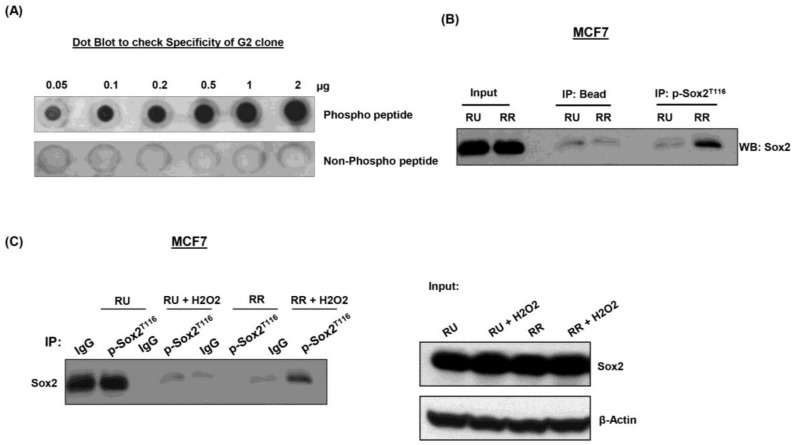
We have previously identified a novel phenotypic dichotomy in breast cancer (BC) based on the response to a SRR2 (Sox2 regulatory region 2) reporter, with reporter responsive (RR) cells being more tumorigenic/stem-like than reporter unresponsive (RU) cells. Since the expression level of Sox2 is comparable between the two cell subsets, we hypothesized that post-translational modifications of Sox2 contribute to their differential reporter response and phenotypic differences. By liquid chromatography-mass spectrometry, we found Sox2 to be phosphorylated in RR but not RU cells. Threonine 116 is an important phosphorylation site, since transfection of the T116A mutant into RR cells significantly decreased the SRR2 reporter luciferase activity and the RR-associated phenotype. Oxidative stress-induced conversion of RU into RR cells was accompanied by Sox2 phosphorylation at T116 and increased Sox2-DNA binding. In a cohort of BC, we found significant correlations between the proportion of tumor cells immuno-reactive with anti-phosphorylated Sox2 and a high tumor grade ( = 0.006), vascular invasion ( = 0.001) and estrogen receptor expression ( = 0.032). In conclusion, our data suggests that phosphorylation of Sox2 contributes to the tumorigenic/stem-like features in RR cells. Detection of phospho-Sox2 may be useful in identifying a small subset of tumor cells carrying stem-like/tumorigenic features in BC.
我们之前基于对SRR2(Sox2调控区域2)报告基因的反应,在乳腺癌(BC)中发现了一种新的表型二分法,报告基因反应性(RR)细胞比报告基因无反应性(RU)细胞更具致瘤性/干细胞样特性。由于两个细胞亚群之间Sox2的表达水平相当,我们推测Sox2的翻译后修饰导致了它们不同的报告基因反应和表型差异。通过液相色谱-质谱联用,我们发现Sox2在RR细胞中被磷酸化,而在RU细胞中未被磷酸化。苏氨酸116是一个重要的磷酸化位点,因为将T116A突变体转染到RR细胞中会显著降低SRR2报告基因的荧光素酶活性以及与RR相关的表型。氧化应激诱导的RU细胞向RR细胞的转变伴随着Sox2在T116处的磷酸化以及Sox2与DNA结合的增加。在一组BC患者中,我们发现与抗磷酸化Sox2免疫反应的肿瘤细胞比例与高肿瘤分级(=0.006)、血管侵犯(=0.001)和雌激素受体表达(=0.032)之间存在显著相关性。总之,我们的数据表明Sox2的磷酸化有助于RR细胞的致瘤性/干细胞样特征。检测磷酸化Sox2可能有助于识别BC中一小部分具有干细胞样/致瘤性特征的肿瘤细胞。