Gug Cristina, Mihaescu Adelina, Mozos Ioana
Department of Microscopic Morphology.
2nd Department of Internal Medicine.
Ther Clin Risk Manag. 2018 Jan 22;14:149-155. doi: 10.2147/TCRM.S150483. eCollection 2018.
Gitelman syndrome (GS) is considered as the most common renal tubular disorder, and we report the first Romanian patient with GS confirmed at molecular level and diagnosed according to genetic testing.
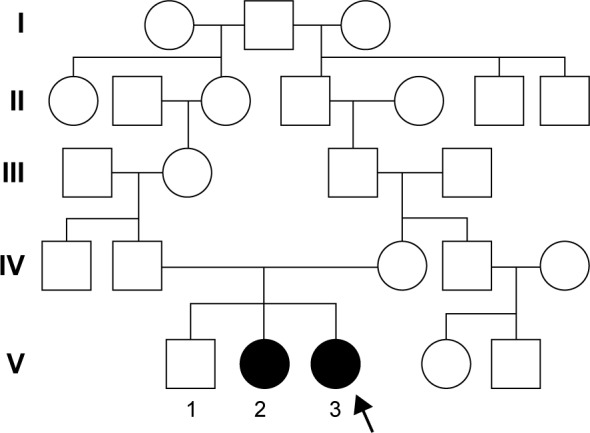
This paper describes the case of a 27-year-old woman admitted with severe hypokalemia, slight hypomagnesemia, hypocalcemia, hypocalciuria, metabolic alkalosis, hyperreninemia, low blood pressure, limb muscle weakness, marked fatigue and palpitations. Family history revealed a consanguineous family with autosomal-recessive transmission of GS with two cases over five generations.
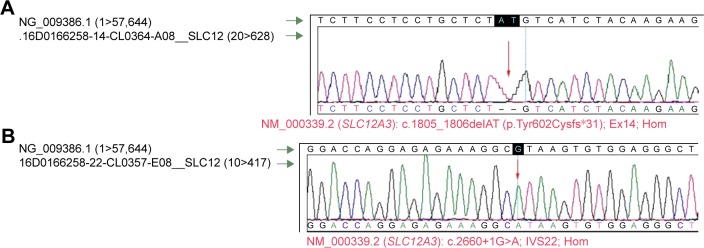
Next-generation sequencing technology detected two different homozygous mutations c.1805_1806delAT and c.2660+1G>A in the gene, which encodes the thiazide-sensitive NaCl co-transporter, confirmed by the Sanger method.
Clinicians should be aware of the existence of GS, manage the condition properly and consider the risk of disease recurrence to the next generations.
吉特林综合征(GS)被认为是最常见的肾小管疾病,我们报告了首例在分子水平确诊并经基因检测诊断的罗马尼亚GS患者。
本文描述了一名27岁女性患者的病例,该患者因严重低钾血症、轻度低镁血症、低钙血症、低钙尿症、代谢性碱中毒、高肾素血症、低血压、肢体肌肉无力、明显疲劳和心悸入院。家族史显示这是一个近亲结婚的家庭,GS呈常染色体隐性遗传,五代中有两例患者。
下一代测序技术在编码噻嗪类敏感型氯化钠协同转运蛋白的基因中检测到两个不同的纯合突变,即c.1805_1806delAT和c.2660+1G>A,经桑格法确认。
临床医生应了解GS的存在,妥善处理病情,并考虑疾病向下一代复发的风险。