Cox-North Paula, Hawkins Kelsey L, Rossiter Sean T, Hawley Marie N, Bhattacharya Renuka, Landis Charles S
Harborview Medical Center.
University of Washington Medical Center Seattle WA.
Hepatol Commun. 2017 Apr 18;1(3):248-255. doi: 10.1002/hep4.1035. eCollection 2017 May.
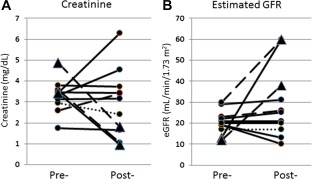
Sofosbuvir (SOF) is a nonstructural 5B polymerase inhibitor with activity in all hepatitis C virus (HCV) genotypes and is the backbone of many anti-HCV drug regimens. SOF is converted into inactive metabolites that undergo renal excretion. Patients with an estimated glomerular filtration rate (eGFR) < 30 mL/minute/1.73 m may experience increased drug exposure and thus potential toxicities along with decreased efficacy due to dose reduction or drug discontinuation. This is a single-center study evaluating safety and effectiveness of SOF-based regimens in patients with severe renal dysfunction, defined as eGFR <30 mL/minute/1.73 m, including those receiving concurrent hemodialysis. Data were collected from patients with HCV and severe renal dysfunction who started full-dose (400 mg) SOF-based antiviral therapy ± ribavirin between April 2014 and February 2016. Medical records were reviewed for demographics, medical history, laboratory, radiologic imaging, echocardiography, transplant status, and liver pathologic findings. Twenty-nine patients were identified; 12 had cirrhosis and 4 of those had decompensated cirrhosis. Fourteen patients had undergone transplantation of liver and/or kidney and were on calcineurin inhibitors, with 42% requiring dose increases or decreases while on therapy. All patients attained viral suppression on treatment, and 97% had a sustained viral response at 12 weeks posttreatment. There were no early treatment discontinuations. One death occurred posttreatment from a non-ST elevation myocardial infarction in a patient with a history of coronary artery disease and ischemic cardiomyopathy. : SOF-based regimens appear safe in a broad range of patients with severe renal dysfunction, including those with decompensated cirrhosis and liver transplant. To confirm these retrospective findings, prospective studies that include SOF and SOF metabolite measurements coupled with prospective serial monitoring of electrocardiograms and echocardiograms are needed. ( 2017;1:248-255).
索磷布韦(SOF)是一种非结构5B聚合酶抑制剂,对所有丙型肝炎病毒(HCV)基因型均有活性,是许多抗HCV药物方案的核心药物。索磷布韦被转化为无活性的代谢产物,经肾脏排泄。估算肾小球滤过率(eGFR)<30 mL/分钟/1.73 m²的患者可能会出现药物暴露增加,进而可能出现毒性反应,同时由于剂量减少或停药,疗效也会降低。这是一项单中心研究,评估了基于索磷布韦的治疗方案在严重肾功能不全患者(定义为eGFR<30 mL/分钟/1.73 m²)中的安全性和有效性,包括接受同期血液透析的患者。收集了2014年4月至2016年2月期间开始接受全剂量(400 mg)基于索磷布韦的抗病毒治疗±利巴韦林的HCV和严重肾功能不全患者的数据。查阅病历以获取人口统计学、病史、实验室检查、影像学检查、超声心动图、移植状态和肝脏病理检查结果。共确定了29例患者;12例有肝硬化,其中4例为失代偿期肝硬化。14例患者接受了肝脏和/或肾脏移植,并使用钙调神经磷酸酶抑制剂,42%的患者在治疗期间需要增加或减少剂量。所有患者在治疗期间均实现了病毒抑制,97%的患者在治疗后12周出现持续病毒学应答。没有早期停药情况。1例有冠状动脉疾病和缺血性心肌病病史的患者在治疗后死于非ST段抬高型心肌梗死。基于索磷布韦的治疗方案在广泛的严重肾功能不全患者中似乎是安全的,包括失代偿期肝硬化和肝移植患者。为了证实这些回顾性研究结果,需要进行前瞻性研究,包括索磷布韦和索磷布韦代谢产物的测量,以及对心电图和超声心动图的前瞻性连续监测。(2017;1:248 - 255)