Ordway Sarah M, Singla Manish B, Young Patrick E, Satoskar Rohit, Kwok Ryan M
Department of Internal Medicine Walter Reed National Military Medical Center Bethesda MD.
Division of Gastroenterology/Hepatology, Department of Internal MedicineWalter Reed National Military Medical Center Bethesda MD.
Hepatol Commun. 2017 May 12;1(4):347-353. doi: 10.1002/hep4.1040. eCollection 2017 Jun.
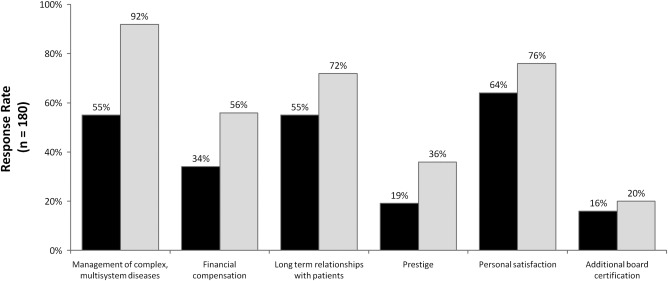
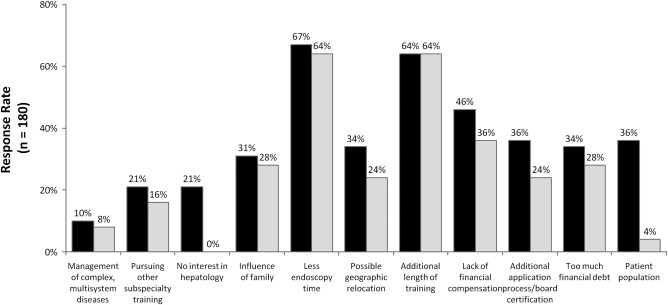
Despite an unmet need for hepatologists in the United States, every year transplant hepatology (TH) fellowship positions remain unfilled. To address this, we investigated factors that influence trainee decisions about pursuing a career in hepatology. We invited current gastroenterology (GI) and TH fellows from all Accreditation Council for Graduate Medical Education-accredited programs for the academic year 2014-2015 to participate in an online survey about factors influencing decisions to train in hepatology. The same paper-based survey was distributed at a nationally recognized GI board review course. The survey was completed by 180 participants of which 91% were current GI or TH fellows and 24% were not aware of the pilot 3-year combined GI and TH training program. A majority of respondents (57%) reported that a shorter time (3 versus 4 years) to become board certification eligible would influence their decisions to pursue TH. The most common reasons for not pursuing hepatology were less endoscopy time (67%), additional length of training (64%), and lack of financial compensation (44%). Personal satisfaction (66%), management of complex multisystem disease (60%), and long-term relationships with patients (57%) were the most attractive factors. Sixty-one percent of participants reported having a mentor, and 94% of those with mentors reported that their mentors influenced their career decisions. We have identified several factors that affect fellows' decision to pursue TH. Shorter training, increased financial compensation, and increased endoscopy time are potentially modifiable factors that may increase the number of trainees seeking careers in hepatology and help alleviate the deficit of hepatologists. ( 2017;1:347-353).
尽管美国对肝病专家的需求尚未得到满足,但每年移植肝病学(TH) fellowship 职位仍有空缺。为了解决这一问题,我们调查了影响学员选择肝病学职业的因素。我们邀请了2014 - 2015学年所有经研究生医学教育认证委员会认证项目的现任胃肠病学(GI)和TH研究员参加一项关于影响肝病学培训决策因素的在线调查。同样的纸质调查问卷也在一个全国认可的GI委员会复习课程上分发。180名参与者完成了调查,其中91%是现任GI或TH研究员,24%不知道试点的3年制GI和TH联合培训项目。大多数受访者(57%)表示,缩短获得委员会认证资格的时间(3年与4年相比)会影响他们选择TH的决定。不选择肝病学的最常见原因是内镜检查时间较少(67%)、培训时间延长(64%)和缺乏经济补偿(44%)。个人满意度(66%)、复杂多系统疾病的管理(60%)和与患者的长期关系(57%)是最具吸引力的因素。61%的参与者表示有导师,其中94%有导师的人表示他们的导师影响了他们的职业决策。我们已经确定了几个影响研究员选择TH的因素。缩短培训时间、增加经济补偿和增加内镜检查时间是潜在的可改变因素,可能会增加寻求肝病学职业的学员数量,并有助于缓解肝病专家的短缺。(2017;1:347 - 353)