Filozof Claudia, Chow Shein-Chung, Dimick-Santos Lara, Chen Yeh-Fong, Williams Richard N, Goldstein Barry J, Sanyal Arun
Covance Clinical Development Services Maidenhead United Kingdom.
Duke University School of Medicine Durham NC.
Hepatol Commun. 2017 Aug 1;1(7):577-585. doi: 10.1002/hep4.1079. eCollection 2017 Sep.
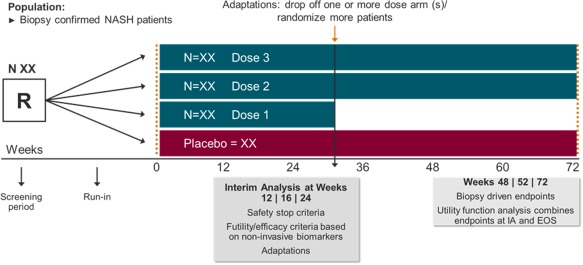
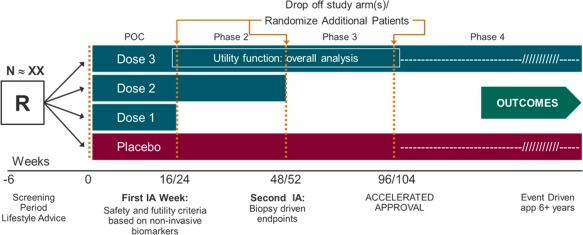
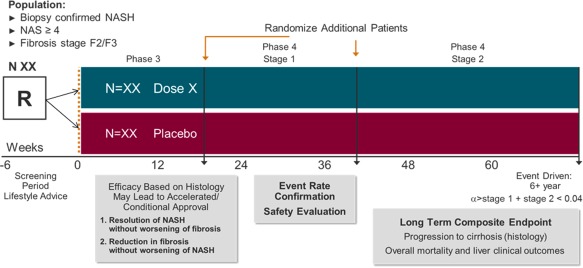
Due to the increasing prevalence of nonalcoholic steatohepatitis (NASH) and its associated health burden, there is a high need to develop therapeutic strategies for patients with this disease. Unfortunately, its long and asymptomatic natural history, the uncertainties about disease progression, the fact that most patients are undiagnosed, and the requirement for sequential liver biopsies create substantial challenges for clinical development. Adaptive design methods are increasingly used in clinical research as they provide the flexibility and efficiency for identifying potential signals of clinical benefit of the test treatment under investigation and make prompt preplanned adaptations without undermining the validity or integrity of the trial. Given the high unmet medical need and the lack of validated surrogate endpoints in NASH, the use of adaptive design methods appears reasonable. Furthermore, due to the limited number of patients willing to have multiple liver biopsies and the need for long-term exposure to assess an impact in outcomes, a continuous seamless adaptive design may reduce the overall sample size while allowing patients to continue after each one of the phases. Here, we review strategic frameworks that include potential surrogate endpoints as well as statistical and logistical approaches that could be considered for applying adaptive designs to clinical trials in NASH with the goal of facilitating drug development for this growing medical need. ( 2017;1:577-585).
由于非酒精性脂肪性肝炎(NASH)的患病率不断上升及其相关的健康负担,迫切需要为患有这种疾病的患者开发治疗策略。不幸的是,其漫长且无症状的自然病史、疾病进展的不确定性、大多数患者未被诊断的事实以及需要进行连续肝脏活检,给临床开发带来了巨大挑战。适应性设计方法在临床研究中越来越多地被使用,因为它们为识别所研究的试验治疗的潜在临床获益信号提供了灵活性和效率,并能在不损害试验有效性或完整性的情况下进行预先计划好的及时调整。鉴于NASH中存在高度未满足的医疗需求且缺乏经过验证的替代终点,使用适应性设计方法似乎是合理的。此外,由于愿意接受多次肝脏活检的患者数量有限,且需要长期暴露以评估对结局的影响,连续无缝适应性设计可能会减少总体样本量,同时允许患者在每个阶段之后继续参与。在此,我们回顾了战略框架,其中包括潜在的替代终点以及在将适应性设计应用于NASH临床试验时可考虑的统计和后勤方法,目的是为满足这一日益增长的医疗需求促进药物开发。(2017;1:577 - 585)