Lv Lingshuang, Li Tiecheng, Xu Kun, Shi Peiyi, He Biyu, Kong Weimin, Wang Jianming, Sun Jian
Department of Epidemiology, Key Laboratory of Infectious Diseases, School of Public Health, Nanjing Medical University, Nanjing, China.
Department of Tuberculosis, the Fourth People's Hospital of Lianyungang City, Lianyungang, China.
Infect Drug Resist. 2018 Jan 23;11:147-154. doi: 10.2147/IDR.S153499. eCollection 2018.
Multidrug-resistant tuberculosis (MDR-TB) requires long-term treatment, has a high fatality rate, and constitutes a global threat. Earlier detection of treatment failure is required to predict therapeutic efficacy.
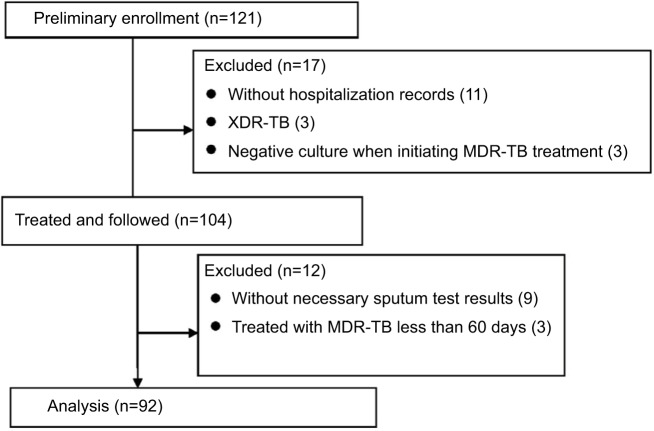
We enrolled MDR-TB patients consecutively from January 2011 through December 2012 in Lianyungang, China. Sputum smear microscopy tests and sputum cultures were performed once a month for the first 6 months following initiation of antituberculosis treatment and once every 2 months thereafter until the end of therapy. The sensitivity, specificity and area under the receiver operating characteristic curve (AUC) were used with a 95% CI to estimate the role of sputum bacteriology conversion in predicting treatment outcomes.
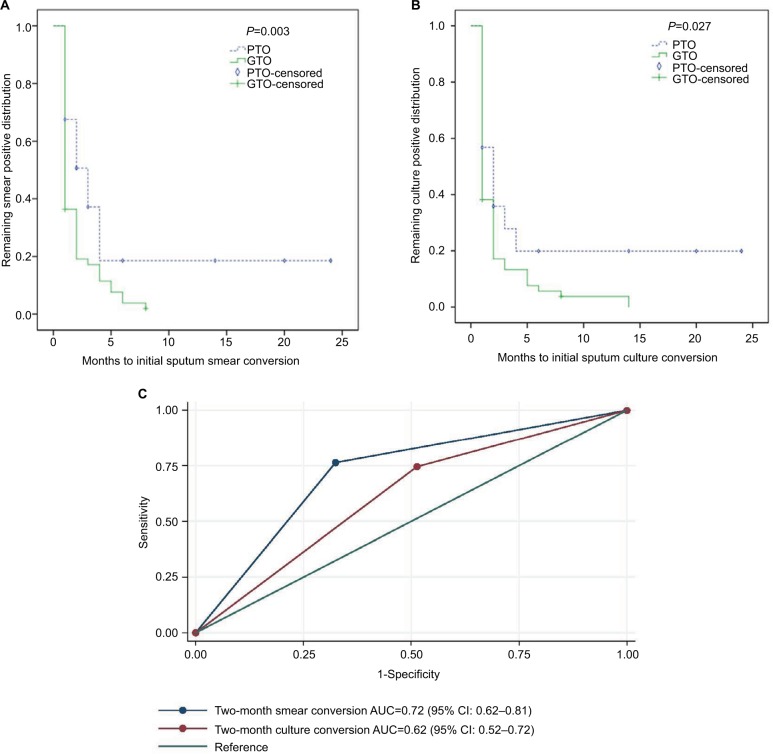
Among the 92 MDR-TB patients enrolled in this study, 40.2% had poor treatment outcomes. The median initial sputum bacteriology conversion time was 1 month. Patients having 2-month sputum smear conversions (adjusted odds ratio [OR]: 7.19, 95% CI: 2.60-19.84) or culture conversions (adjusted OR: 2.88, 95% CI: 1.11-7.45) were more likely to experience good outcomes. The sensitivity and specificity obtained when using two-month sputum smear conversions to predict treatment outcomes were 67.6% (95% CI: 50.2-82.0) and 76.4% (95% CI: 63.0-86.8), respectively. The sensitivity and specificity obtained when using 2-month culture conversions to predict treatment outcomes were 48.6% (95% CI: 32.0-65.6) and 74.5% (95% CI: 61.0-85.3), respectively. The AUC for two-month smear conversions was 0.72 (95% CI: 0.62-0.81), significantly higher than that obtained for 2-month culture conversions (0.62, 95% CI: 0.52-0.72) (χ = 4.18, = 0.041).
The prognoses of MDR-TB patients displaying persistent sputum positivity were inferior to those for whom sputum bacteriology conversion was observed. Thus, sputum smear conversion results obtained 2 months after treatment initiation may provide a potential means for predicting MDR-TB treatment outcomes.
耐多药结核病(MDR-TB)需要长期治疗,病死率高,对全球构成威胁。需要更早地检测治疗失败情况以预测治疗效果。
我们于2011年1月至2012年12月在中国连云港连续纳入耐多药结核病患者。在开始抗结核治疗后的前6个月每月进行一次痰涂片显微镜检查和痰培养,此后每2个月进行一次,直至治疗结束。使用敏感性、特异性和受试者工作特征曲线下面积(AUC)及95%置信区间来评估痰菌转阴在预测治疗结果中的作用。
在本研究纳入的92例耐多药结核病患者中,40.2%的患者治疗效果不佳。初始痰菌转阴的中位时间为1个月。痰涂片在2个月内转阴的患者(调整优势比[OR]:7.19,95%置信区间:2.60 - 19.84)或痰培养在2个月内转阴的患者(调整OR:2.88,95%置信区间:1.11 - 7.45)更有可能获得良好的治疗结果。使用治疗2个月后的痰涂片转阴来预测治疗结果时,敏感性和特异性分别为67.6%(95%置信区间:50.2 - 82.0)和76.4%(95%置信区间:63.0 - 86.8)。使用治疗2个月后的痰培养转阴来预测治疗结果时,敏感性和特异性分别为48.6%(95%置信区间:32.0 - 65.6)和74.5%(95%置信区间:61.0 - 85.3)。治疗2个月痰涂片转阴的AUC为0.72(95%置信区间:0.62 - 0.81),显著高于治疗2个月痰培养转阴的AUC(0.62,95%置信区间:0.52 - 0.72)(χ = 4.18,P = 0.041)。
痰持续阳性的耐多药结核病患者的预后不如痰菌转阴的患者。因此,治疗开始2个月后获得的痰涂片转阴结果可能为预测耐多药结核病的治疗结果提供一种潜在方法。