Hunter-Smith Alison E, Rayter Zenon
Breast Surgery Unit, Bristol Breast Care Centre, North Bristol NHS Trust, Southmead Hospital, Westbury-on-Trym, Bristol, UK.
Breast Cancer (Dove Med Press). 2018 Jan 25;10:13-21. doi: 10.2147/BCTT.S113737. eCollection 2018.
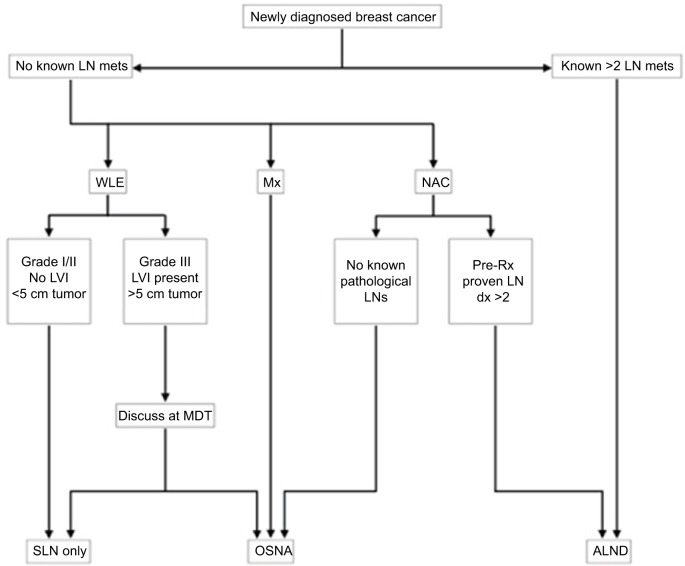
Breast cancer is the most common cancer in women, worldwide, and 1,400 deaths per day are attributed to it. The success of national screening programs has seen breast cancers being diagnosed at an earlier stage. With conservative surgery to the breast demonstrating equivalent long-term outcomes, the last 10 years have seen a growing interest in the safety of less invasive management for the axilla in breast cancer patients. One-step nucleic acid amplification (OSNA) is a validated, reliable, and efficient tool in identifying micro- and macro-metastases intraoperatively. It is the most widely used intraoperative analysis tool within the United Kingdom, and is employed by over 320 units across Europe and Asia. Recent evidence from the AMAROS, IBCSG 23-01, and ACOSOG Z0011 trials has changed surgical practice in managing the axilla of patients with breast cancer. We propose a clinical algorithm demonstrating the role of OSNA as an intraoperative analysis tool in today's management of breast cancer as well as prospects for the future use of OSNA.
乳腺癌是全球女性中最常见的癌症,每天有1400人死于该病。国家筛查项目的成功使得乳腺癌在更早期被诊断出来。由于保乳手术显示出相当的长期效果,在过去10年里,乳腺癌患者腋窝微创治疗的安全性越来越受到关注。一步核酸扩增(OSNA)是一种在术中识别微转移和宏转移的经过验证的、可靠且高效的工具。它是英国使用最广泛的术中分析工具,在欧洲和亚洲有超过320个单位采用。AMAROS、IBCSG 23 - 01和ACOSOG Z0011试验的最新证据改变了乳腺癌患者腋窝处理的手术方式。我们提出一种临床算法,展示OSNA作为术中分析工具在当今乳腺癌治疗中的作用以及OSNA未来的应用前景。