Pediatrics Orthopedics Department, Necker Hospital, Paris Descartes University, Assistance Publique Hôpitaux de Paris, Paris, France.
Pediatrics Orthopedics Department, The Royal Children's Hospital, Melbourne, Australia.
Spine (Phila Pa 1976). 2018 Aug;43(16):E968-E975. doi: 10.1097/BRS.0000000000002588.
A retrospective review.
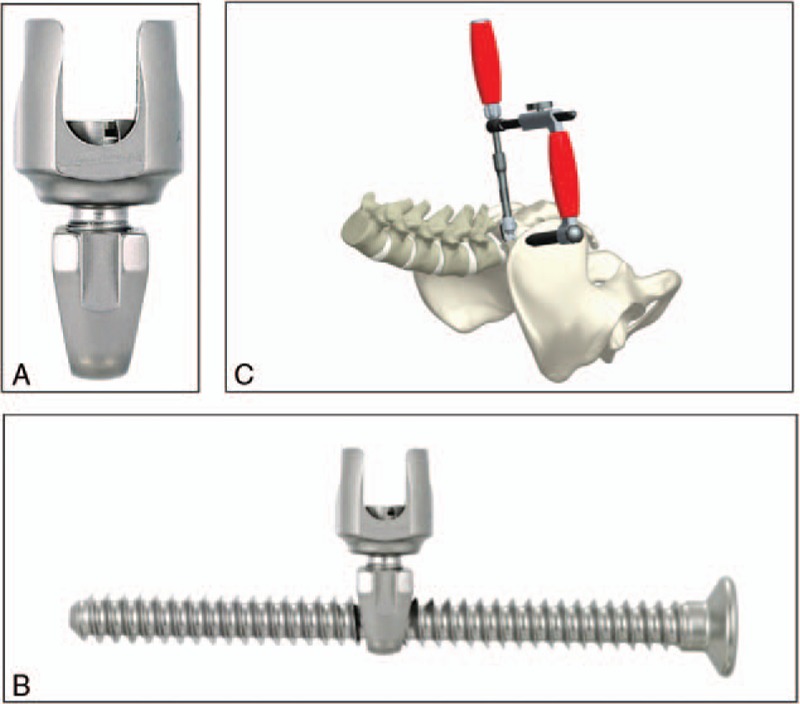
To report the results of an alternative technique using a minimally invasive fusionless surgery. The originality is based on the progressive correction of the deformities with proximal and distal fixation and on the reliability of the pelvic fixation using iliosacral screws on osteoporotic bones.
Spinal deformities are common in neuromuscular diseases. Conventional treatment involves bracing, followed by spinal instrumented fusion. Growing rod techniques are increasingly advocated but have a high rate of complications.
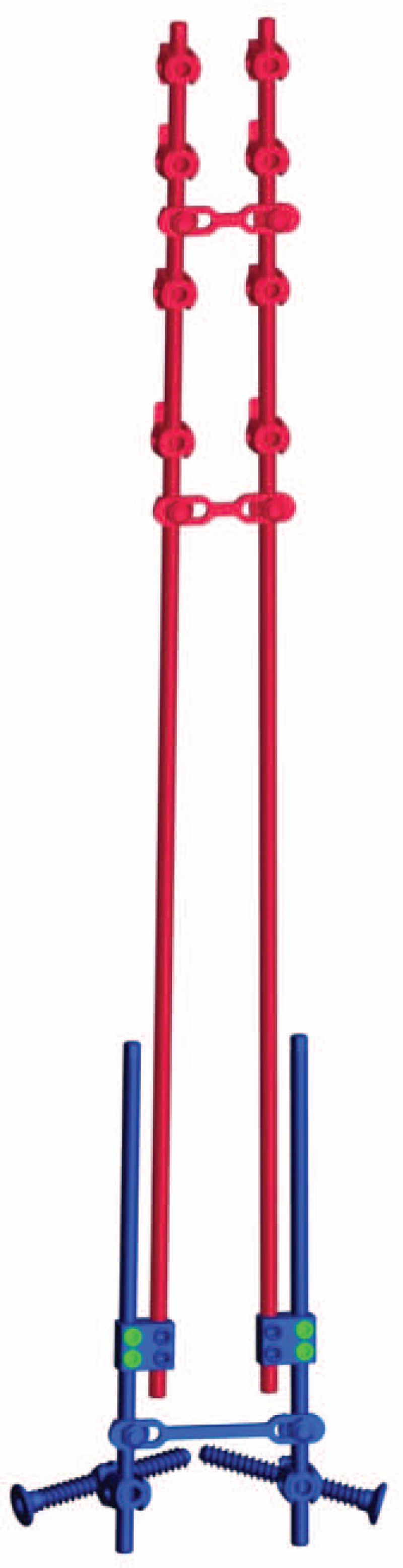
The technique relies on a bilateral double rod sliding construct anchored proximally by four hooks claws and distally to the pelvis by iliosacral screws through a minimally invasive approach. Hundred patients with neuromuscular scoliosis underwent the same fusionless surgery extended from T1 to the pelvis. The average age at initial surgery was 11 + 6 years. Diagnoses included cerebral palsy (61), spinal muscular atrophy (22), muscular dystrophy (10), and other neurological etiologies (7). Cobb angle and pelvic obliquity were measured before and after initial surgery, and at final follow-up. Complications were reviewed.
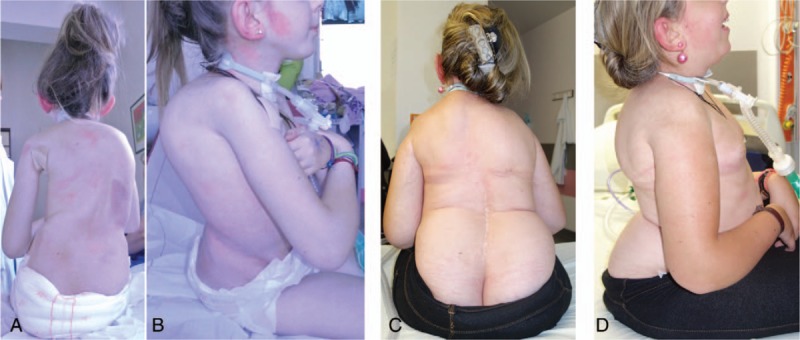
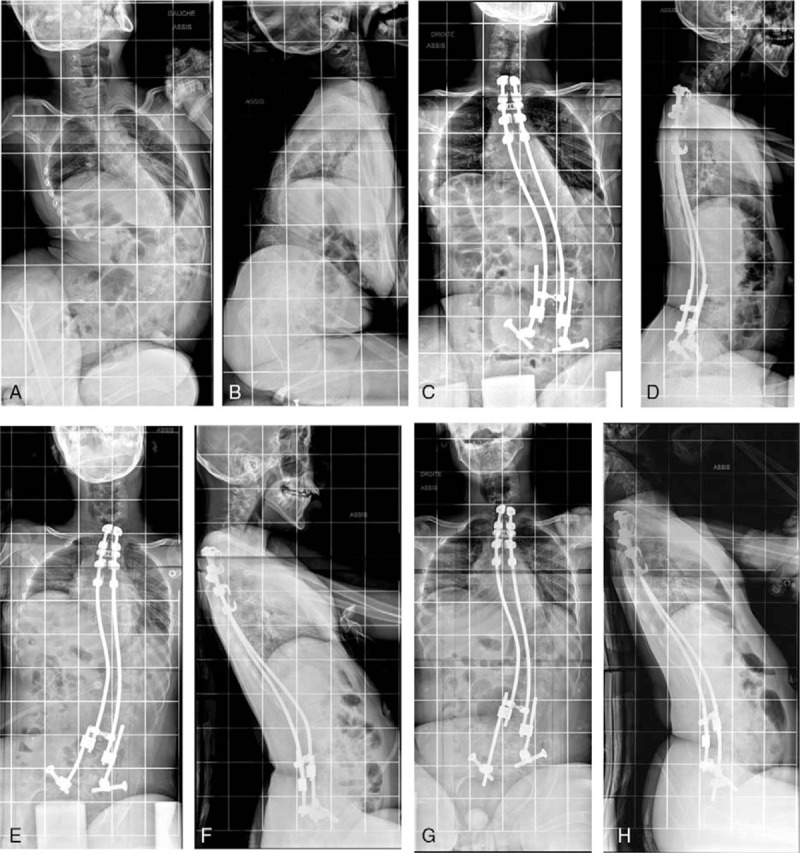
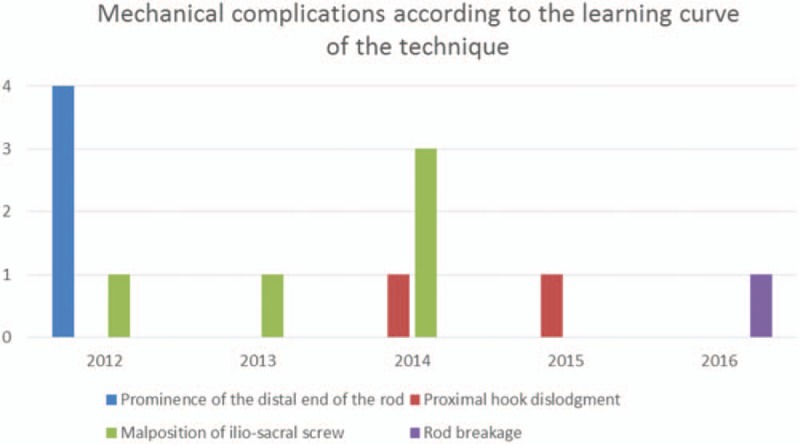
At latest follow-up 3 + 9 years (range 2 yr-6 + 3 yr), the mean Cobb angle improved from 89° to 35° which corresponds to 61% correction. Mean pelvic obliquity improved from 29° to 5°, which corresponds to 83% correction. Mean T1-S1 length increased from 30.02 to 37.28 cm. Mean preoperative hyper kyphosis was reduced from 68.44° to 33.29°. Complications occurred in 26 patients including mechanical complications (12) and wound infections (16). No arthrodesis was required at last follow-up.
This original fusionless technique is safe and effective, preserving spinal and thoracic growth. It provides a significant correction of spinal deformities and pelvic obliquity with a reduced complications rate. The strength and stability of this modular construct over time allow the avoidance of final arthrodesis.
回顾性研究。
报告一种使用微创非融合手术的替代技术的结果。该技术的创新性在于,通过近端和远端固定来逐步矫正畸形,并通过在骨质疏松骨上使用髂骨螺钉来实现骨盆固定的可靠性。
脊柱畸形在神经肌肉疾病中很常见。传统的治疗方法包括支具固定,然后进行脊柱器械融合。生长棒技术越来越受到推崇,但并发症发生率较高。
该技术依赖于双侧双棒滑动结构,近端通过四个钩爪固定,远端通过微创入路固定到骨盆上的髂骨螺钉。100 例神经肌肉性脊柱侧凸患者接受了同样的非融合手术,手术范围从 T1 到骨盆。初次手术时的平均年龄为 11 岁+6 岁。诊断包括脑瘫(61 例)、脊髓性肌萎缩症(22 例)、肌肉营养不良(10 例)和其他神经病因(7 例)。在初次手术前后以及最终随访时测量 Cobb 角和骨盆倾斜度。回顾并发症。
在最近的随访 3 年+9 年(范围 2 年-6 年+3 年),平均 Cobb 角从 89°改善到 35°,矫正率为 61%。平均骨盆倾斜度从 29°改善到 5°,矫正率为 83%。T1-S1 长度平均增加 30.02-37.28cm。术前平均过度后凸从 68.44°减少到 33.29°。26 例患者发生并发症,包括机械并发症(12 例)和伤口感染(16 例)。末次随访时无需融合。
这种原创的非融合技术安全有效,可保留脊柱和胸廓的生长。它可显著矫正脊柱畸形和骨盆倾斜,降低并发症发生率。随着时间的推移,这种模块化结构的强度和稳定性可避免最终融合。
4 级。