Department of Radiation Oncology, University Hospital, LMU Munich, Marchioninistraße 15, 81377, Munich, Germany.
Department of Therapeutic Radiology and Oncology, Innsbruck Medical University, Innsbruck, Austria.
Radiat Oncol. 2018 Feb 9;13(1):25. doi: 10.1186/s13014-018-0964-7.
The objective of the present study was to evaluate the effectiveness of postoperative radiotherapy after breast conserving surgery (BCS) in DCIS in a large patient population treated in clinical practice.
Data were provided by the population-based Munich Cancer Registry. Between 1998 and 2014, 1048 female patients with diagnosis of DCIS and treated at two Breast Care Centres were included in this observational study. The effectiveness of postoperative radiotherapy and variables predicting the use of radiotherapy were retrospectively analysed.
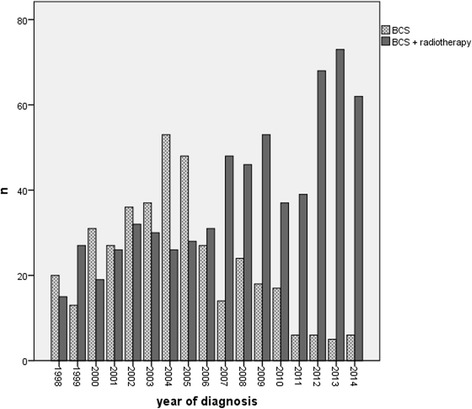
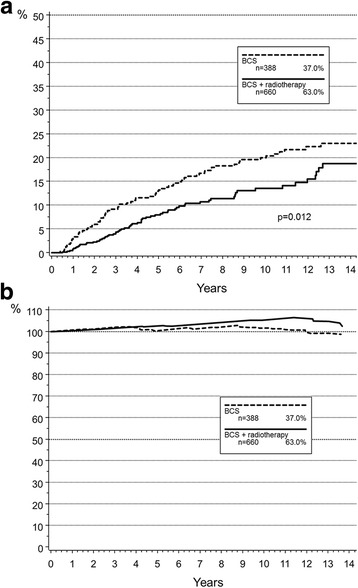
After adjusting for age, tumour characteristics and therapies, Cox regression analysis for local recurrence-free survival identified RT as an independent predictor for improved local control (HR: 0.579; 95%CI: 0.384-0.872, p = 0.008). Ten-year cumulative incidence of in-breast recurrences was 20.0% following BCS, compared to 13.6% in patients receiving postoperative radiotherapy (p = 0.012). As an estimate for disease-specific survival, 10-year relative survival was 105.4% for patients receiving postoperative radiotherapy and 101.6% without radiotherapy. On multivariate analysis, postoperative radiotherapy was not associated with improved overall survival (HR 0.526; 95%CI: 0.263-1.052, p = 0.069). Over time, a significant increase of RT was registered: while 1998 only 42.9% of patients received postoperative radiotherapy, the proportion rose to 91.2% in 2014. Women aged < 50 years (OR: 2.559, 95%CI: 1.416-4.625, p < 0.001) or with negative hormone receptor status (OR: 2.625, 95%CI: 1.458-4.728, p = 0.001) or receiving endocrine therapy (OR: 1.762, 95%CI: 1.060-2.927, p = 0.029) were more likely to receive postoperative radiotherapy after BCS.
In conclusion, this study provides insights regarding the adoption and treatment pattern of postoperative RT following BCS for DCIS in a large cohort reflecting "real-life" clinical practice in this setting. Postoperative RT was found to be associated with a reduced risk of ipsilateral recurrence and no survival benefit compared to observation alone.
本研究旨在评估保乳手术后(BCS)对 DCIS 患者术后放疗的有效性,该研究纳入了在临床实践中治疗的大量患者。
数据来自基于人群的慕尼黑癌症登记处。1998 年至 2014 年期间,纳入了在两个乳腺保健中心接受治疗的 1048 名女性 DCIS 患者,进行回顾性观察研究。分析了术后放疗的有效性和预测放疗使用的变量。
在调整年龄、肿瘤特征和治疗后,局部无复发生存的 Cox 回归分析确定 RT 是局部控制改善的独立预测因素(HR:0.579;95%CI:0.384-0.872,p=0.008)。BCS 后 10 年累积同侧复发率为 20.0%,而接受术后放疗的患者为 13.6%(p=0.012)。作为疾病特异性生存的估计,接受术后放疗的患者 10 年相对生存率为 105.4%,未接受放疗的患者为 101.6%。多变量分析显示,术后放疗与总生存改善无关(HR 0.526;95%CI:0.263-1.052,p=0.069)。随着时间的推移,RT 的应用显著增加:1998 年仅 42.9%的患者接受术后放疗,2014 年这一比例上升至 91.2%。年龄<50 岁的女性(OR:2.559,95%CI:1.416-4.625,p<0.001)或激素受体阴性(OR:2.625,95%CI:1.458-4.728,p=0.001)或接受内分泌治疗(OR:1.762,95%CI:1.060-2.927,p=0.029)的患者更有可能在 BCS 后接受术后放疗。
总之,本研究提供了有关在大型队列中观察到的保乳手术后(BCS)对 DCIS 患者术后放疗的采用和治疗模式的见解,反映了该环境下的“真实生活”临床实践。与单独观察相比,术后放疗与同侧复发风险降低相关,但与生存获益无关。