Department of Public Health Sciences, University of Rochester School of Medicine and Dentistry, Rochester, NY, USA.
School of Public Health, Yale University, New Haven, CT, USA.
J Int AIDS Soc. 2018 Feb;21(2). doi: 10.1002/jia2.25079.
Reducing high-risk behaviours (i.e. multiple partnership, condomless anal/vaginal sex, alcohol use before sex, illicit drug use) after HIV diagnosis is critical for curtailing HIV transmission. We designed an intervention to explore peer- counselling in reducing high-risk behaviours among newly diagnosed HIV-positive Chinese men who have sex with men (MSM).
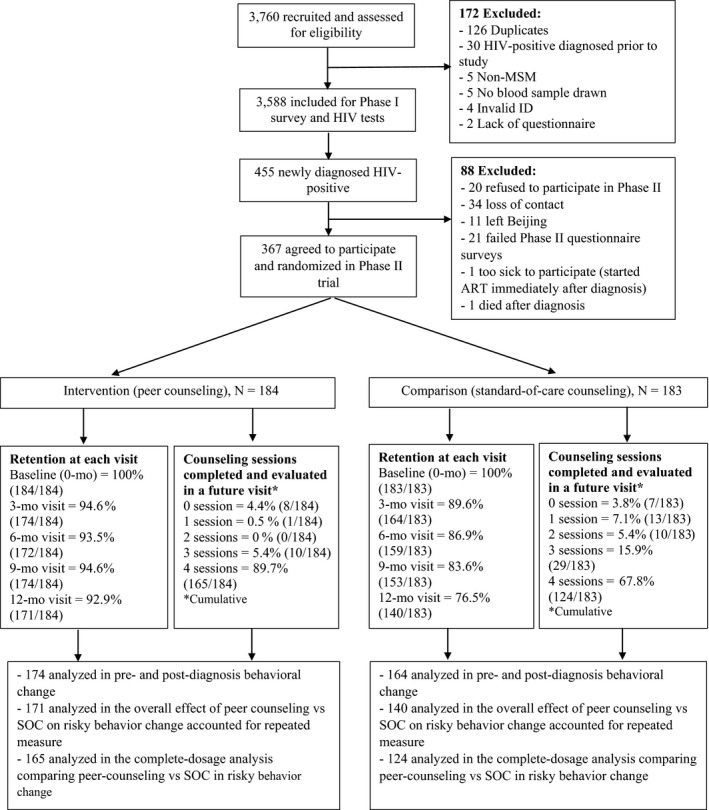
We randomized 367 newly diagnosed HIV-positive men to either standard-of-care (SOC; n = 183) or peer-counselling intervention (n = 184), and followed them for 12 months (visit at 0-, 3-, 6-, 9- and 12-month). SOC participants received counselling on high-risk behaviour reduction by clinic staff. Intervention participants received both SOC and peer counselling. A generalized estimating equation was used to compare pre-post diagnosis high-risk behaviour change; logistic regression was used to assess the likelihood of practicing high-risk behaviours between intervention and SOC participants. Both intent-to-treat and per-protocol (full-dosage) approaches were used for the analyses.
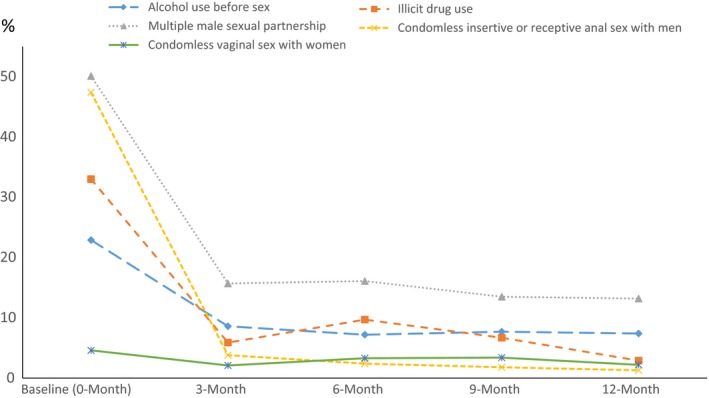
For pre- and post-diagnosis comparisons, multiple partnership fell from 50% to 16% (p < 0.001), alcohol use before sex from 23% to 9% (p = 0.001), illicit drug use from 33% to 6% (p < 0.001), condomless anal sex from 47% to 4% (insertive from 23% to 2%; receptive from 36% to 3%; p < 0.001). In the intent-to-treat analysis accounting for repeated measures, peer counselling was more likely to reduce insertive anal sex (AOR = 0.65; 95% CI: 0.45 to 0.94), condomless anal sex (AOR = 0.27; 95% CI: 0.10 to 0.64) and illicit drug use (AOR = 0.32; 95% CI: 0.16 to 0.64). In the per-protocol analysis, peer counselling was associated with a lower likelihood of using illicit drug (OR = 0.23; 95% CI: 0.07 to 0.81) and having condomless vaginal sex with women (OR = 0.12; 95% CI: 0.07 to 0.98).
We observed a 14 to 43% decrease in the prevalence of selected high-risk behaviours after HIV diagnosis. Peer counselling had a greater impact in reducing condomless anal sex with men, illicit drug use and condomless vaginal sex with women over time. Future studies with exclusive peer-counselling arm are necessary to test its efficacy and effectiveness among Chinese MSM. Clinical Trial Number: NCT01904877.
减少艾滋病毒诊断后高危行为(即多重性伴、无保护肛交/阴道交、性行为前饮酒、使用非法药物)对于遏制艾滋病毒传播至关重要。我们设计了一项干预措施,以探索同伴咨询在减少新诊断为艾滋病毒阳性的男男性行为者(MSM)中的高危行为。
我们将 367 名新诊断为艾滋病毒阳性的男性随机分为标准护理(SOC;n=183)或同伴咨询干预组(n=184),并随访 12 个月(0、3、6、9 和 12 个月时进行随访)。SOC 参与者接受临床工作人员关于减少高危行为的咨询。干预组参与者同时接受 SOC 和同伴咨询。使用广义估计方程比较诊断前后高危行为的变化;使用逻辑回归评估干预组和 SOC 组之间高危行为的可能性。分析均采用意向治疗和全剂量(完整剂量)方案。
对于诊断前后的比较,多重性伴从 50%下降到 16%(p<0.001),性行为前饮酒从 23%下降到 9%(p=0.001),非法药物使用从 33%下降到 6%(p<0.001),无保护肛交从 47%下降到 4%(插入性从 23%下降到 2%;接受性从 36%下降到 3%;p<0.001)。在考虑重复测量的意向治疗分析中,同伴咨询更有可能减少插入性肛交(AOR=0.65;95%CI:0.45 至 0.94)、无保护肛交(AOR=0.27;95%CI:0.10 至 0.64)和非法药物使用(AOR=0.32;95%CI:0.16 至 0.64)。在全剂量方案分析中,同伴咨询与较低的使用非法药物(OR=0.23;95%CI:0.07 至 0.81)和与女性发生无保护阴道交(OR=0.12;95%CI:0.07 至 0.98)的可能性相关。
我们观察到艾滋病毒诊断后选定高危行为的流行率下降了 14%至 43%。同伴咨询随着时间的推移对减少男性间无保护肛交、非法药物使用和与女性发生无保护阴道交的影响更大。需要进行专门的同伴咨询干预试验,以检验其在中国 MSM 中的疗效和效果。临床试验编号:NCT01904877。