Zhang Li, Jiang Zechun, Lv Jingjing, Liu Jiaye, Yan Bingyu, Feng Yi, Li Li, Zhang Guomin, Wang Fuzhen, Xu Aiqiang
Academy of Preventive Medicine, Shandong University, Jinan, China.
Shandong Provincial Key Laboratory of Infectious Disease Control and Prevention, Shandong Center for Disease Control and Prevention, Jinan, China.
BMC Infect Dis. 2018 Feb 12;18(1):75. doi: 10.1186/s12879-018-2974-3.
Persons with chronic hepatitis B (CHB) infection were reported to suffer severe disease after hepatitis E virus (HEV) superinfection, but the studies regarding HEV seroprevalence in this population were limited. A recent study in Vietnam found higher HEV seroprevalence among CHB patients compared with healthy controls.
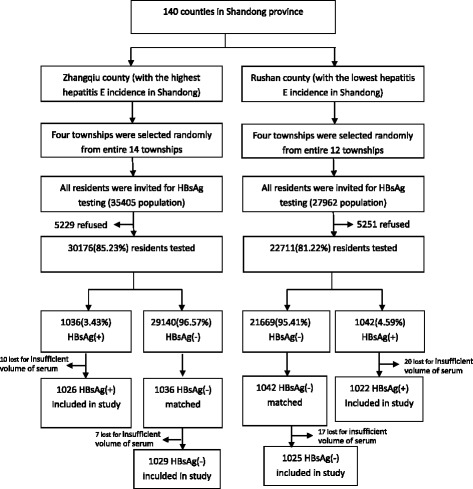
A community-based case-control study was conducted in two counties of Shandong province, China, where hepatitis E incidence was at the highest (Rushan) and lowest (Zhangqiu) in the province based on data from routine public health surveillance. Four townships were selected randomly from each county and all residents in these townships were tested for hepatitis B surface antigen (HBsAg). Those tested positive for HBsAg (CHB group) and the 1:1 age and sex-matched HBsAg-negative residents (control group) were included. Anti-HEV IgM and IgG were tested and positive rates of IgG and IgM were compared between the CHB group and the control group.
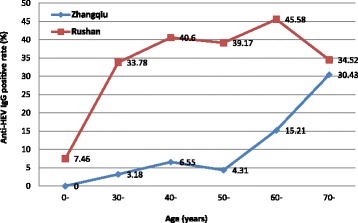
In total, 2048 CHB participants and 2054 controls were included in the study. In the CHB group, HEV IgG seroprevalence was 9.16% (95% CI: 7.47-11.09) in Zhangqiue and 38.06% (95% CI: 35.07-41.19) in Rushan (P < 0.001); the corresponding rates of IgM were 0.1% (95% CI: 0.002-0.54) and 1.57% (95% CI: 0.90-2.53), respectively (P < 0.001). HEV IgG seroprevalence was similar between CHB group and the control group in both counties (P = 0.21, P = 0.47, respectively) and the same results were found for the positive rate of IgM (P = 0.103, P = 0.262, respectively). Multivariable analysis showed the status of HBsAg was not independently associated with the status of anti-HEV IgG in either Zhangqiu or Rushan [P = 0.187, OR = 1.23(95% CI: 0.90, 1.68); P = 0.609, OR = 1.05 (95% CI: 0.87, 1.26)].
The seroprevalence of HEV varies greatly in different geographic areas, but the seroprevalence is similar between populations with and without CHB. CHB patients residing in high HEV endemic areas might be at higher risk for HBV-HEV superinfection.
据报道,慢性乙型肝炎(CHB)感染者在感染戊型肝炎病毒(HEV)后病情严重,但关于该人群中HEV血清流行率的研究有限。越南最近的一项研究发现,CHB患者的HEV血清流行率高于健康对照者。
在中国山东省的两个县开展了一项基于社区的病例对照研究,根据常规公共卫生监测数据,这两个县的戊型肝炎发病率分别为该省最高(乳山)和最低(章丘)。从每个县随机选取4个乡镇,对这些乡镇的所有居民进行乙型肝炎表面抗原(HBsAg)检测。纳入HBsAg检测呈阳性者(CHB组)以及年龄和性别1:1匹配的HBsAg阴性居民(对照组)。检测抗HEV IgM和IgG,并比较CHB组和对照组中IgG和IgM的阳性率。
该研究共纳入2048名CHB参与者和2054名对照者。在CHB组中,章丘的HEV IgG血清流行率为9.16%(95%CI:7.47-11.09),乳山为38.06%(95%CI:35.07-41.19)(P<0.001);相应的IgM率分别为0.1%(95%CI:0.002-0.54)和1.57%(95%CI:0.90-2.53)(P<0.001)。两个县的CHB组和对照组之间的HEV IgG血清流行率相似(分别为P=0.21,P=0.47),IgM阳性率也得到相同结果(分别为P=0.103,P=0.262)。多变量分析显示,在章丘或乳山,HBsAg状态均与抗HEV IgG状态无独立相关性[P=0.187,OR=1.23(95%CI:0.90,1.68);P=0.609,OR=1.05(95%CI:0.87,1.26)]。
HEV的血清流行率在不同地理区域差异很大,但CHB患者和非CHB患者人群中的血清流行率相似。居住在HEV高流行地区的CHB患者可能有更高的HBV-HEV重叠感染风险。