Department of Pediatrics, Division of Pediatric Gastroenterology, Stony Brook University, Stony Brook, NY 11794, United States.
Department of Medicine, Division of Gastroenterology, Stony Brook University, Stony Brook, NY 11794, United States.
World J Gastroenterol. 2018 Feb 7;24(5):623-630. doi: 10.3748/wjg.v24.i5.623.
To examine the relationship between elevated granulocyte-macrophage colony-stimulating factor (GM-CSF) auto-antibodies (Ab) level and time to surgical recurrence after initial surgery for Crohn's disease (CD).
We reviewed 412 charts from a clinical database at tertiary academic hospital. Patients included in the study had ileal or ileocolonic CD and surgical resection of small bowel or ileocecal region for management of disease. Serum samples were analyzed for serological assays including GM-CSF cytokine, GM-CSF Ab, ASCA IgG and IgA, and genetic markers including SNPs rs2066843, rs2066844, rs2066845, rs2076756 and rs2066847 in NOD2, rs2241880 in ATG16L1, and rs13361189 in IRGM. Cox proportional-hazards models were used to assess the predictors of surgical recurrence.
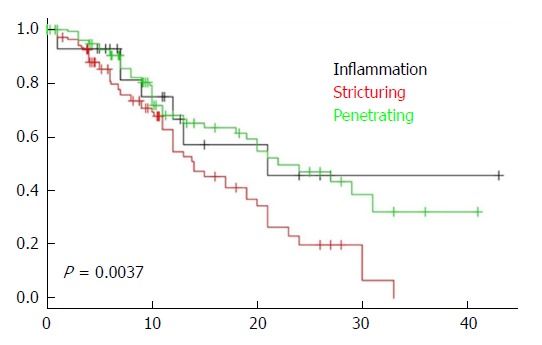
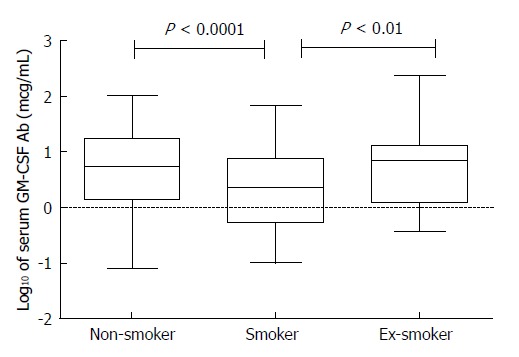
Ninety six percent of patients underwent initial ileocecal resection (ICR) or ileal resection (IR) and subsequently 40% of patients required a second ICR/IR for CD. GM-CSF Ab level was elevated at a median of 3.81 mcg/mL. Factors predicting faster time to a second surgery included elevated GM-CSF Ab [hazard ratio (HR) 3.52, 95%CI: 1.45-8.53, = 0.005] and elevated GM-CSF cytokine (HR = 2.48, 95%CI: 1.31-4.70, = 0.005). Factors predicting longer duration between first and second surgery included use of Immunomodulators (HR = 0.49, 95%CI: 0.31-0.77, = 0.002), the interaction effect of low GM-CSF Ab levels and smoking (HR = 0.60, 95%CI: 0.45-0.81, = 0.001) and the interaction effect of low GM-CSF cytokine levels and ATG16L1 (HR = 0.65, 95%CI: 0.49-0.88, = 0.006).
GM-CSF bioavailability plays a critical role in maintaining intestinal homeostasis. Decreased bioavailability coupled with the genetic risk markers and/or smoking results in aggressive CD behavior.
研究初始手术后克罗恩病(CD)患者粒细胞-巨噬细胞集落刺激因子(GM-CSF)自身抗体(Ab)水平升高与手术复发时间之间的关系。
我们对一家三级学术医院的临床数据库中的 412 份图表进行了回顾。纳入本研究的患者患有回肠或回结肠 CD,且进行了小肠或回盲肠区域的手术切除以治疗疾病。血清样本进行了包括 GM-CSF 细胞因子、GM-CSF Ab、抗酿酒酵母抗体 IgG 和 IgA 以及包括 NOD2 中的 SNPs rs2066843、rs2066844、rs2066845、rs2076756 和 rs2066847、ATG16L1 中的 rs2241880 和 IRGM 中的 rs13361189 的遗传标记物等血清学检测。采用 Cox 比例风险模型评估手术复发的预测因素。
96%的患者接受了初始回盲部切除术(ICR)或回肠切除术(IR),随后 40%的患者因 CD 需要再次接受 ICR/IR。GM-CSF Ab 水平中位数升高至 3.81 mcg/mL。预测第二次手术时间更快的因素包括 GM-CSF Ab 升高[风险比(HR)3.52,95%置信区间:1.45-8.53, = 0.005]和 GM-CSF 细胞因子升高(HR = 2.48,95%置信区间:1.31-4.70, = 0.005)。预测首次和第二次手术之间持续时间更长的因素包括使用免疫调节剂(HR = 0.49,95%置信区间:0.31-0.77, = 0.002)、低 GM-CSF Ab 水平与吸烟的交互作用(HR = 0.60,95%置信区间:0.45-0.81, = 0.001)和低 GM-CSF 细胞因子水平与 ATG16L1 的交互作用(HR = 0.65,95%置信区间:0.49-0.88, = 0.006)。
GM-CSF 生物利用度在维持肠道内稳态中起着关键作用。生物利用度降低加上遗传风险标记物和/或吸烟导致 CD 行为更为激进。