Marques Graça S, Silva Zélia, Videira Paula A
1CEDOC, NOVA Medical School/Faculdade de Ciências Médicas, Universidade NOVA de Lisboa, Lisbon, Portugal.
2UCIBIO, Departamento Ciências da Vida, Faculdade de Ciências e Tecnologia, Universidade NOVA de Lisboa, Lisbon, Portugal.
Biol Proced Online. 2018 Feb 2;20:4. doi: 10.1186/s12575-018-0069-6. eCollection 2018.
Dendritic cells (DCs), which can be used as anti-cancer vaccines, are generally obtained in vitro from isolated CD14 monocytes (MoDCs). This generates high cell numbers and allows instructing DCs to guarantee effective antitumor responses. However, the impact of the monocyte isolation step in the antitumor effectiveness of the generated MoDCs is still unknown. Here, we compared the most used immunomagnetic technologies for monocyte isolation: magnetic activated cell sorting (MACS) from Miltenyi Biotec and EasySep from STEM CELL.
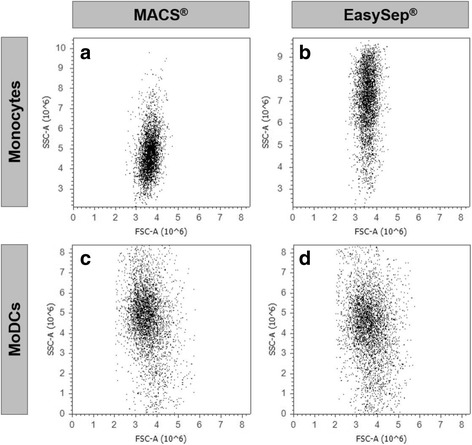
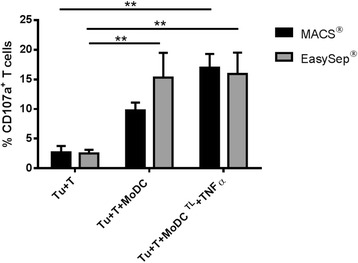
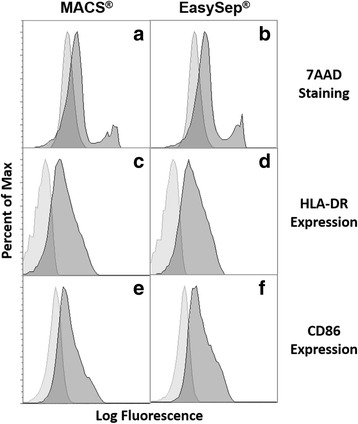
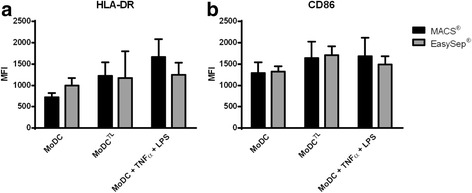
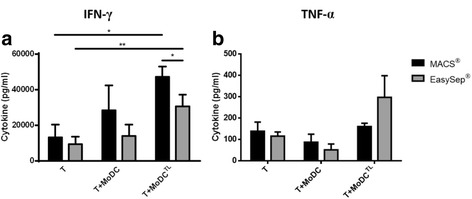
MACS technology allowed a higher monocyte yield and purity and, by flow cytometry, monocytes displayed higher size and lower granularity. In the resting state, EasySep_MoDCs showed a higher basal expression of HLA-DR, and no significant response to stimulation by LPS and TNF-α. When stimulated with whole tumor cells lysates, both MoDCs expressed similar levels of maturation and co-stimulatory markers. However, when cultured with autologous T cells, MACS_MoDCs induced significantly higher IFN-γ secretion than EasySep_MoDCs, indicating a stronger induction of Th1 cell response profile. Concordantly, T cells induced by MACS_MoDCs also showed a higher release of cytotoxic granules when in contact with tumor cells.
Overall, both the MACS and the EasySep isolation immunomagnetic technologies provide monocytes that differentiate into viable and functional MoDCs. In our experimental settings, resting EasySep_MoDCs showed a higher basal level of maturation but show less responsivity to stimuli. On the other hand, MACS_MoDCs, when stimulated with tumor antigens, showed better ability to stimulate Th1 responses and to induce T cell cytotoxicity against tumor cells. Thus, monocyte isolation techniques crucially affect MoDCs' function and, therefore, should be carefully selected to obtain the desired functionality.
可作为抗癌疫苗的树突状细胞(DCs)通常在体外从分离的CD14单核细胞中获得(单核细胞来源的树突状细胞,MoDCs)。这能产生大量细胞,并能对DCs进行定向诱导以确保有效的抗肿瘤反应。然而,单核细胞分离步骤对所产生的MoDCs抗肿瘤效果的影响仍不清楚。在此,我们比较了最常用的用于单核细胞分离的免疫磁珠技术:美天旎生物技术公司的磁性激活细胞分选(MACS)和STEM CELL公司的EasySep。
MACS技术能获得更高的单核细胞产量和纯度,通过流式细胞术检测,单核细胞显示出更大的尺寸和更低的颗粒度。在静息状态下,EasySep_MoDCs显示出更高的HLA-DR基础表达水平,并且对脂多糖(LPS)和肿瘤坏死因子-α(TNF-α)刺激无显著反应。当用全肿瘤细胞裂解物刺激时,两种MoDCs表达相似水平的成熟和共刺激标志物。然而,当与自体T细胞共培养时,MACS_MoDCs诱导的干扰素-γ(IFN-γ)分泌显著高于EasySep_MoDCs,表明其对Th1细胞反应谱的诱导更强。与此一致,MACS_MoDCs诱导的T细胞在与肿瘤细胞接触时也显示出更高的细胞毒性颗粒释放。
总体而言,MACS和EasySep分离免疫磁珠技术都能提供分化为有活力且功能正常的MoDCs的单核细胞。在我们的实验条件下,静息的EasySep_MoDCs显示出更高的基础成熟水平,但对刺激的反应性较低。另一方面,MACS_MoDCs在用肿瘤抗原刺激时,显示出更好的刺激Th1反应和诱导T细胞对肿瘤细胞细胞毒性的能力。因此,单核细胞分离技术对MoDCs的功能有至关重要的影响,所以应谨慎选择以获得所需的功能。