Lin Xinfeng, Jiang Qilong, Liu Jiduo, Zhao Fu, Chen Weitao
Intensive Care Unit, The First Affiliated Hospital of Guangzhou University of Chinese Medicine, Guangzhou, Guangdong 510405, P.R. China.
Department of Laboratory Medicine, The First Affiliated Hospital of Guangzhou University of Chinese Medicine, Guangzhou, Guangdong 510405, P.R. China.
Exp Ther Med. 2018 Feb;15(2):1199-1202. doi: 10.3892/etm.2017.5519. Epub 2017 Nov 16.
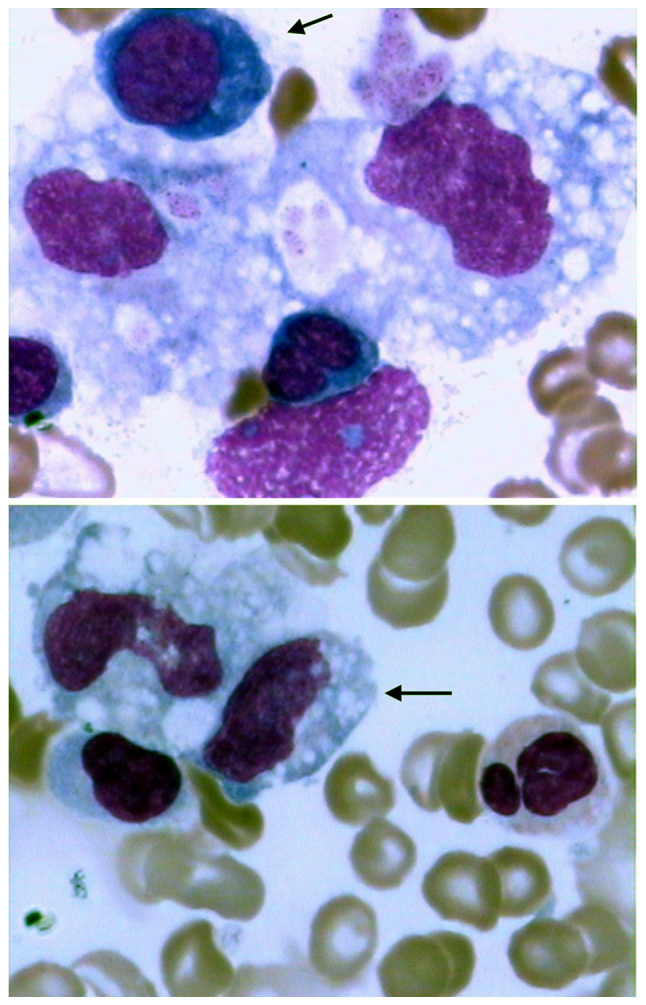
Hemophagocytic lymphohistiocytosis (HLH) is a rare hyperinflammatory syndrome characterized by fever, pancytopenia and splenomegaly. The underlying hemophagocytosis occurs primarily in the bone marrow, liver and lymph nodes. Multiple microbiological agents, including cytomegalovirus, Epstein-Barr virus and , have been implicated in the pathogenesis of HLH. The present study presents a case of HLH associated with infection treated successfully with clindamycin. A 33-year-old man presented with recurrent episodes of fever and diarrhea. Upon initial treatment at another hospital (the First Affiliated Hospital of Sun Yat-sen University, Guangzhou, China), blood chemistry analysis demonstrated moderate anemia (hemoglobin 88 g/l; reference range, 120.0-160.0), elevated ferritin (1,068.47 mg/l; reference range, 21.81-274.66), total bilirubin (392.4 mmol/l; reference range, 5.1-28.0), conjugated bilirubin (335.7 mmol/l; reference range, 0-10.0), and γ-glutamyl transpeptidase (150 U/l; reference range, 10-60). The patient was treated with antibiotics for suspected pneumonia and cholecystitis, but new symptoms (including diarrhea and inflammatory colitis) started to emerge. The patient was subsequently treated with ganciclovir (5 mg/kg/day for 1 month), but body temperature increased to 41.0°C. Upon transferring to our hospital, the patient had severe anemia (hemoglobin, 39 g/l; red blood cell, 1.61×10/l; reference range, 4.0-5.5×10/l). Jaundice was apparent: Total bilirubin, 299.5 mmol/l; conjugated bilirubin, 215.7 mmol/l. The patient was treated with clindamycin (150 mg, taken orally every 12 h for 1 week) and supportive care that included parenteral nutrition. Symptoms rapidly dissipated after the treatment. Blood chemistry analysis 5 days after the first dose of clindamycin revealed substantial improvement in anemia and jaundice. The patient requested discharge for financial reasons, but continued treatment (details not available) at a local hospital (Pengpai Memorial Hospital, Shanwei, China). Upon a visit to our hospital 8 months later, the patient has no notable complaints, with the exception of moderate anemia. The present case suggests that HLH may be associated with infection.
噬血细胞性淋巴组织细胞增生症(HLH)是一种罕见的高炎症综合征,其特征为发热、全血细胞减少和脾肿大。潜在的噬血细胞现象主要发生在骨髓、肝脏和淋巴结。多种微生物病原体,包括巨细胞病毒、爱泼斯坦-巴尔病毒等,都与HLH的发病机制有关。本研究报告了一例与 感染相关的HLH病例,经克林霉素治疗成功。一名33岁男性出现反复发热和腹泻。在另一家医院(中国广州中山大学附属第一医院)初次治疗时,血液化学分析显示中度贫血(血红蛋白88 g/l;参考范围,120.0 - 160.0)、铁蛋白升高(1,068.47 mg/l;参考范围,21.81 - 274.66)、总胆红素(392.4 mmol/l;参考范围,5.1 - 28.0)、结合胆红素(335.7 mmol/l;参考范围,0 - 10.0)和γ-谷氨酰转肽酶(150 U/l;参考范围,10 - 60)。该患者因疑似肺炎和胆囊炎接受抗生素治疗,但新的症状(包括腹泻和炎症性结肠炎)开始出现。随后患者接受更昔洛韦治疗(5 mg/kg/天,持续1个月),但体温升至41.0°C。转至我院时,患者出现严重贫血(血红蛋白39 g/l;红细胞1.61×10/l;参考范围,4.0 - 5.5×10/l)。黄疸明显:总胆红素299.5 mmol/l;结合胆红素215.7 mmol/l。患者接受克林霉素治疗(150 mg,每12小时口服1次,持续1周)及包括肠外营养在内的支持治疗。治疗后症状迅速缓解。首次服用克林霉素5天后的血液化学分析显示贫血和黄疸有显著改善。患者因经济原因要求出院,但在当地医院(中国汕尾彭湃纪念医院)继续治疗(具体情况不详)。8个月后到我院复诊时,患者除中度贫血外无明显不适。本病例提示HLH可能与 感染有关。 (注:原文中有一处未明确写出的病原体,用 代替)