Murphy Dominic, Ross Jana, Ashwick Rachel, Armour Cherie, Busuttil Walter
Research Department, Combat Stress, Leatherhead, UK.
King's Centre for Military Health Research, Department of Psychological Medicine, King's College London, London, UK.
Eur J Psychotraumatol. 2017 Nov 13;8(1):1398001. doi: 10.1080/20008198.2017.1398001. eCollection 2017.
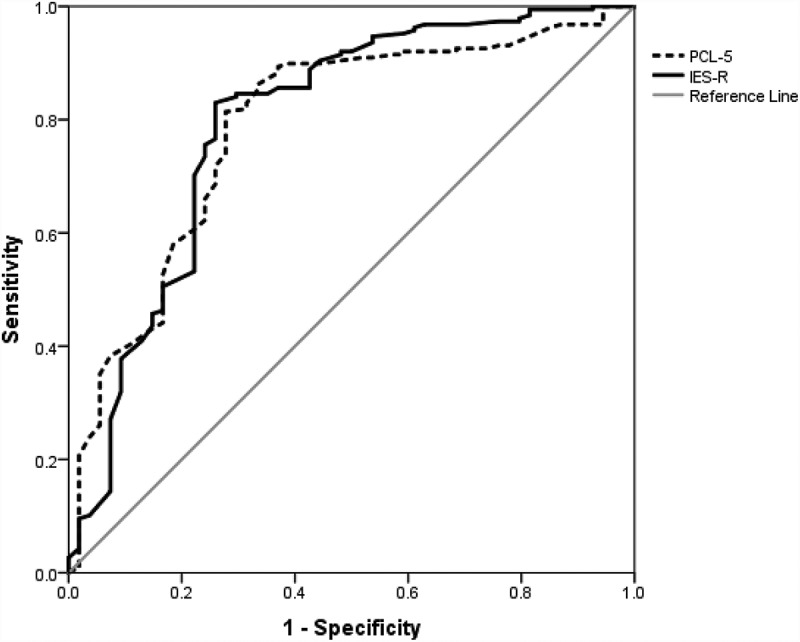
: Previous research exploring the psychometric properties of the scores of measures of posttraumatic stress disorder (PTSD) suggests there is variation in their functioning depending on the target population. To date, there has been little study of these properties within UK veteran populations. : This study aimed to determine optimally efficient cut-off values for the Impact of Event Scale-Revised (IES-R) and the PTSD Checklist for DSM-5 (PCL-5) that can be used to assess for differential diagnosis of presumptive PTSD. : Data from a sample of 242 UK veterans assessed for mental health difficulties were analysed. The criterion-related validity of the PCL-5 and IES-R were evaluated against the Clinician-Administered PTSD Scale for DSM-5 (CAPS-5). Kappa statistics were used to assess the level of agreement between the DSM-IV and DSM-5 classification systems. : The optimal cut-off scores observed within this sample were 34 or above on the PCL-5 and 46 or above on the IES-R. The PCL-5 cut-off is similar to the previously reported values, but the IES-R cut-off identified in this study is higher than has previously been recommended. Overall, a moderate level of agreement was found between participants screened positive using the DSM-IV and DSM-5 classification systems of PTSD. : Our findings suggest that the PCL-5 and IES-R can be used as brief measures within veteran populations presenting at secondary care to assess for PTSD. The use of a higher cut-off for the IES-R may be helpful for differentiating between veterans who present with PTSD and those who may have some sy`mptoms of PTSD but are sub-threshold for meeting a diagnosis. Further, the use of more accurate optimal cut-offs may aid clinicians to better monitor changes in PTSD symptoms during and after treatment.
先前探索创伤后应激障碍(PTSD)测量分数心理测量特性的研究表明,其功能会因目标人群的不同而有所差异。迄今为止,在英国退伍军人人群中对这些特性的研究很少。
本研究旨在确定事件影响量表修订版(IES-R)和DSM-5创伤后应激障碍检查表(PCL-5)的最佳有效临界值,可用于评估疑似创伤后应激障碍的鉴别诊断。
对242名接受心理健康问题评估的英国退伍军人样本数据进行了分析。以DSM-5临床医生管理的创伤后应激障碍量表(CAPS-5)为对照,评估PCL-5和IES-R与标准相关的效度。使用kappa统计量来评估DSM-IV和DSM-5分类系统之间的一致性水平。
在该样本中观察到的最佳临界分数为PCL-5为34分及以上,IES-R为46分及以上。PCL-5的临界值与先前报告的值相似,但本研究中确定的IES-R临界值高于先前推荐的值。总体而言,在使用DSM-IV和DSM-5创伤后应激障碍分类系统筛查呈阳性的参与者之间发现了中等程度的一致性。
我们的研究结果表明,PCL-5和IES-R可作为二级医疗中退伍军人人群评估创伤后应激障碍的简短测量工具。对IES-R使用更高的临界值可能有助于区分患有创伤后应激障碍的退伍军人和那些可能有一些创伤后应激障碍症状但未达到诊断阈值的人。此外,使用更准确的最佳临界值可能有助于临床医生更好地监测治疗期间和治疗后创伤后应激障碍症状的变化。