Liu Xiang, Chen Fei, Lyu Shengman, Sun Dexin, Zhou Shurong
State Key Laboratory of Earth Surface Processes and Resource Ecology Beijing Normal University Beijing China.
Ministry of Education Key Laboratory for Biodiversity Science and Ecological Engineering School of Life Sciences Fudan University Shanghai China.
Ecol Evol. 2018 Jan 8;8(3):1705-1713. doi: 10.1002/ece3.3749. eCollection 2018 Feb.
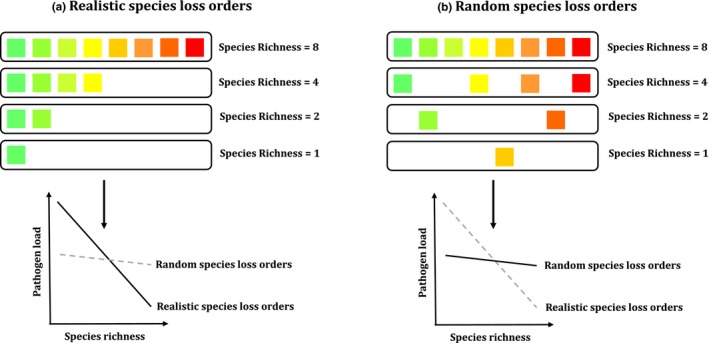
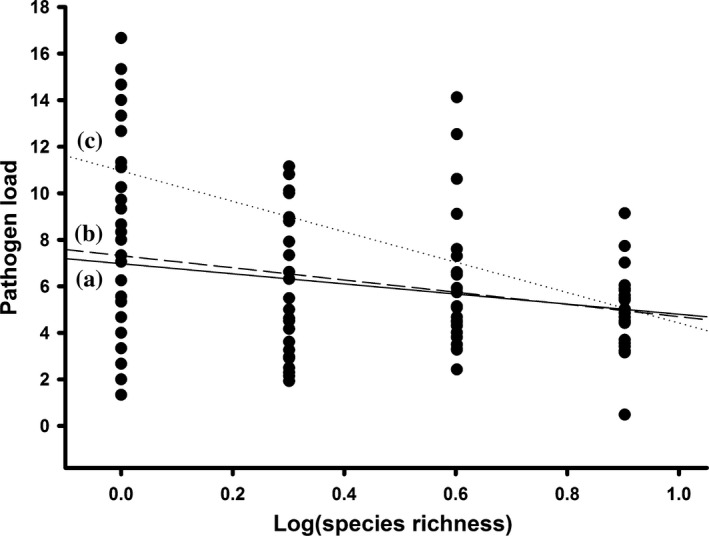
With increasing attention being paid to the consequences of global biodiversity losses, several recent studies have demonstrated that realistic species losses can have larger impacts than random species losses on community productivity and resilience. However, little is known about the effects of the order in which species are lost on biodiversity-disease relationships. Using a multiyear nitrogen addition and artificial warming experiment in natural assemblages of alpine meadow vegetation on the Qinghai-Tibetan Plateau, we inferred the sequence of plant species losses under fertilization/warming. Then the sequence of species losses under fertilization/warming was used to simulate the species loss orders (both realistic and random) in an adjacently novel removal experiment manipulating plot-level plant diversity. We explicitly compared the effect sizes of random versus realistic species losses simulated from fertilization/warming on plant foliar fungal diseases. We found that realistic species losses simulated from fertilization had greater effects than random losses on fungal diseases, and that species identity drove the diversity-disease relationship. Moreover, the plant species most prone to foliar fungal diseases were also the least vulnerable to extinction under fertilization, demonstrating the importance of protecting low competence species (the ability to maintain and transmit fungal infections was low) to impede the spread of infectious disease. In contrast, there was no difference between random and realistic species loss scenarios simulated from experimental warming (or the combination of warming and fertilization) on the diversity-disease relationship, indicating that the functional consequences of species losses may vary under different drivers.
随着全球生物多样性丧失的后果受到越来越多的关注,最近的几项研究表明,实际的物种丧失比随机的物种丧失对群落生产力和恢复力的影响更大。然而,对于物种丧失的顺序对生物多样性与疾病关系的影响却知之甚少。我们在青藏高原高寒草甸植被的自然群落中进行了一项多年的氮添加和人工增温实验,推断施肥/增温条件下植物物种丧失的顺序。然后,利用施肥/增温条件下的物种丧失顺序,在一个相邻的新颖去除实验中模拟物种丧失顺序(包括实际的和随机的),该实验操纵样地水平的植物多样性。我们明确比较了从施肥/增温模拟出的随机物种丧失和实际物种丧失对植物叶部真菌病害的效应大小。我们发现,施肥模拟出的实际物种丧失比随机丧失对真菌病害的影响更大,而且物种身份驱动了多样性与疾病的关系。此外,最易感染叶部真菌病害的植物物种在施肥条件下也是最不易灭绝的,这表明保护低感染能力物种(维持和传播真菌感染的能力较低)对于阻止传染病传播的重要性。相比之下,实验增温(或增温和施肥相结合)模拟出的随机物种丧失和实际物种丧失情景在多样性与疾病关系上没有差异,这表明在不同驱动因素下,物种丧失的功能后果可能会有所不同。