Lee Joo Eun, Park Eun Cheol, Jang Suk Yong, Lee Sang Ah, Choy Yoon Soo, Kim Tae Hyun
Department of Public Health, Yonsei University College of Medicine, Seoul, Korea.
Institute of Health Services Research, Yonsei University College of Medicine, Seoul, Korea.
Yonsei Med J. 2018 Mar;59(2):243-251. doi: 10.3349/ymj.2018.59.2.243.
Readmission and mortality rates of patients with heart failure are good indicators of care quality. To determine whether hospital resources are associated with care quality for cardiac patients, we analyzed the effect of number of physicians and the combined effects of number of physicians and beds on 30-day readmission and 1-year mortality.
We used national cohort sample data of the National Health Insurance Service (NHIS) claims in 2002-2013. Subjects comprised 2345 inpatients (age: >65 years) admitted to acute-care hospitals for heart failure. A multivariate Cox regression was used.
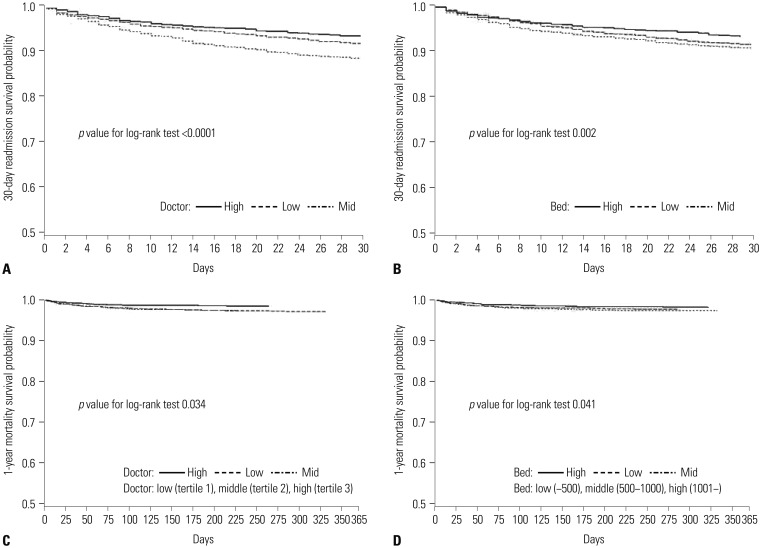
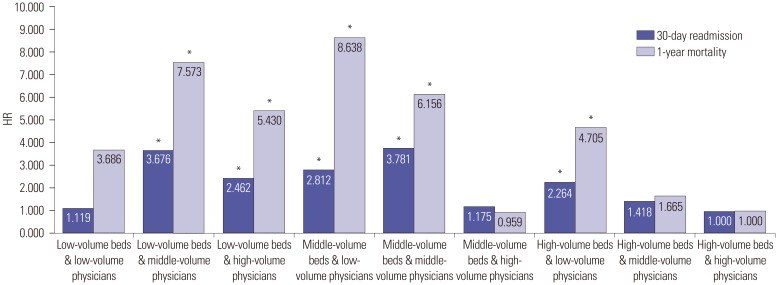
Of the 2345 patients hospitalized with heart failure, 812 inpatients (34.6%) were readmitted within 30 days and 190 (8.1%) had died within a year. Heart-failure patients treated at hospitals with low physician volumes had higher readmission and mortality rates than high physician volumes [30-day readmission: hazard ratio (HR)=1.291, 95% confidence interval (CI)=1.020-1.633; 1-year mortality: HR=2.168, 95% CI=1.415-3.321]. Patients admitted to hospitals with low or middle bed and physician volume had higher 30-day readmission and 1-year mortality rates than those admitted to hospitals with high volume (30-day readmission: HR=2.812, 95% CI=1.561-5.066 for middle-volume beds & low-volume physicians, 1-year mortality: HR=8.638, 95% CI=2.072-36.02 for middle-volume beds & low-volume physicians).
Physician volume is related to lower readmission and mortality for heart failure. Of interest, 30-day readmission and 1-year mortality were significantly associated with the combined effects of physician and institution bed volume.
心力衰竭患者的再入院率和死亡率是护理质量的良好指标。为了确定医院资源是否与心脏病患者的护理质量相关,我们分析了医生数量以及医生数量和床位的综合影响对30天再入院率和1年死亡率的作用。
我们使用了2002年至2013年国家健康保险服务(NHIS)索赔的全国队列样本数据。研究对象包括2345名因心力衰竭入住急症医院的住院患者(年龄:>65岁)。采用多变量Cox回归分析。
在2345例因心力衰竭住院的患者中,812例(34.6%)在30天内再次入院,190例(8.1%)在1年内死亡。在医生数量少的医院接受治疗的心力衰竭患者比医生数量多的医院有更高的再入院率和死亡率[30天再入院率:风险比(HR)=1.291,95%置信区间(CI)=1.020 - 1.633;1年死亡率:HR = 2.168,95% CI = 1.415 - 3.321]。入住床位和医生数量少或中等的医院的患者比入住数量多的医院的患者有更高的30天再入院率和1年死亡率(30天再入院率:中等床位且医生数量少的医院,HR = 2.812,95% CI = 1.561 - 5.066;1年死亡率:中等床位且医生数量少的医院,HR = 8.638,95% CI = 2.072 - 36.02)。
医生数量与心力衰竭患者较低的再入院率和死亡率相关。有趣的是,30天再入院率和1年死亡率与医生数量和医院床位数量的综合影响显著相关。