Department of Ecology and Evolution, University of Lausanne, Biophore Building, 1015 Lausanne, Switzerland.
Department of Conservation Biology, UFZ Helmholtz-Centre for Environmental Research, Permoserstrasse 15, 04318 Leipzig, Germany.
Proc Biol Sci. 2018 Feb 14;285(1872). doi: 10.1098/rspb.2017.2667. Epub 2018 Feb 7.
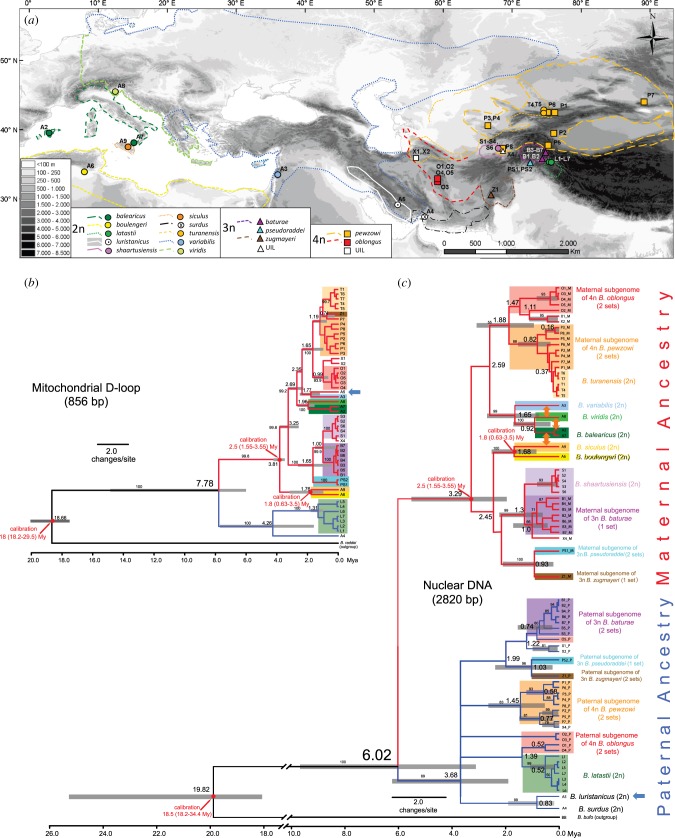
The evolutionary causes and consequences of allopolyploidization, an exceptional pathway to instant hybrid speciation, are poorly investigated in animals. In particular, when and why hybrid polyploids versus diploids are produced, and constraints on sources of paternal and maternal ancestors, remain underexplored. Using the Palearctic green toad radiation (including bisexually reproducing species of three ploidy levels) as model, we generate a range-wide multi-locus phylogeny of 15 taxa and present four new insights: (i) at least five (up to seven) distinct allotriploid and allotetraploid taxa have evolved in the Pleistocene; (ii) all maternal and paternal ancestors of hybrid polyploids stem from two deeply diverged nuclear clades (6 Mya, 3.1-9.6 Mya), with distinctly greater divergence than the parental species of diploid hybrids found at secondary contact zones; (iii) allotriploid taxa possess two conspecific genomes and a deeply diverged allospecific one, suggesting that genomic imbalance and divergence are causal for their partly clonal reproductive mode; (iv) maternal versus paternal genome contributions exhibit asymmetry, with the maternal nuclear (and mitochondrial) genome of polyploids always coming from the same clade, and the paternal genome from the other. We compare our findings with similar patterns in diploid/polyploid vertebrates, and suggest deep ancestral divergence as a precondition for successful allopolyploidization.
多倍体化的进化原因和后果,即杂种快速形成新物种的特殊途径,在动物中研究甚少。特别是,杂种多倍体与二倍体的产生时间和原因,以及父本和母本祖先的来源限制,仍未得到充分探索。利用包括三种倍性水平的两性生殖物种在内的古北界绿蟾蜍辐射作为模型,我们生成了一个全范围的 15 个分类单元的多基因座系统发育,并提出了四个新的见解:(i)至少有五个(最多七个)不同的异源多倍体和异源四倍体分类单元是在更新世进化而来的;(ii)杂种多倍体的所有母本和父本祖先都来自两个深度分化的核类群(6 Mya,3.1-9.6 Mya),与在次级接触区发现的二倍体杂种的亲本物种相比,分化程度明显更大;(iii)异源多倍体分类单元拥有两个同种基因组和一个深度分化的异源基因组,表明基因组失衡和分化是其部分克隆繁殖模式的原因;(iv)母本与父本基因组的贡献存在不对称性,多倍体的母本核(和线粒体)基因组总是来自同一类群,而父本基因组则来自另一类群。我们将我们的发现与二倍体/多倍体脊椎动物的类似模式进行了比较,并提出了深度的祖先分化是成功多倍体化的前提条件。