Kempkes L J M, Boles G C, Martens J, Berden G, Armentrout P B, Oomens J
FELIX Laboratory, Institute for Molecules and Materials , Radboud University , Toernooiveld 7c , 6525 ED , Nijmegen , The Netherlands.
Department of Chemistry , University of Utah , 315 South 1400 East , Room 2020, Salt Lake City , Utah 84112 , United States.
J Phys Chem A. 2018 Mar 8;122(9):2424-2436. doi: 10.1021/acs.jpca.7b12348. Epub 2018 Feb 27.
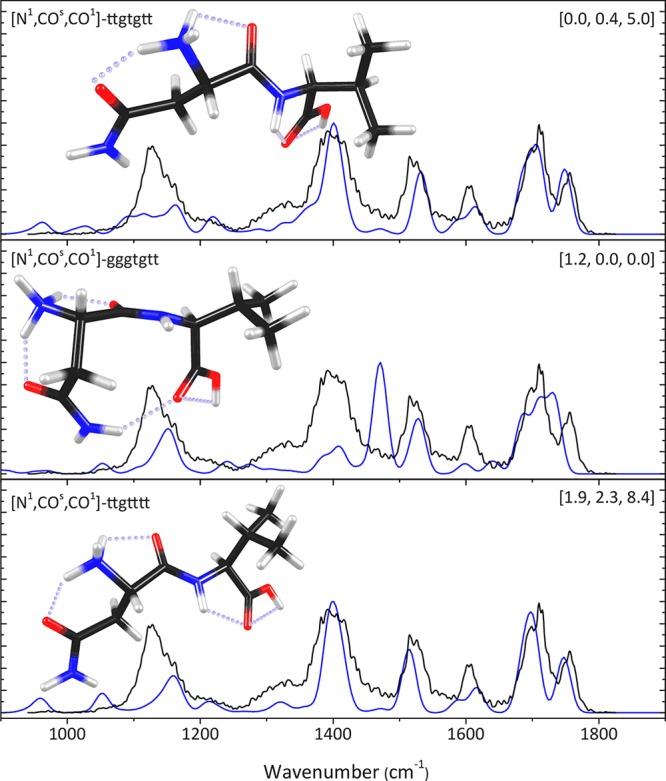
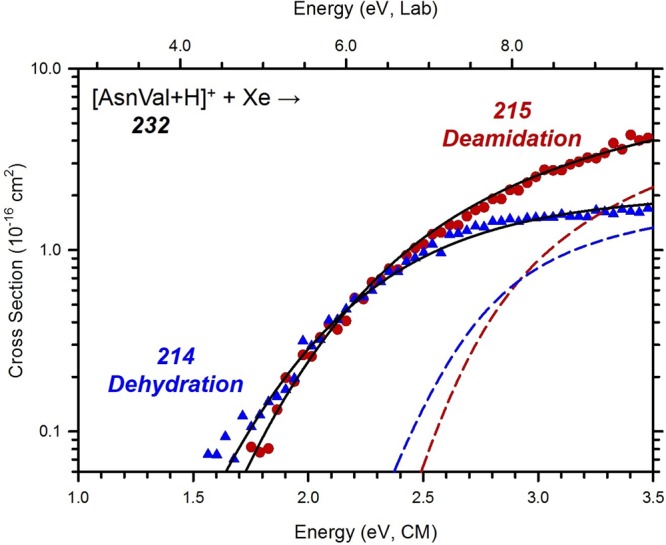
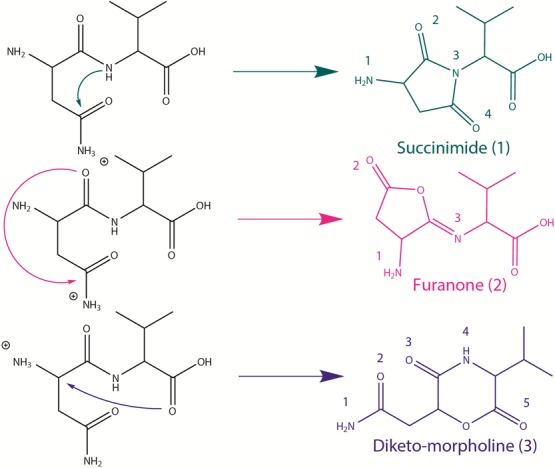
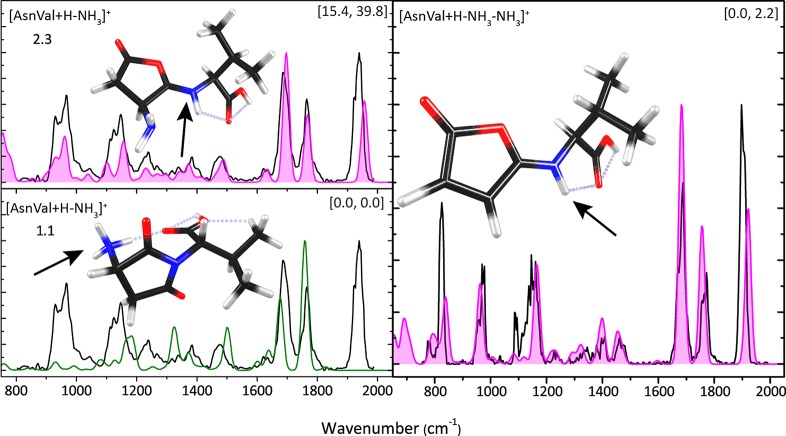
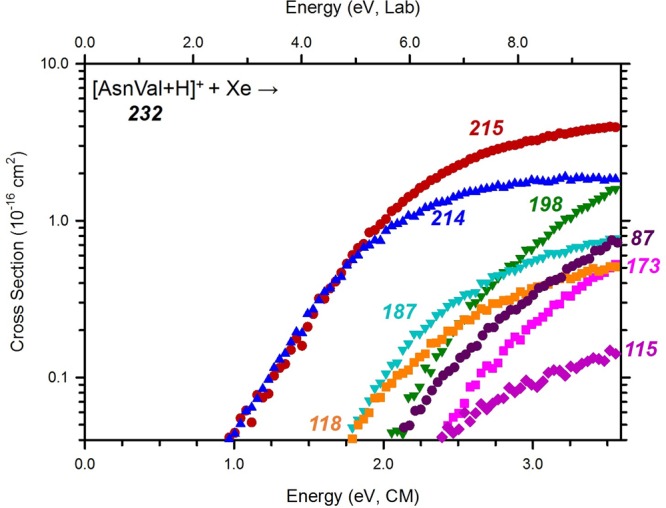
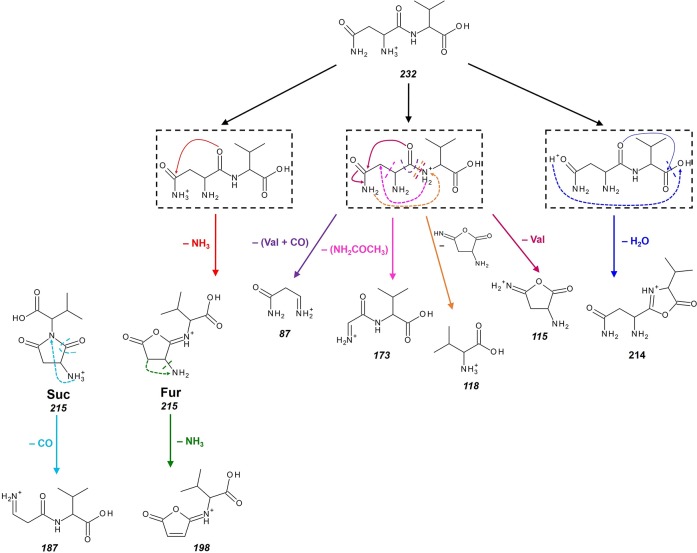
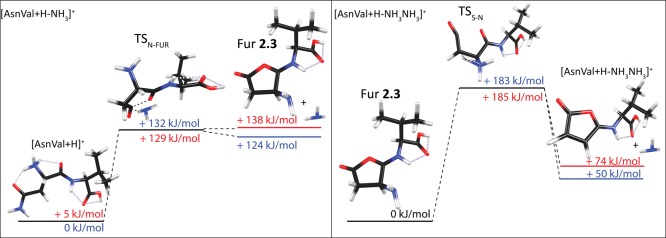
Peptide deamidation of asparaginyl residues is a spontaneous post-translational modification that is believed to play a role in aging and several diseases. It is also a well-known small-molecule loss channel in the MS/MS spectra of protonated peptides. Here we investigate the deamidation reaction, as well as other decomposition pathways, of the protonated dipeptide asparagine-valine ([AsnVal + H]) upon low-energy activation in a mass spectrometer. Using a combination of infrared ion spectroscopy, guided ion beam tandem mass spectrometry, and theoretical calculations, we have been able to identify product ion structures and determine the energetics and mechanisms for decomposition. Deamidation proceeds via ammonia loss from the asparagine side chain, initiated by a nucleophilic attack of the peptide bond oxygen on the γ-carbon of the Asn side chain. This leads to the formation of a furanone ring containing product ion characterized by a threshold energy of 129 ± 5 kJ/mol (15 kJ/mol higher in energy than dehydration of [AsnVal + H], the lowest energy dissociation channel available to the system). Competing formation of a succinimide ring containing product, as has been observed for protonated asparagine-glycine ([AsnGly + H]) and asparagine-alanine ([AsnAla + H]), was not observed here. Quantum-chemical modeling of the reaction pathways confirms these subtle differences in dissociation behavior. Measured reaction thresholds are in agreement with predicted theoretical reaction energies computed at several levels of theory.
天冬酰胺残基的肽脱酰胺作用是一种自发的翻译后修饰,被认为在衰老和多种疾病中起作用。它也是质子化肽的串联质谱(MS/MS)谱中一个众所周知的小分子损失通道。在此,我们研究了质子化二肽天冬酰胺 - 缬氨酸([AsnVal + H])在质谱仪中低能活化后的脱酰胺反应以及其他分解途径。通过结合红外离子光谱、导向离子束串联质谱和理论计算,我们能够识别产物离子结构,并确定分解的能量学和机制。脱酰胺作用通过从天冬酰胺侧链失去氨进行,起始于肽键氧对天冬酰胺侧链γ - 碳的亲核攻击。这导致形成一个含呋喃酮环的产物离子,其特征阈值能量为129±5 kJ/mol(比[AsnVal + H]脱水的能量高15 kJ/mol,脱水是该系统可利用的最低能量解离通道)。此处未观察到如质子化天冬酰胺 - 甘氨酸([AsnGly + H])和天冬酰胺 - 丙氨酸([AsnAla + H])中所观察到的含琥珀酰亚胺环产物的竞争形成。反应途径的量子化学建模证实了解离行为中的这些细微差异。测得的反应阈值与在几个理论水平计算的预测理论反应能量一致。