Zhang Ling, Liu Wenkuan, Liu Donglan, Chen Dehui, Tan Weiping, Qiu Shuyan, Xu Duo, Li Xiao, Liu Tiantian, Zhou Rong
State Key Laboratory of Respiratory Diseases, The First Affiliated Hospital of Guangzhou Medical University, Guangzhou Medical University, Guangzhou, People's Republic of China.
Department of Pediatrics, The First Affiliated Hospital of Guangzhou Medical University, Guangzhou Medical University, Guangzhou, People's Republic of China.
BMJ Open. 2018 Feb 6;8(2):e019308. doi: 10.1136/bmjopen-2017-019308.
Human metapneumovirus (HMPV) is one of the most important respiratory viral pathogens affecting infants and children worldwide. Our study describes the epidemiological and clinical characteristics of HMPV present in patients hospitalised with acute respiratory illness (ARI) in Guangzhou, Southern China.
A cross-sectional study.
Two tertiary hospitals in Guangzhou.
Throat swabs were collected over a 3-year period from 5133 paediatric patients (≤14 years) hospitalised with ARI. Patients who are HMPV positive with clinical presentations (101/103) were recorded for further analysis.
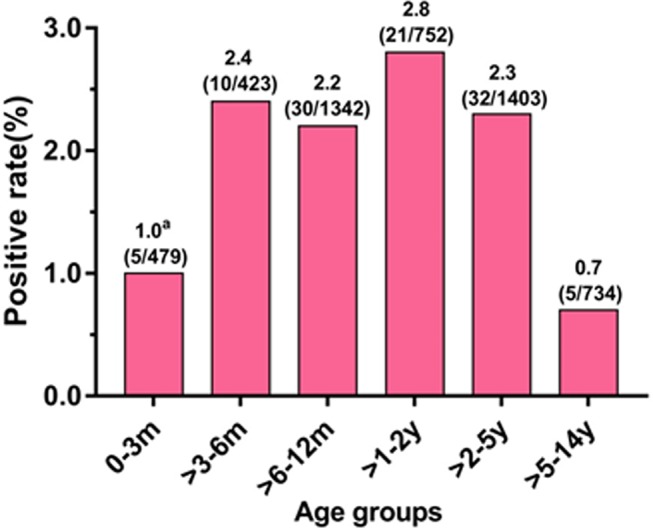
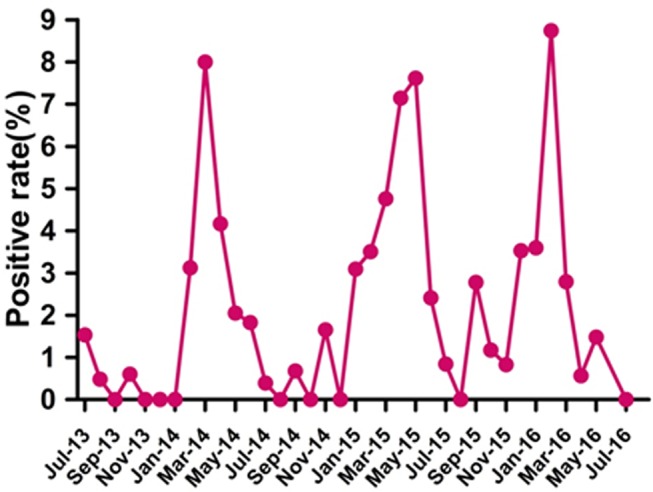
Of the 5133 patients included in the study, 103 (2.0%) were positive for HMPV. HMPV was more prevalent in children ≤5 years (2.2%, 98/4399) compared with older children (>5-14 years) (0.7%, 5/734) (P0.004). Two seasonal HMPV peaks were observed each year and mainly occurred in spring and early summer. Overall, 18.4% (19/103) of patients who are HMPV positive were codetected with other pathogens, most frequently respiratory syncytial virus (36.8%, 7/19). Patients who are HMPV positive presented with a wide spectrum of clinical features, including cough (100.0%, 101/101), abnormal pulmonary breath sound (91.1%, 92/101), fever (88.1%, 89/101), expectoration (77.2%, 78/101), coryza (50.5%, 51/101) and wheezing (46.5%, 47/101). The main diagnosis of patients who are HMPV positive was bronchopneumonia (66.7%, 56/84). Fever (≥38˚C) (91.6%, 76/83) was detected more often in patients with only HMPV detected than in patients with HMPV plus other pathogen(s) detected (72.2%, 13/18) (P=0.037), whereas diarrhoea was more common in patients with HMPV plus other pathogen(s) detected (22.2%, 4/18), compared with patients with HMPV only (3.6%, 3/83) (P=0.018).
HMPV is an important respiratory pathogen in children with ARI in Guangzhou, particularly in children ≤5 years old. HMPV has a seasonal variation. Bronchopneumonia is a major diagnosis in patients who are HMPV positive.
人偏肺病毒(HMPV)是影响全球婴幼儿的最重要的呼吸道病毒病原体之一。我们的研究描述了中国南方广州地区因急性呼吸道疾病(ARI)住院患者中HMPV的流行病学和临床特征。
横断面研究。
广州的两家三级医院。
在3年时间里,从5133名因ARI住院的儿科患者(≤14岁)中采集咽拭子。记录HMPV检测呈阳性且有临床表现的患者(101/103),进行进一步分析。
在纳入研究的5133名患者中,103名(2.0%)HMPV检测呈阳性。与大龄儿童(>5 - 14岁)(0.7%,5/734)相比,HMPV在≤5岁儿童中更常见(2.2%,98/4399)(P<0.004)。每年观察到两个HMPV季节性高峰,主要发生在春季和初夏。总体而言,18.4%(19/103)的HMPV阳性患者同时检测出其他病原体,最常见的是呼吸道合胞病毒(36.8%,7/19)。HMPV阳性患者表现出广泛的临床特征,包括咳嗽(100.0%,101/101)、肺部呼吸音异常(91.1%,92/101)、发热(88.1%,89/101)、咳痰(77.2%,78/101)、鼻塞(50.5%,51/101)和喘息(46.5%,47/101)。HMPV阳性患者的主要诊断为支气管肺炎(66.7%,56/84)。仅检测出HMPV的患者中发热(≥38˚C)(91.6%,76/83)的发生率高于同时检测出HMPV和其他病原体的患者(72.2%,13/18)(P = 0.037),而腹泻在同时检测出HMPV和其他病原体的患者中更常见(22.2%,4/18),相比之下仅检测出HMPV的患者中腹泻发生率为3.6%(3/83)(P = 0.018)。
HMPV是广州地区ARI儿童中的重要呼吸道病原体,尤其是在≤5岁儿童中。HMPV有季节性变化。支气管肺炎是HMPV阳性患者的主要诊断。