Department of Endocrinology, First Affiliated Hospital, China Medical University, Shenyang, Liaoning, China (mainland).
Department of Orthopedic Surgery, First Affiliated Hospital, China Medical University, Shenyang, Liaoning, China (mainland).
Med Sci Monit. 2018 Feb 13;24:903-911. doi: 10.12659/msm.908705.
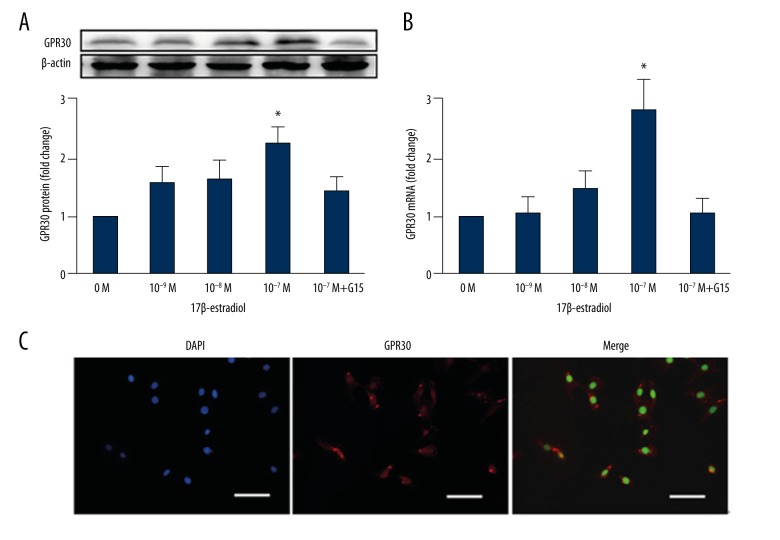
BACKGROUND Osteoporosis is associated with 17β-estradiol deficiency. The G protein-coupled receptor 30 (GPR30) is known to be an estrogen-responsive receptor, but its role in the degradation of mitochondria in osteoblasts by autophagy, or mitophagy, remains unclear. The aim of this in vitro study was to evaluate the effects of 17β-estradiol, GPR30, and its signaling pathway, on mitophagy in the murine MC3T3-E1 osteoblast cell line. MATERIAL AND METHODS In the murine MC3T3-E1 osteoblast cell line, cells were treated with 17β-estradiol, or G15, a selective GPR30 antagonist, or U0126, a mitogen-activated protein (MAP) kinase (ERK1/2) inhibitor, or with vehicle as control. The expression of GPR30 was determined by Western blot, reverse transcription-polymerase chain reaction (RT-PCR), and confocal immunofluorescence imaging. Cell morphology and mitochondrial autophagosomes were identified using transmission electron microscopy (TEM). Phosphorylation of the mitophagy markers, heat shock protein 60 (Hsp60), translocase of outer membrane (Tom)20, and microtubule-associated protein 1A/1B-light chain 3 (LC3) were determined by Western blot, and cell proliferation was determined using the bromodeoxyuridine (BrdU) assay. RESULTS The optimum concentration of 17β-estradiol that resulted in GPR30 expression in MC3T3-E1 cells was 10^-7 M, which led to the accumulation of mitochondrial autophagosomes and increased protein phosphorylation levels of Hsp60, Tom20, and LC3. In cells pretreated with G15 or U0126, 17b-estradiol treatment did not increase mitophagy in MC3T3-E1 cells. CONCLUSIONS In murine osteoblasts cultured in vitro, treatment with 17β-estradiol resulted in the expression of GPR30 and enhanced mitophagy through the GPR30 and ERK1/2 signaling pathway.
骨质疏松症与 17β-雌二醇缺乏有关。G 蛋白偶联受体 30(GPR30)已知是一种雌激素反应受体,但它在成骨细胞自噬或线粒体自噬(mitophagy)中导致线粒体降解的作用尚不清楚。本体外研究旨在评估 17β-雌二醇、GPR30 及其信号通路对鼠 MC3T3-E1 成骨细胞系中 mitophagy 的影响。
在鼠 MC3T3-E1 成骨细胞系中,用 17β-雌二醇、G15(一种选择性 GPR30 拮抗剂)或 U0126(丝裂原活化蛋白激酶(MAPK)ERK1/2 抑制剂)或载体处理细胞作为对照。通过 Western blot、逆转录聚合酶链反应(RT-PCR)和共聚焦免疫荧光成像确定 GPR30 的表达。使用透射电子显微镜(TEM)鉴定细胞形态和线粒体自噬体。通过 Western blot 测定线粒体自噬标志物热休克蛋白 60(Hsp60)、外膜转位酶 20(Tom20)和微管相关蛋白 1A/1B-轻链 3(LC3)的磷酸化水平,并使用溴脱氧尿苷(BrdU)测定细胞增殖。
在 MC3T3-E1 细胞中导致 GPR30 表达的 17β-雌二醇最佳浓度为 10^-7 M,导致线粒体自噬体积累,并增加 Hsp60、Tom20 和 LC3 的蛋白磷酸化水平。在用 G15 或 U0126 预处理的细胞中,17b-雌二醇处理不会增加 MC3T3-E1 细胞中的线粒体自噬。
在体外培养的鼠成骨细胞中,用 17β-雌二醇处理导致 GPR30 的表达,并通过 GPR30 和 ERK1/2 信号通路增强 mitophagy。