
一种针对未对齐全色和多光谱数据的改进型全色锐化方法。
An Improved Pansharpening Method for Misaligned Panchromatic and Multispectral Data.
作者信息
Li Hui, Jing Linhai, Tang Yunwei, Ding Haifeng
机构信息
Key Laborary of Digital Earth Sciences, Institute of Remote Sensing and Digital Earth, Chinese Academy of Sciences, Beijing 100094, China.
出版信息
Sensors (Basel). 2018 Feb 11;18(2):557. doi: 10.3390/s18020557.
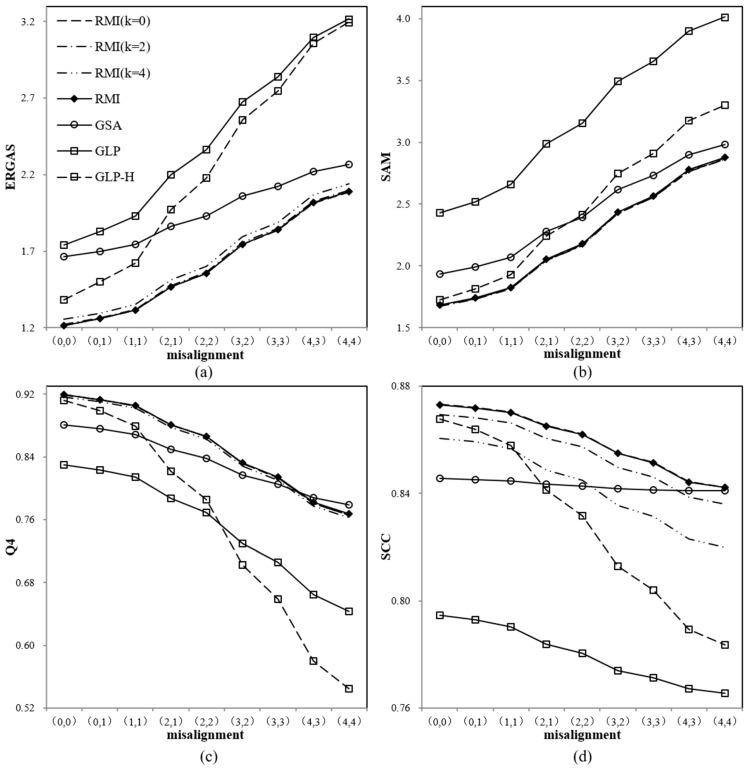
Numerous pansharpening methods were proposed in recent decades for fusing low-spatial-resolution multispectral (MS) images with high-spatial-resolution (HSR) panchromatic (PAN) bands to produce fused HSR MS images, which are widely used in various remote sensing tasks. The effect of misregistration between MS and PAN bands on quality of fused products has gained much attention in recent years. An improved method for misaligned MS and PAN imagery is proposed, through two improvements made on a previously published method named RMI (reduce misalignment impact). The performance of the proposed method was assessed by comparing with some outstanding fusion methods, such as adaptive Gram-Schmidt and generalized Laplacian pyramid. Experimental results show that the improved version can reduce spectral distortions of fused dark pixels and sharpen boundaries between different image objects, as well as obtain similar quality indexes with the original RMI method. In addition, the proposed method was evaluated with respect to its sensitivity to misalignments between MS and PAN bands. It is certified that the proposed method is more robust to misalignments between MS and PAN bands than the other methods.
近几十年来,人们提出了许多全色锐化方法,用于将低空间分辨率的多光谱(MS)图像与高空间分辨率(HSR)的全色(PAN)波段进行融合,以生成融合后的高空间分辨率多光谱图像,这些图像广泛应用于各种遥感任务中。近年来,MS波段和PAN波段之间的配准误差对融合产品质量的影响备受关注。本文提出了一种针对MS和PAN图像未对齐情况的改进方法,该方法是在之前发表的名为RMI(减少配准误差影响)的方法基础上进行了两处改进。通过与一些优秀的融合方法(如自适应Gram-Schmidt和广义拉普拉斯金字塔)进行比较,评估了所提方法的性能。实验结果表明,改进后的版本可以减少融合后暗像素的光谱失真,锐化不同图像对象之间的边界,并且与原始RMI方法获得相似的质量指标。此外针对所提方法对MS和PAN波段之间配准误差的敏感性进行了评估。结果证明,所提方法在MS和PAN波段之间的配准误差方面比其他方法更具鲁棒性。


 Zotero 插件