Xu Yuhao, Yao Shun, Wei Hong, Zhu Xiaolan, Yu Ming, Li Yuefeng
Department of Neurology, The Affiliated Hospital of Jiangsu University, Zhenjiang, People's Republic of China.
Department of Radiology, The Affiliated Hospital of Jiangsu University, Zhenjiang, People's Republic of China.
Neuropsychiatr Dis Treat. 2018 Feb 8;14:459-465. doi: 10.2147/NDT.S152247. eCollection 2018.
Transient depressive state (TDS) is a transient, negative emotional state caused by certain events or situations. Because of the similarity in depressive symptoms between depression and TDS that arise within 2 weeks of their onset, it is difficult to distinguish TDS from depression. The aims of the present study were to investigate the application value of selected serum indicators in the differential diagnosis of geriatric depression and TDS in the early stage and to provide evidence for treatment.
In this study, a total of 274 elderly patients were divided into the depression group (n=144) and the TDS group (n=130). All participants' serum samples were collected, and 9 selected serum indicators were analyzed. Afterward, 90 patients with depression and 90 patients with TDS were used to build the diagnostic model. A binary logistic regression analysis was used to establish regression models, and the area under the receiver operating characteristic (ROC) curve was drawn. Finally, another 54 patients with depression and 40 patients with TDS were used to validate our model.
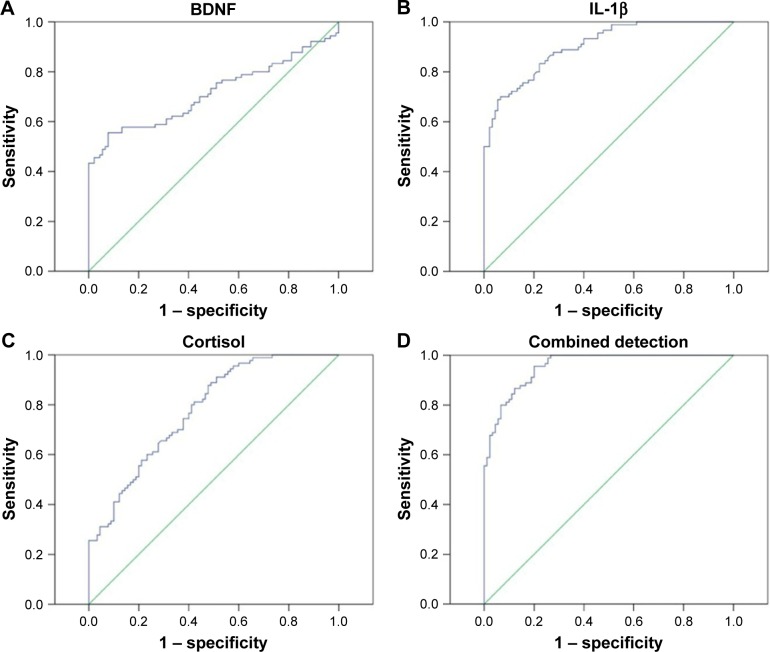
For the 9 screening serum indicators, the 3 serum indicators selected to build the regression model were BDNF (=0.001), IL-1β (<0.001), and cortisol (<0.001). The regression equation was Y = 1/[1 + e], and the ROC curve of combined detection was 0.926. The diagnostic rate of the logistic model was 89.36%.
The logistic regression model and ROC curves based on serum levels of BDNF, IL-1β, and cortisol could distinguish depression from TDS in early stage, which could provide assistance to the differential diagnosis of geriatric depression and TDS.
短暂抑郁状态(TDS)是由某些事件或情境引起的一种短暂的负面情绪状态。由于抑郁症与发病2周内出现的TDS在抑郁症状上相似,因此难以将TDS与抑郁症区分开来。本研究的目的是探讨所选血清指标在老年抑郁症和TDS早期鉴别诊断中的应用价值,并为治疗提供依据。
本研究共纳入274例老年患者,分为抑郁症组(n = 144)和TDS组(n = 130)。收集所有参与者的血清样本,并分析9种所选血清指标。之后,选取90例抑郁症患者和90例TDS患者建立诊断模型。采用二元逻辑回归分析建立回归模型,并绘制受试者工作特征(ROC)曲线下面积。最后,另选取54例抑郁症患者和40例TDS患者对我们的模型进行验证。
对于9种筛查血清指标,用于建立回归模型的3种血清指标为脑源性神经营养因子(BDNF,P = 0.001)、白细胞介素-1β(IL-1β,P < 0.001)和皮质醇(P < 0.001)。回归方程为Y = 1/[1 + e],联合检测的ROC曲线为0.926。逻辑模型的诊断率为89.36%。
基于BDNF、IL-1β和皮质醇血清水平的逻辑回归模型和ROC曲线可在早期区分抑郁症和TDS,可为老年抑郁症和TDS的鉴别诊断提供帮助。