Center for Biotechnology and Genomic Medicine, Augusta University, Augusta, GA, United States.
Department of Obstetrics and Gynecology, Medical College of Georgia, Augusta University, Augusta, GA, United States.
Front Immunol. 2018 Jan 31;9:154. doi: 10.3389/fimmu.2018.00154. eCollection 2018.
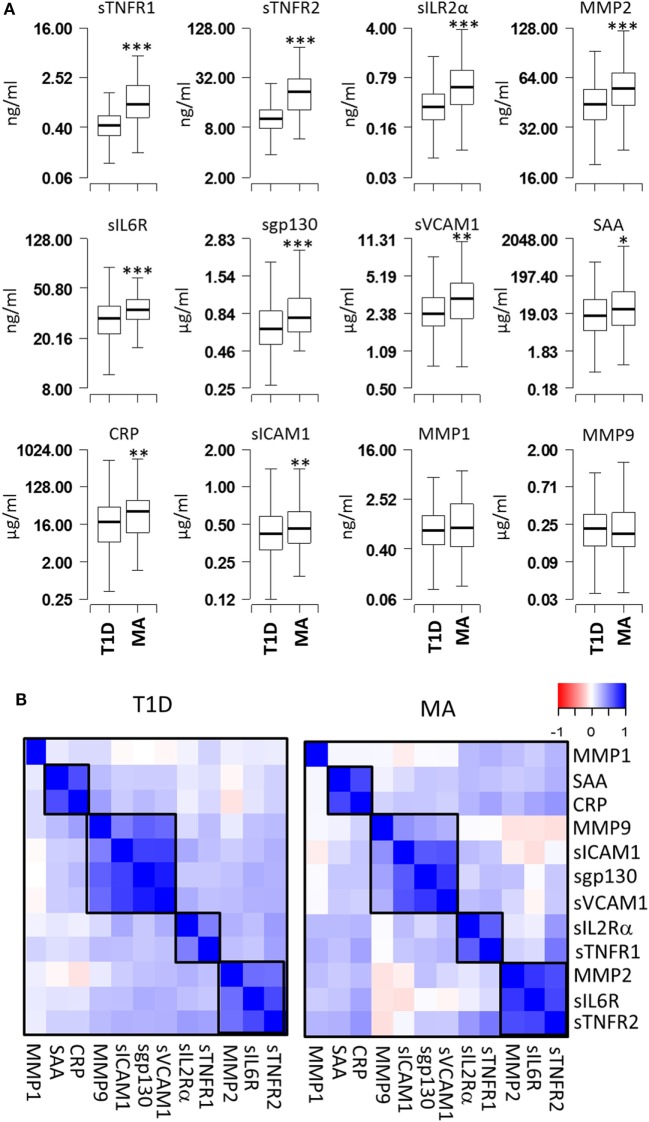
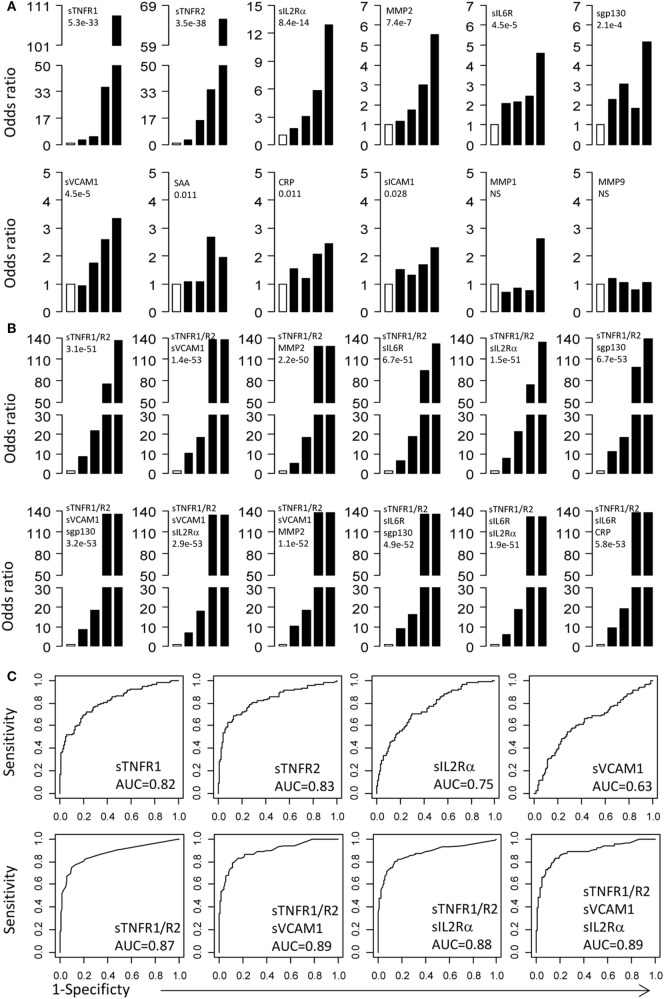
Soluble cytokine receptors may play an important role in development of microalbuminuria (MA) in type-1 diabetes (T1D). In this study, we measured 12 soluble receptors and ligands from TNF-α/IL6/IL2 pathways in T1D patients with MA ( = 89) and T1D patients without MA ( = 483) participating in the PAGODA study. Twelve proteins in the sera from T1D patients with and without MA were measured using multiplex Luminex assays. Ten serum proteins (sTNFR1, sTNFR2, sIL2Rα, MMP2, sgp130, sVCAM1, sIL6R, SAA, CRP, and sICAM1) were significantly elevated in T1D patients with MA. After adjusting for age, duration of diabetes, and sex in logistic regression, association remained significant for seven proteins. MA is associated with increasing concentrations of all 10 proteins, with the strongest associations observed for sTNFR1 (OR = 108.3, < 10) and sTNFR2 (OR = 65.5, < 10), followed by sIL2Rα (OR = 12.9, < 10), MMP2 (OR = 5.5, < 10), sgp130 (OR = 5.2, < 10), sIL6R (OR = 4.6, < 10), and sVCAM1 (OR = 3.3, < 10). We developed a risk score system based on the combined odds ratios associated with each quintile for each protein. The risk scores cluster MA patients into three subsets, each associated with distinct risk for MA attributable to proteins in the TNF-α/IL6 pathway (mean OR = 1, 13.5, and 126.3 for the three subsets, respectively). Our results suggest that the TNF-α/IL6 pathway is overactive in approximately 40% of the MA patients and moderately elevated in the middle 40% of the MA patients. Our results suggest the existence of distinct subsets of MA patients identifiable by their serum protein profiles.
可溶性细胞因子受体可能在 1 型糖尿病(T1D)患者微量白蛋白尿(MA)的发展中发挥重要作用。在这项研究中,我们测量了 PAGODA 研究中患有 MA(n=89)和不患有 MA(n=483)的 T1D 患者的 12 种来自 TNF-α/IL6/IL2 途径的可溶性受体和配体。使用多重 Luminex 分析检测 T1D 患者血清中的 12 种蛋白质。在患有 MA 的 T1D 患者和不患有 MA 的 T1D 患者中,有 10 种血清蛋白(sTNFR1、sTNFR2、sIL2Rα、MMP2、sgp130、sVCAM1、sIL6R、SAA、CRP 和 sICAM1)显著升高。在逻辑回归中调整年龄、糖尿病持续时间和性别后,7 种蛋白质的关联仍然显著。MA 与所有 10 种蛋白质浓度的增加相关,其中 sTNFR1(OR=108.3, <10)和 sTNFR2(OR=65.5, <10)的关联最强,其次是 sIL2Rα(OR=12.9, <10)、MMP2(OR=5.5, <10)、sgp130(OR=5.2, <10)、sIL6R(OR=4.6, <10)和 sVCAM1(OR=3.3, <10)。我们基于与每种蛋白质的每个五分位数相关的联合优势比开发了一种风险评分系统。风险评分将 MA 患者聚类为三个子集,每个子集都与 TNF-α/IL6 途径中的蛋白质相关的 MA 风险显著相关(三个子集的平均 OR 分别为 1、13.5 和 126.3)。我们的结果表明,TNF-α/IL6 途径在大约 40%的 MA 患者中过度活跃,在 MA 患者的中间 40%中中度升高。我们的结果表明,MA 患者存在不同的亚群,可以通过他们的血清蛋白谱来识别。