Ms. Boggs and Dr. Beck are with the Institute for Health Research, Kaiser Permanente Colorado, Denver. Dr. Hubley is with the Department of Family Medicine, University of Colorado School of Medicine, Aurora. Dr. Peterson is with the Department of Public Health Sciences, Mr. Hu and Dr. Ahmedani are with the Center for Health Policy and Health Services Research, Dr. Williams is with the Center for Health Policy and Health Services Research and the Department of Internal Medicine, and Dr. Prabhakar is with the Department of Behavioral Health Services, all at the Henry Ford Health System, Detroit. Dr. Rossom is with the HealthPartners Institute, Bloomington, Minnesota. Dr. Lynch is with the Center for Health Research, Kaiser Permanente Northwest, Portland, Oregon. Dr. Lu is with the Department of Population Medicine, Harvard Medical School, and with Harvard Pilgrim Health Care Institute, both in Boston. Dr. Waitzfelder is with the Center for Health Research, Kaiser Permanente Hawaii, Honolulu. Dr. Owen-Smith is with the Center for Clinical and Outcomes Research, Kaiser Permanente Georgia, and the School of Public Health, Georgia State University, Atlanta. Dr. Simon is with the Health Research Institute, Kaiser Permanente Washington, Seattle.
Psychiatr Serv. 2018 Jun 1;69(6):677-684. doi: 10.1176/appi.ps.201700237. Epub 2018 Feb 15.
Mitigation of suicide risk by reducing access to lethal means, such as firearms and potentially lethal medications, is a highly recommended practice. To better understand groups of patients at risk of suicide in medical settings, the authors compared demographic and clinical risk factors between patients who died by suicide by using firearms or other means with matched patients who did not die by suicide (control group).
In a case-control study in 2016 from eight health care systems within the Mental Health Research Network, 2,674 suicide cases from 2010-2013 were matched to a control group (N=267,400). The association between suicide by firearm or other means and medical record information on demographic characteristics, general medical disorders, and mental disorders was assessed.
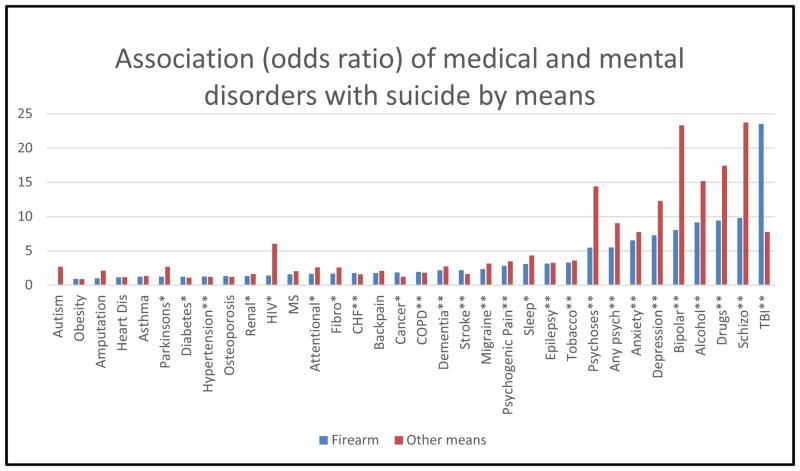
The odds of having a mental disorder were higher among cases of suicide involving a method other than a firearm. Fourteen general medical disorders were associated with statistically significant (p<.001) greater odds of suicide by firearm, including traumatic brain injury (TBI) (odds ratio [OR]=23.53), epilepsy (OR=3.17), psychogenic pain (OR=2.82), migraine (OR=2.35), and stroke (OR=2.20). Fifteen general medical disorders were associated with statistically significant (p<.001) greater odds of suicide by other means, with particularly high odds for TBI (OR=7.74), epilepsy (OR=3.28), HIV/AIDS (OR=6.03), and migraine (OR=3.17).
Medical providers should consider targeting suicide risk screening for patients with any mental disorder, TBI, epilepsy, HIV, psychogenic pain, stroke, and migraine. When suicide risk is detected, counseling on reducing access to lethal means should include both firearms and other means for at-risk groups.
通过减少获得致命手段(如枪支和潜在致命药物)的机会来降低自杀风险,这是一种高度推荐的做法。为了更好地了解医疗环境中存在自杀风险的患者群体,作者比较了因使用枪支或其他手段自杀的患者与未自杀的匹配患者(对照组)的人口统计学和临床风险因素。
在 2016 年心理健康研究网络内的 8 个医疗系统进行的病例对照研究中,作者将 2010-2013 年的 2674 例自杀病例与对照组(n=267400)进行匹配。评估了通过枪支或其他手段自杀与病历信息中人口统计学特征、一般医学疾病和精神障碍之间的关联。
与非枪支手段自杀相关的病例,其患有精神障碍的几率更高。14 种一般医学疾病与枪支自杀的几率显著增加(p<.001)相关,包括创伤性脑损伤(TBI)(比值比[OR]=23.53)、癫痫(OR=3.17)、心因性疼痛(OR=2.82)、偏头痛(OR=2.35)和中风(OR=2.20)。15 种一般医学疾病与其他方式自杀的几率显著增加(p<.001)相关,TBI(OR=7.74)、癫痫(OR=3.28)、HIV/AIDS(OR=6.03)和偏头痛(OR=3.17)的几率特别高。
医疗服务提供者应考虑针对任何患有精神障碍、TBI、癫痫、HIV、心因性疼痛、中风和偏头痛的患者进行自杀风险筛查。当发现自杀风险时,减少获得致命手段的咨询应包括针对高危群体的枪支和其他手段。