
袢利尿剂与非透析依赖型慢性肾脏病患者肌肉减少症的风险增加有关。
Loop diuretics are associated with greater risk of sarcopenia in patients with non-dialysis-dependent chronic kidney disease.
作者信息
Ishikawa Seiko, Naito Shotaro, Iimori Soichiro, Takahashi Daiei, Zeniya Moko, Sato Hidehiko, Nomura Naohiro, Sohara Eisei, Okado Tomokazu, Uchida Shinichi, Rai Tatemitsu
机构信息
Department of Nephrology, Graduate School of Medical and Dental Sciences, Tokyo Medical and Dental University, Tokyo, Japan.
Department of Nephrology, Tokyo Metropolitan Ohtsuka Hospital, Tokyo, Japan.
出版信息
PLoS One. 2018 Feb 15;13(2):e0192990. doi: 10.1371/journal.pone.0192990. eCollection 2018.
INTRODUCTION
Sarcopenia, the age-related loss of muscle mass and function, frequently accompanies chronic kidney disease. The aim of this study was to clarify the prevalence and the risk factors for sarcopenia among patients with non-dialysis-dependent chronic kidney disease (NDD-CKD), focusing on the use of drugs.
METHODS
We conducted a cross-sectional analysis on a cohort of 260 patients with NDD-CKD in a university hospital, recruited between June 2016 and March 2017. We extracted data on patient gender, age, cause of chronic kidney disease, use of drugs, and comorbidities that could potentially affect the prevalence of sarcopenia. Sarcopenia was diagnosed using the criteria of the Asian Working Group for Sarcopenia. Logistic regression analysis was performed to analyze the association of each factor on the prevalence of sarcopenia.
RESULTS
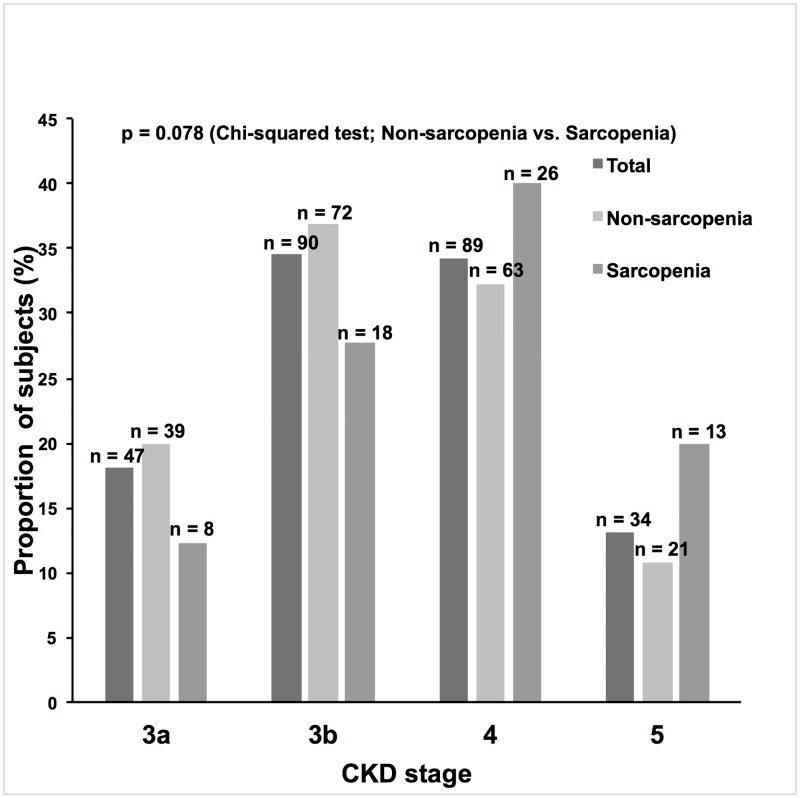
25.0% of our study subjects had sarcopenia. Multivariable analysis revealed that an increased risk of sarcopenia was significantly associated with age, male gender, body mass index, diabetes mellitus, and loop diuretic use (odds ratio, 4.59: 95% confidence interval, 1.81-11.61: P-value 0.001).
CONCLUSIONS
In our cohort, the prevalence of sarcopenia in patients with NDD-CKD was high, and diuretics use, particularly loop diuretic use, was suggested to be a risk factor of sarcopenia. Although loop diuretics are commonly used in patients with CKD, careful consideration of the risk of sarcopenia may be necessary.
引言
肌肉减少症是与年龄相关的肌肉质量和功能丧失,常伴随慢性肾脏病。本研究的目的是阐明非透析依赖性慢性肾脏病(NDD-CKD)患者中肌肉减少症的患病率及危险因素,重点关注药物的使用情况。
方法
我们对2016年6月至2017年3月期间在一所大学医院招募的260例NDD-CKD患者队列进行了横断面分析。我们提取了患者的性别、年龄、慢性肾脏病病因、药物使用情况以及可能影响肌肉减少症患病率的合并症数据。采用亚洲肌肉减少症工作组的标准诊断肌肉减少症。进行逻辑回归分析以分析各因素与肌肉减少症患病率的关联。
结果
我们的研究对象中有25.0%患有肌肉减少症。多变量分析显示,肌肉减少症风险增加与年龄、男性、体重指数、糖尿病和襻利尿剂的使用显著相关(比值比,4.59;95%置信区间,1.81 - 11.61;P值0.001)。
结论
在我们的队列中,NDD-CKD患者中肌肉减少症的患病率较高,利尿剂的使用,尤其是襻利尿剂的使用,被认为是肌肉减少症的一个危险因素。尽管襻利尿剂在CKD患者中常用,但可能有必要仔细考虑肌肉减少症的风险。


 Zotero 插件