Oxford Autoimmune Neurology Group, Nuffield Department of Clinical Neurosciences, University of Oxford, Oxford, UK.
Oxford University Hospitals, John Radcliffe Hospital, Oxford, OX3 9DS, UK.
Brain. 2018 Apr 1;141(4):1063-1074. doi: 10.1093/brain/awy010.
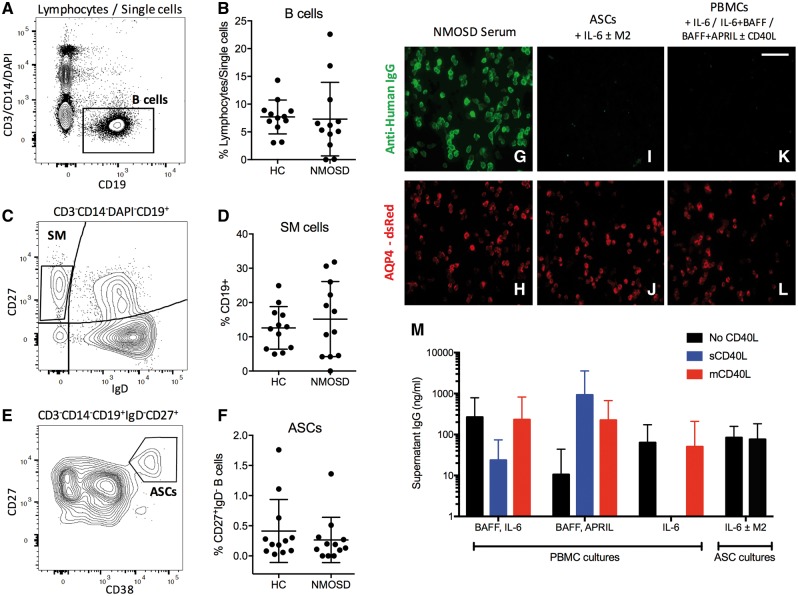
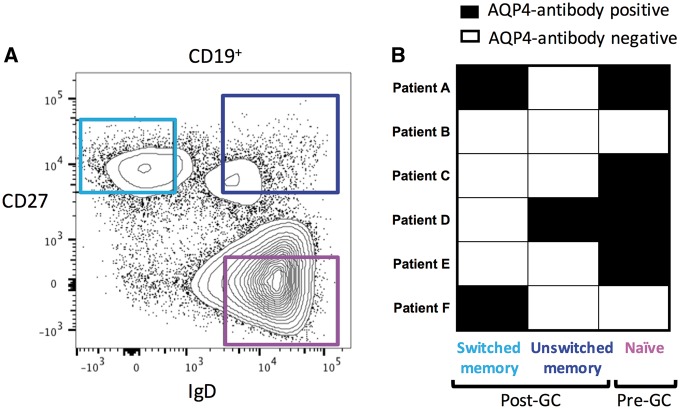
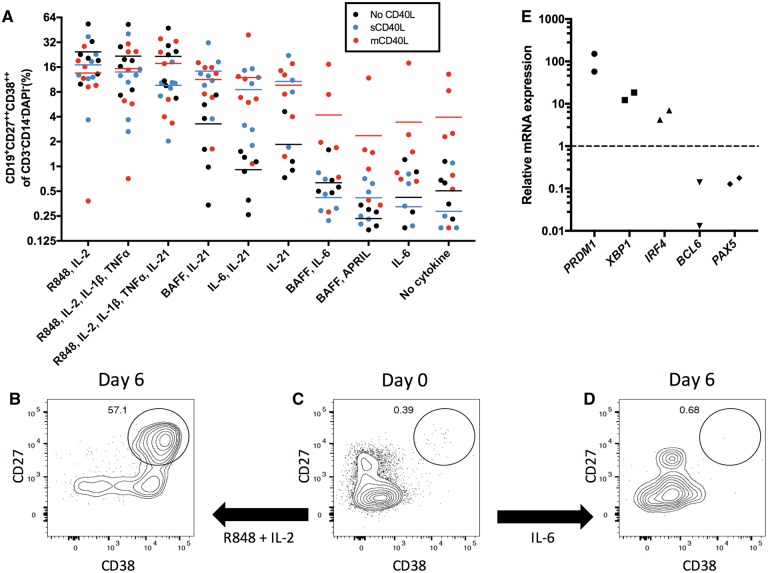
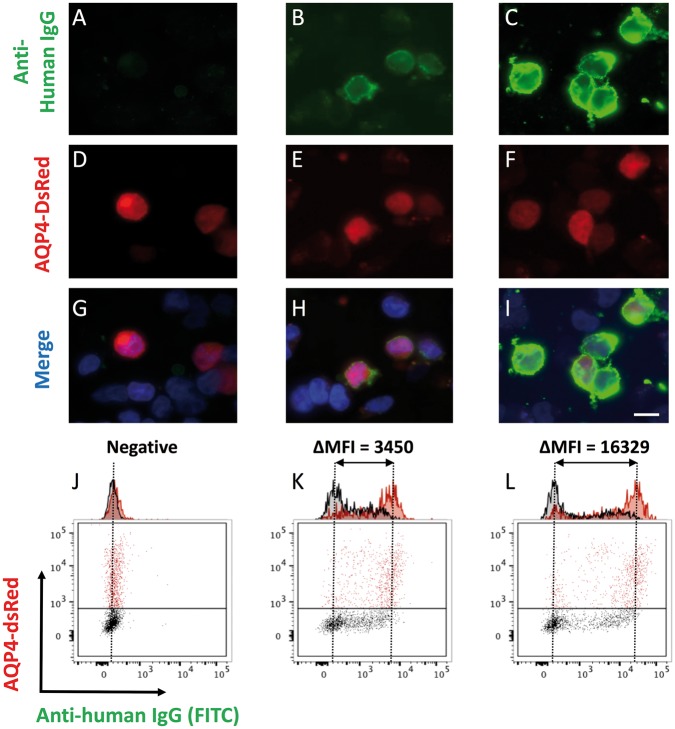
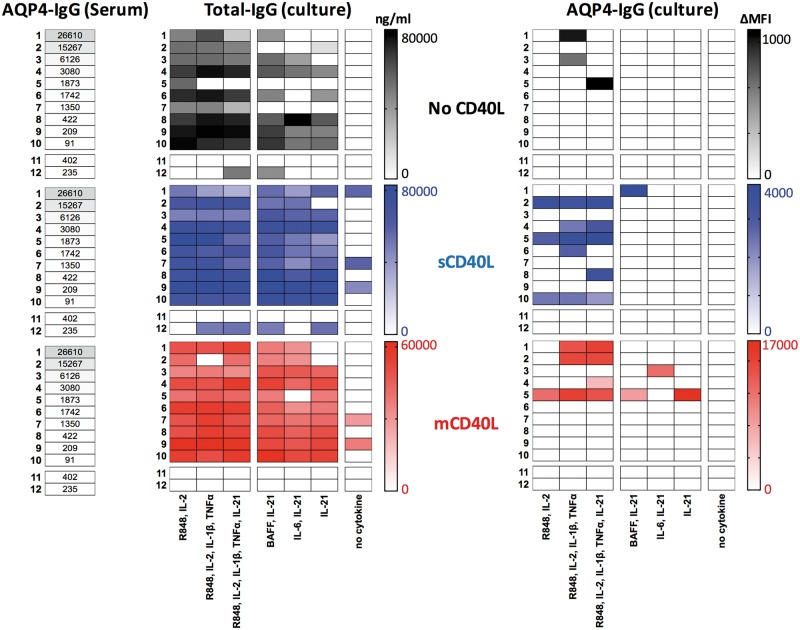
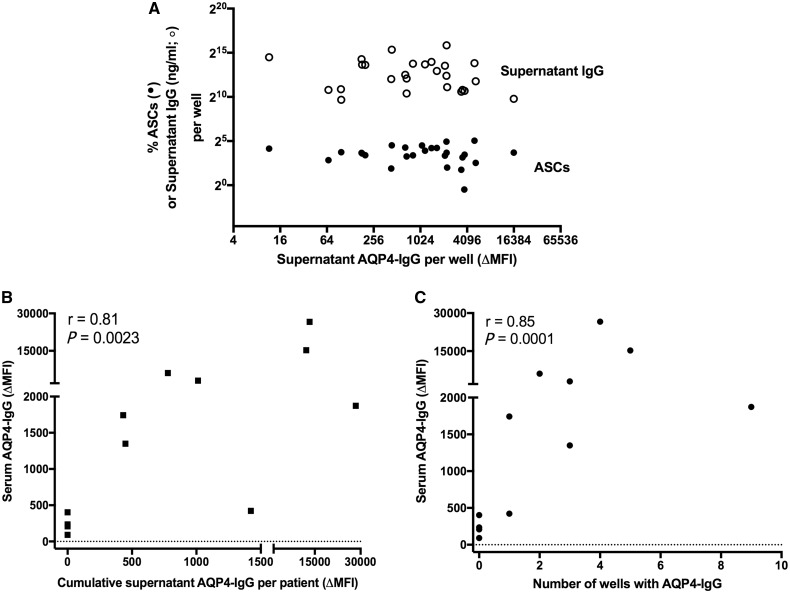
Autoantibodies to aquaporin-4 (AQP4) are pathogenic in neuromyelitis optica spectrum disorder (NMOSD). However, it is not known which B cells are the major contributors to circulating AQP4 antibodies nor which conditions promote their generation. Our experiments showed CD19+CD27++CD38++ circulating ex vivo antibody-secreting cells did not produce AQP4 antibodies under several culture conditions. To question whether other cells in circulation were capable of AQP4 antibody production, B cells were differentiated into antibody-secreting cells in vitro. Unfractionated peripheral blood mononuclear cells, isolated from 12 patients with NMOSD and a wide range of serum AQP4 antibody levels (91-26 610 units), were cultured with factors that mimicked established associations of NMOSD including T cell help, concurrent infections and cytokines reported to be elevated in NMOSD. Overall, the in vitro generation of CD19+CD27++CD38++ cells across several culture conditions correlated closely with the total IgG secreted (P < 0.0001, r = 0.71), but not the amount of AQP4 antibody. AQP4 antibody production was enhanced by CD40-ligand (P = 0.005), and by interleukin-2 plus toll-like receptor stimulation versus interleukin-21-predominant conditions (P < 0.0001), and did not require antigen. Across NMOSD patients, this in vitro generation of AQP4 antibodies correlated well with serum AQP4 antibody levels (P = 0.0023, r = 0.81). To understand how early within B cell lineages this AQP4 specificity was generated, purified B cell subsets were activated under these optimized conditions. Naïve pre-germinal centre B cells (CD19+CD27-IgD+) differentiated to secrete AQP4 antibodies as frequently as post-germinal centre cells (CD19+CD27+). Taken together, these human cell-culture experiments demonstrate that preformed B cells, rather than ex vivo circulating antibody-secreting cells, possess AQP4 reactivity. Their differentiation and AQP4 antibody secretion is preferentially driven by select cytokines and these cells may make the dominant contribution to serum AQP4 antibodies. Furthermore, as AQP4-specific B cells can derive from likely autoreactive naïve populations an early, pre-germinal centre loss of immunological tolerance appears present in some patients with NMOSD. This study has implications for understanding mechanisms of disease perpetuation and for rational choice of immunotherapies in NMOSD. Furthermore, the in vitro model presents an opportunity to apply condition-specific approaches to patients with NMOSD and may be a paradigm to study other antibody-mediated diseases.awy010media15732448284001.
水通道蛋白 4 (AQP4) 自身抗体在视神经脊髓炎谱系疾病 (NMOSD) 中具有致病性。然而,目前尚不清楚哪些 B 细胞是循环 AQP4 抗体的主要产生者,也不知道哪些条件促进了它们的产生。我们的实验表明,在几种培养条件下,体外分离的 CD19+CD27++CD38++循环抗体分泌细胞不能产生 AQP4 抗体。为了研究循环中的其他细胞是否能够产生 AQP4 抗体,我们将 B 细胞在体外分化为抗体分泌细胞。我们用模拟 NMOSD 中已建立关联的因子(包括 T 细胞帮助、并发感染和 NMOSD 中报告升高的细胞因子),对来自 12 名 NMOSD 患者(血清 AQP4 抗体水平范围为 91-26610 单位)的未分离外周血单核细胞进行培养。总的来说,几种培养条件下 CD19+CD27++CD38++细胞的体外生成与总 IgG 分泌密切相关(P<0.0001,r=0.71),但与 AQP4 抗体的量无关。CD40 配体(P=0.005)和白细胞介素-2 加 Toll 样受体刺激与白细胞介素-21 为主的条件(P<0.0001)增强了 AQP4 抗体的产生,并且不需要抗原。在 NMOSD 患者中,这种体外产生的 AQP4 抗体与血清 AQP4 抗体水平密切相关(P=0.0023,r=0.81)。为了了解 B 细胞谱系中这种 AQP4 特异性产生的早期情况,我们在这些优化条件下激活了纯化的 B 细胞亚群。与生发中心后细胞(CD19+CD27+)相比,幼稚生发中心前 B 细胞(CD19+CD27-IgD+)分化为分泌 AQP4 抗体的频率更高。总的来说,这些人类细胞培养实验表明,预先形成的 B 细胞而非体外循环抗体分泌细胞具有 AQP4 反应性。它们的分化和 AQP4 抗体分泌优先由特定的细胞因子驱动,这些细胞可能对血清 AQP4 抗体做出主要贡献。此外,由于 AQP4 特异性 B 细胞可以源自可能的自身反应性幼稚群体,因此在一些 NMOSD 患者中似乎存在早期生发中心前免疫耐受的丧失。本研究对理解疾病持续存在的机制以及 NMOSD 中免疫治疗的合理选择具有重要意义。此外,体外模型为 NMOSD 患者应用特定条件的方法提供了机会,并且可能成为研究其他抗体介导疾病的范例。